The most popular advice about mushroom nootropics is to choose a brain-health blend and take it consistently. That skips the more important question: which ingredient has been tested for the result you want? A supplement marketed for focus, memory and long-term brain health needs evidence for each claim, not just an interesting biological mechanism.
The useful distinction isn't natural versus synthetic, or powder versus capsule. It's whether a particular preparation helped a particular group on a particular test, and whether that improvement lasted. Judged that way, mushroom nootropics deserve a more selective reading than their packaging usually encourages.
Which Mushroom Nootropics Have Human Evidence
Mushroom nootropic species and their human evidence
| Species | Commonly claimed for | Strongest human evidence | Evidence level |
|---|---|---|---|
| Lion's mane (Hericium erinaceus) | Focus, memory, nerve growth support | A small randomized trial in adults with mild cognitive impairment; a small healthy-adult trial | Preliminary |
| Reishi (Ganoderma lucidum) | Stress, sleep, relaxation | Few small human trials, mostly not cognitive | Limited |
| Cordyceps (Cordyceps militaris) | Energy, exercise endurance | Mostly small or animal studies; little cognitive data | Limited |
| Chaga (Inonotus obliquus) | Antioxidant support | Laboratory and animal work; no established cognitive trials | Very limited |
| Psilocybin-containing products | Mood and focus claims | Separate category; effects and evidence differ from functional species | Not directly comparable |
Lion's mane is the strongest candidate for further cognitive research, not an established winner for everyday brain enhancement. The evidence ratings above describe support for cognitive claims, not a universal ranking of usefulness or safety.
A review of mushroom-based cognitive interventions describes limited, often small and mixed human studies, and discusses a proposed randomized trial involving approximately 600 middle-aged and older adults. That proposed scale matters: researchers still need larger, well-controlled comparisons before they can make clear recommendations.
Read each species against its actual claim
Lion's mane stands apart because researchers have tested cognition directly in humans. Even so, findings in people with mild impairment don't automatically establish benefits for healthy adults trying to concentrate at work. The relevant question is whether the population and outcome resemble your own situation.
Reishi requires a different distinction. A product promoted for relaxation isn't necessarily a cognitive enhancer, even if someone feels more comfortable while taking it. Feeling calmer and performing better on a validated memory test are separate outcomes.
Cordyceps presents a similar mismatch between categories. When evaluating a cordyceps mushroom supplement, separate energy and exercise claims from claims about attention or recall. Evidence for physical endurance wouldn't, by itself, demonstrate better thinking.
Chaga's antioxidant positioning is further removed from established cognitive benefit. Laboratory activity can help researchers choose what to investigate, but it doesn't tell a buyer whether a serving improves memory. Psilocybin-containing products also need their own evaluation, rather than borrowing evidence from functional species.
Biological plausibility isn't a consumer outcome
The review discusses antioxidant, anti-inflammatory and neuroprotective mechanisms. Those mechanisms are reasons to conduct clinical trials, not substitutes for them.
Evidence rule: A species backed by a small positive trial is worth watching. It isn't a settled nootropic.
The practical consequence is to evaluate ingredients individually. A blend doesn't become better supported merely because it includes more mushrooms.
What Mushroom Nootropics Can and Cannot Change
A mushroom nootropic is more like a spotlight than a floodlight: it may illuminate a narrow task without brightening the whole room. That distinction explains why an encouraging attention result can coexist with disappointing memory findings.
The Enel Health lion's mane evidence summary describes a 2023 double-blind randomized trial in healthy adults using approximately 1.8 grams daily: performance was faster on a Stroop response-inhibition task 60 minutes after dosing, with a reported p=0.005, but the 28-day phase didn't demonstrate broad cognitive improvement and reported worse delayed-word recall than placebo.
The visual suggests concentration, but the evidence concerns a specific test rather than an entire productive afternoon.

Separate attention from memory and prevention
A Stroop task tests the ability to respond while resisting interfering information. Faster performance is relevant to response control, but it doesn't establish that participants learned more, remembered more or became more intelligent.
Put the marketing claims into distinct categories:
- Acute attention or response control: There's a narrow positive signal worth investigating, not a reliable promise of immediate focus.
- Memory and intelligence: This trial didn't establish generalized improvement. Its delayed-recall result argues against describing the findings as uniformly positive.
- Disease prevention: Neither a brief attention task nor a short supplementation period establishes protection against future dementia.
The significance level doesn't tell you how noticeable the difference would feel in daily life. Nor does it turn a task-specific result into a benefit across other cognitive functions.
Why testimonials can't settle mixed results
Small trials produce uncertain estimates. A positive result deserves replication, especially when other outcomes don't improve or move in the opposite direction. Selecting only the favorable test gives consumers an incomplete account.
Testimonials have a different problem: they can't isolate the mushroom from expectations, sleep, workload or other changes. A buyer who starts a supplement while improving their routine may sincerely feel sharper without knowing what caused it.
Higher doses aren't automatically better, either. Without comparative dose evidence, increasing the amount doesn't resolve uncertainty about whether the ingredient works.
A mushroom sold as a nootropic shouldn't therefore be treated as a stimulant, an antidepressant or a proven cognitive enhancer. Those labels imply broader or different effects than this trial demonstrated.
Lion's Mane Trial Results and How It Works
The older-adult lion's mane trial begins with a specific clinical situation, not healthy people seeking an extra edge. Participants already had mild cognitive impairment, making the findings relevant to that population before anyone else.
The aging context matters when interpreting the result.

The National Library of Medicine's LiverTox account describes a randomized, double-blind, placebo-controlled trial in 30 Japanese adults aged 50–80, who consumed 3 grams daily of powdered lion's mane for 16 weeks; the lion's mane group improved on dementia symptom scales while the placebo group did not. Reported adverse effects were mild abdominal discomfort and diarrhea, and ALT, AST, alkaline phosphatase and bilirubin remained within normal ranges.
That design offers more useful evidence than an uncontrolled account of feeling better. Randomization and a placebo comparison help separate the intervention from expectations and changes unrelated to supplementation. The small sample, however, limits how confidently the result can be generalized.
The stopping period changes the interpretation
The study also reported that cognitive benefits declined after supplementation stopped. A useful analogy is a training program: performance may improve while someone follows the program, then fade when they stop.
That analogy describes the pattern, not a proven explanation of what happened biologically. The trial doesn't show that supplementation permanently repaired neurons or changed the course of cognitive decline.
The accompanying video offers another way to engage with the topic, but trial outcomes should remain the basis for judging benefit.
A plausible mechanism isn't proof of treatment
The Alzheimer's Drug Discovery Foundation's Cognitive Vitality assessment discusses hericenones and erinacines, compounds investigated for effects on nerve growth factor pathways involved in neuronal growth and function. This provides biological plausibility, but doesn't establish that every commercial lion's mane product delivers clinically meaningful amounts of those constituents.
When evaluating lion's mane cognitive benefits, keep the preparation and population attached to the claim.
Improvement on a cognitive scale isn't the same as demonstrating dementia prevention.
The study was too small to prove benefits for healthy adults or prevention of dementia. Investigational cognitive support is a defensible description; proven treatment or permanent enhancement isn't.
Dosing Amounts, Timing and How Long Effects Last
Doses and durations used in human mushroom nootropic trials
| Trial or product | Dose | Duration | What was reported |
|---|---|---|---|
| Powdered lion's mane, mild cognitive impairment trial | 3 g per day | 16 weeks | Dementia symptom scores improved versus placebo; benefit declined after stopping |
| Lion's mane, healthy adults, 2023 trial | About 1.8 g per day | 28-day phase; acute test at 60 minutes | Faster Stroop response at 60 minutes; no broad cognitive gain at 28 days |
| Commercial gummy or capsule with no dose stated | Not disclosed | No evidence-matched schedule can be established | Ask for milligrams of extract per serving and marker compounds |
These are trial conditions, not interchangeable prescriptions. A review of lion's mane evidence emphasizes heterogeneous preparations, small studies and insufficient evidence to establish optimal dosing or definitive clinical efficacy.
A capsule containing extract can't automatically be compared gram-for-gram with powdered mushroom. Before considering a routine, identify the fungal material, extraction method, amount per serving and measured marker compounds. An extract ratio alone doesn't establish equivalence to a trial preparation.
Turn a label into a checkable routine
Use this sequence as a monitoring framework to discuss with a healthcare professional, not as a self-treatment protocol:
- Write down the evidence match. Record the species, preparation and proposed serving. If the material doesn't resemble the tested preparation, mark that uncertainty rather than treating the dose as equivalent.
- Keep timing consistent. Taking a clinician-approved serving at the same time makes your record easier to interpret. It doesn't imply that researchers have established an optimal time of day.
- Record a baseline before starting. Choose a validated cognitive measure with professional guidance, rather than relying only on how focused you feel. Keep testing conditions consistent and account for improvement from practice.
- Schedule reviews. For a longer monitored routine, an interim review around week eight and another around week sixteen can be practical checkpoints. These are organizational choices, not proven onset times.
- Document what happens after stopping. Don't interpret a temporary improvement as a permanent change, and don't assume fading performance automatically justifies indefinite use.
Compare material, not capsule counts
Look at the serving size, not just the amount printed prominently on the front. Confirm whether that amount describes an individual capsule, the complete serving or a blend of ingredients.
Dosing caution: More material doesn't compensate for an unidentified extract or an unsupported claim.
There's no established basis here for escalating above a studied amount to chase a stronger effect. If the label can't be mapped to a preparation, the appropriate next step is clarification, not a larger serving.
How to Check Potency and Contaminants
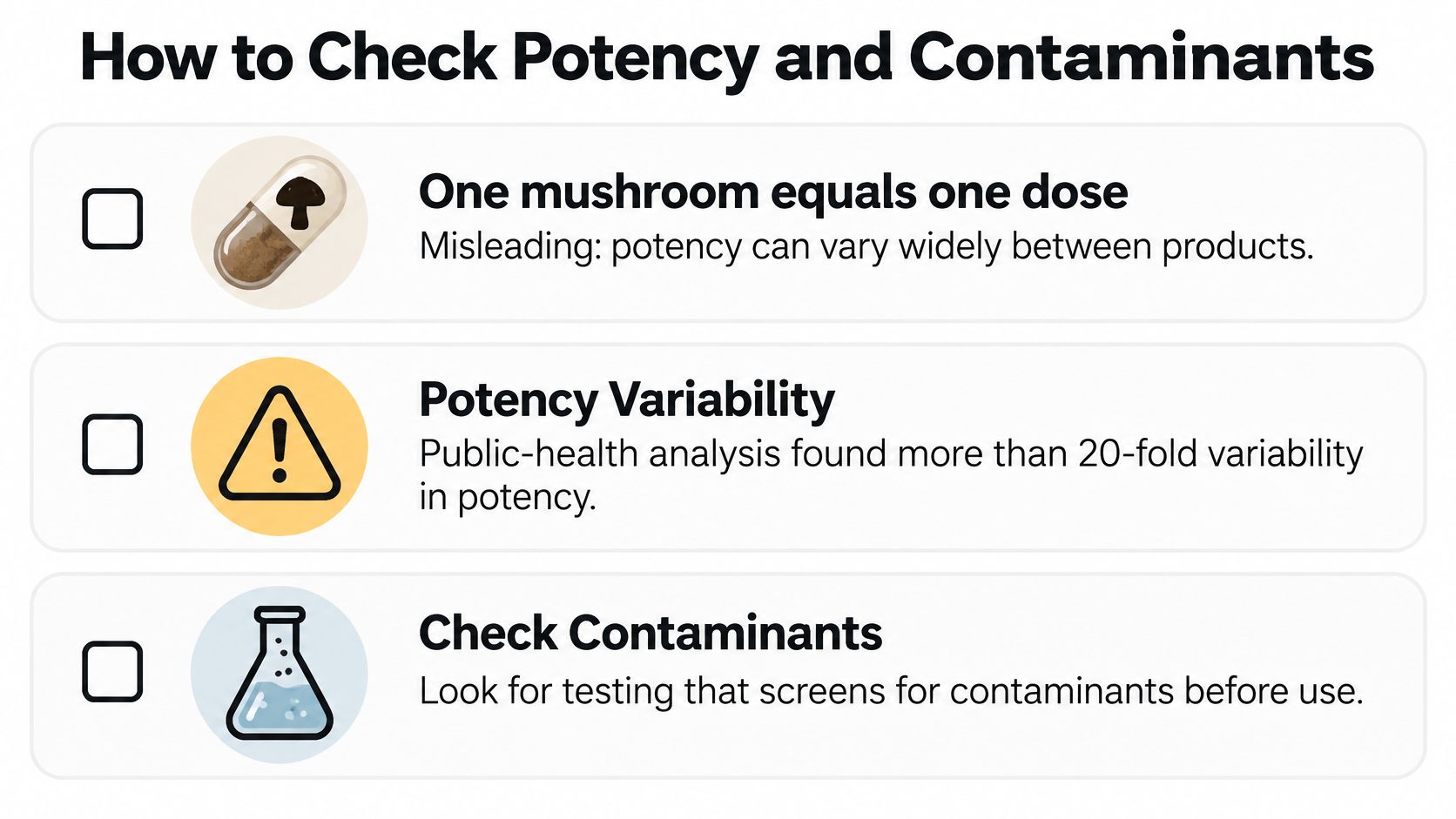
The assumption that one mushroom equals one dose is misleading. The Minnesota Department of Agriculture's mushroom product safety guide discusses public-health analysis of psilocybin products from decriminalized regions showing more than 20-fold variability in potency, alongside inconsistent minor tryptamine levels across strains; it also notes that dietary supplements generally don't receive FDA premarket approval for safety or efficacy.
That variability finding concerns psilocybin products, not a measured variability estimate for every functional mushroom supplement. Its practical lesson is still important: product weight alone may not identify exposure to the compounds that matter.
Use this visual checklist as a starting point, then inspect the actual laboratory documentation.
What a usable test report should show
A certificate of analysis is useful only when you can connect its results to the product being sold. Use this checklist when reviewing third-party lab testing:
- Matching batch identification. Confirm that the report identifies the bottle's batch and includes a test date. A generic sample report doesn't establish what's in your purchase.
- Direct potency measurements. Look for named compounds, units and the analytical result. Mushroom weight isn't a substitute for active-compound testing.
- Heavy-metal results. Check individual results and stated limits, rather than accepting a broad purity statement.
- Microbial testing. Confirm that the report includes contamination screening and identifies what the laboratory tested.
- Undeclared-ingredient screening. Read the scope of testing. A negative result for selected substances isn't proof that every possible adulterant was excluded.
- Fungal material identification. The label should identify fruiting body, mycelium or a combination. Don't assume these are interchangeable preparations.
- Extraction and serving details. Require the extract ratio, where applicable, and the amount per serving in milligrams.
Distinguish a tested product from a proven benefit
We test our mushrooms to ensure they're free from DMT and any other contaminants. A testing commitment still serves a different purpose from a clinical trial: quality testing addresses identity, composition and contamination, not whether a product improves cognition.
A weak label combines an undisclosed proprietary blend, broad brain-health promises without a relevant trial, and no usable batch identifier. That doesn't establish that the product is harmful, but it prevents meaningful verification.
Don't substitute confidence in the brand for access to evidence about the batch.
Medication Interactions and Who Should Be Cautious
Check prescriptions before starting mushroom products. Potential adverse effects and medication interactions make this a product-specific decision, not something a general wellness label can settle.
Bring the complete ingredient list, proposed serving and medication list to a clinician or pharmacist. Include other supplements, because a blend may introduce ingredients beyond the mushroom named on the front.
People who need particular caution
The groups most often flagged in mushroom-product safety guidance include:
- People taking immunosuppressants. Have the specific preparation reviewed rather than assuming every functional mushroom has the same interaction profile.
- People taking anticoagulants or blood thinners. Don't start a product or alter prescribed medication without professional advice.
- People with kidney disease. Ask whether the ingredients and preparation are suitable for your condition.
- People with a kidney-stone history. Make that history explicit during the review, even if your current kidney function is normal.
These cautions aren't a claim that every mushroom creates the same risk. They identify situations where self-selection from marketing copy is a poor substitute for individualized advice.
Interpret tolerability findings narrowly
The lion's mane trial's reported side-effect pattern makes abdominal discomfort and diarrhea sensible symptoms to watch for. Normal liver-related laboratory results in that study are reassuring within its scope, but they don't rule out problems in other people, longer use or different products.
For psilocybin-containing products, people with a personal or family history of psychiatric conditions should speak with a clinician before use. Don't combine them with mushroom nootropics without medical advice, and don't assume evidence from lion's mane establishes safety for the combination.
Safety threshold: If you take any prescription, check first. If an unexpected symptom appears, stop and seek advice.
Bring the packaging and batch details when seeking help. They give the healthcare professional more useful information than the general description mushroom supplement.
Choose a Product You Can Verify
Buy only a product whose species, preparation, dose per serving and batch testing you can inspect before purchase. Treat anything else as unverified, regardless of price, packaging or testimonials.
Start with the batch-level laboratory report. Match its date and batch number to the bottle, then check whether it covers potency, heavy metals, microbes and undeclared ingredients. Passing those checks earns a place on the shortlist, not a guarantee of cognitive benefit.
Make the purchase conditional
- Match the preparation before choosing a starting amount. With professional guidance, use the lowest appropriate evidence-matched serving. Don't transfer a powdered-mushroom amount to an extract or apply a functional-mushroom trial dose to a psilocybin product.
- Plan a monitored evaluation. Write down your baseline, interim review and stopping criteria before starting. A longer routine is useful only if it's appropriate, tolerated and assessed against a defined outcome.
- Complete the medication review first. Show a healthcare professional the full formula and your complete medication list. Stop and seek advice if an unexpected symptom appears.
Our Magic Mushroom Gummies should be used as part of a balanced wellness routine, with a healthcare professional consulted for personalized recommendations. That guidance doesn't make them equivalent to the lion's mane preparations evaluated in cognitive trials.
Use the quality checklist as a comparison sheet. Reject products that omit the serving amount, skip the batch report or offer testimonials in place of relevant evidence.
The first action is concrete: obtain the matching batch report before paying.
The Magic Mushroom Delivery offers functional mushroom and psilocybin products, including capsules, gummies and mushroom coffee, alongside educational resources. Visit The Magic Mushroom Delivery to review the product categories, compare ingredient information against your checklist and identify what needs clarification before choosing.