
Decaf mushroom coffee is best understood as low-caffeine, not caffeine-free. The FDA requires at least 97% of the original caffeine to be removed, yet an 8-ounce cup typically still contains roughly 2 to 15 milligrams of caffeine.
That distinction matters when you're reaching for a warm cup in the afternoon, hoping to keep the coffee ritual without the jitters or a restless night. The mushroom ingredients don't automatically make the drink stimulating or stimulant-free. The coffee base determines most of the caffeine, while the mushroom side of the formula raises a different question: how much extract is in your serving, and what evidence supports it?
Why Decaf Mushroom Coffee Exists
It's late afternoon. You want something roasted, warm, and familiar, but another full-strength coffee could interfere with sleep. Tea doesn't quite satisfy the craving, and a plain decaf feels uninteresting. A decaf mushroom blend seems to offer a middle path, coffee flavor with a lower stimulant load and an ingredient list that feels more intentional.
That's the appeal of mushroom coffee decaf. It suits people who still enjoy coffee but have started paying closer attention to caffeine sensitivity, sleep, timing, and ingredient quality. Some drinkers are reducing stimulants after noticing jitters. Others want a coffee-like beverage after lunch or in the evening. Some are curious about lion's mane, reishi, chaga, or cordyceps but don't want to begin with a highly caffeinated product.
In the United States, “decaffeinated” does not mean caffeine-free. The Food and Drug Administration requires at least 97% of a coffee's original caffeine to be removed, and a typical 8-ounce serving still contains roughly 2 to 15 milligrams of caffeine, according to the FDA's caffeine guidance.
Who tends to choose it
- Caffeine-sensitive adults who want a coffee ritual without the stronger lift of a standard brew.
- Late-day drinkers who enjoy coffee flavors but want to reduce the chance of sleep disruption.
- People tapering stimulant intake who prefer a gradual change rather than abandoning coffee altogether.
- Functional-beverage shoppers who are interested in mushroom extracts but wary of products marketed around intense energy.
- Flavor-first drinkers who like earthy, roasted profiles and see the mushrooms as part of the formulation rather than a guaranteed health solution.
The category may not suit someone who needs a completely caffeine-free drink. It also may disappoint anyone expecting the word “functional” to guarantee better focus, calmer moods, or stronger energy. A decaf blend is a lower-caffeine beverage with added mushroom ingredients, not a clinical intervention by default.
Practical rule: Treat “decaf” as a caffeine-reduction claim, then inspect the finished product's caffeine per serving before deciding whether it fits your routine.
How Decaf Coffee Is Actually Made
The coffee half of the formula comes first. Decaffeination generally happens before roasting, while the beans are still green, and the process removes caffeine from the bean before roasting develops its familiar flavor. The major approaches use water, carbon dioxide, or approved solvents, and the method can influence flavor, cost, and how the product is positioned, as described in this overview of decaffeination methods.
The three common routes
The Swiss Water Process uses water to draw compounds from green coffee beans, then filters caffeine through activated carbon. Producers can manage the process to retain more of the flavor compounds that make coffee taste like coffee.
The carbon dioxide method places green beans in a pressurized environment. Liquid or supercritical carbon dioxide interacts with the beans and pulls out caffeine. Once the pressure changes, the caffeine separates from the carbon dioxide, allowing the gas to be used again within the process.
Solvent methods use substances such as methylene chloride or ethyl acetate to extract caffeine. Producers steam or otherwise prepare the beans, apply the solvent, and then remove residual solvent through further processing. The finished beans are still subject to quality controls, but the method can affect the way a brand talks about the product and how buyers perceive it.
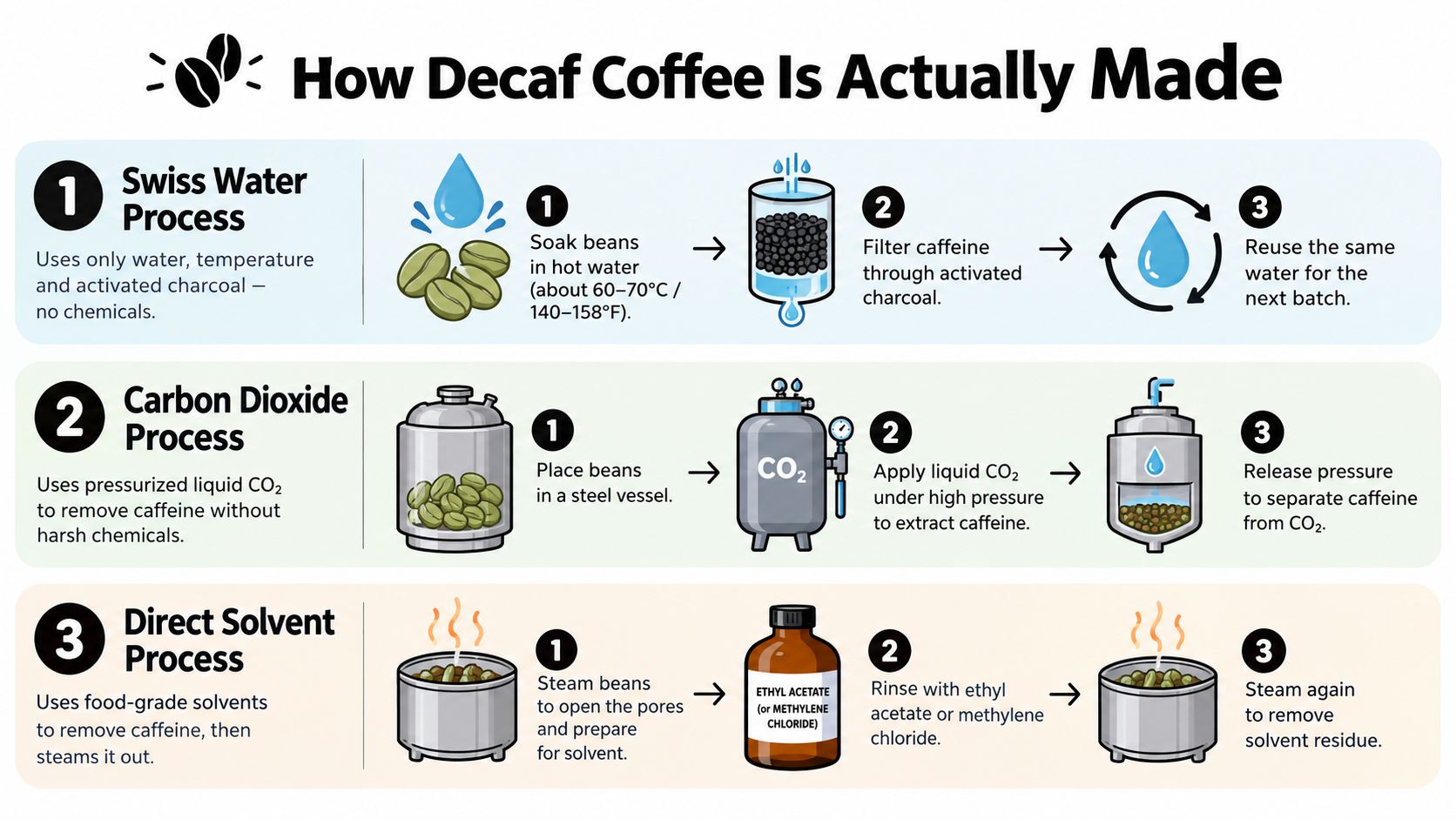
The important point is that none of these routes creates a universal caffeine result for every finished cup. The FDA threshold defines when coffee can be marketed as decaf, but it doesn't promise that every brand, serving size, roast, or brewing method will contain the same residual amount.
An 8-ounce serving can still contain roughly 2 to 15 milligrams of caffeine, which explains why a decaf mushroom blend may feel gentler without being biologically caffeine-free. The coffee component supplies that residual caffeine. The mushroom extracts don't erase it.
Why the final serving matters
A powdered blend, a brewed ground coffee, and a concentrated instant product may use different amounts of coffee in the recommended serving. Water volume, scoop size, and preparation strength can also change what ends up in the cup.
This is why the useful question isn't only, “Was this coffee decaffeinated?” Ask instead, “How much caffeine is in the serving I'll drink?”
What the Mushrooms Actually Add
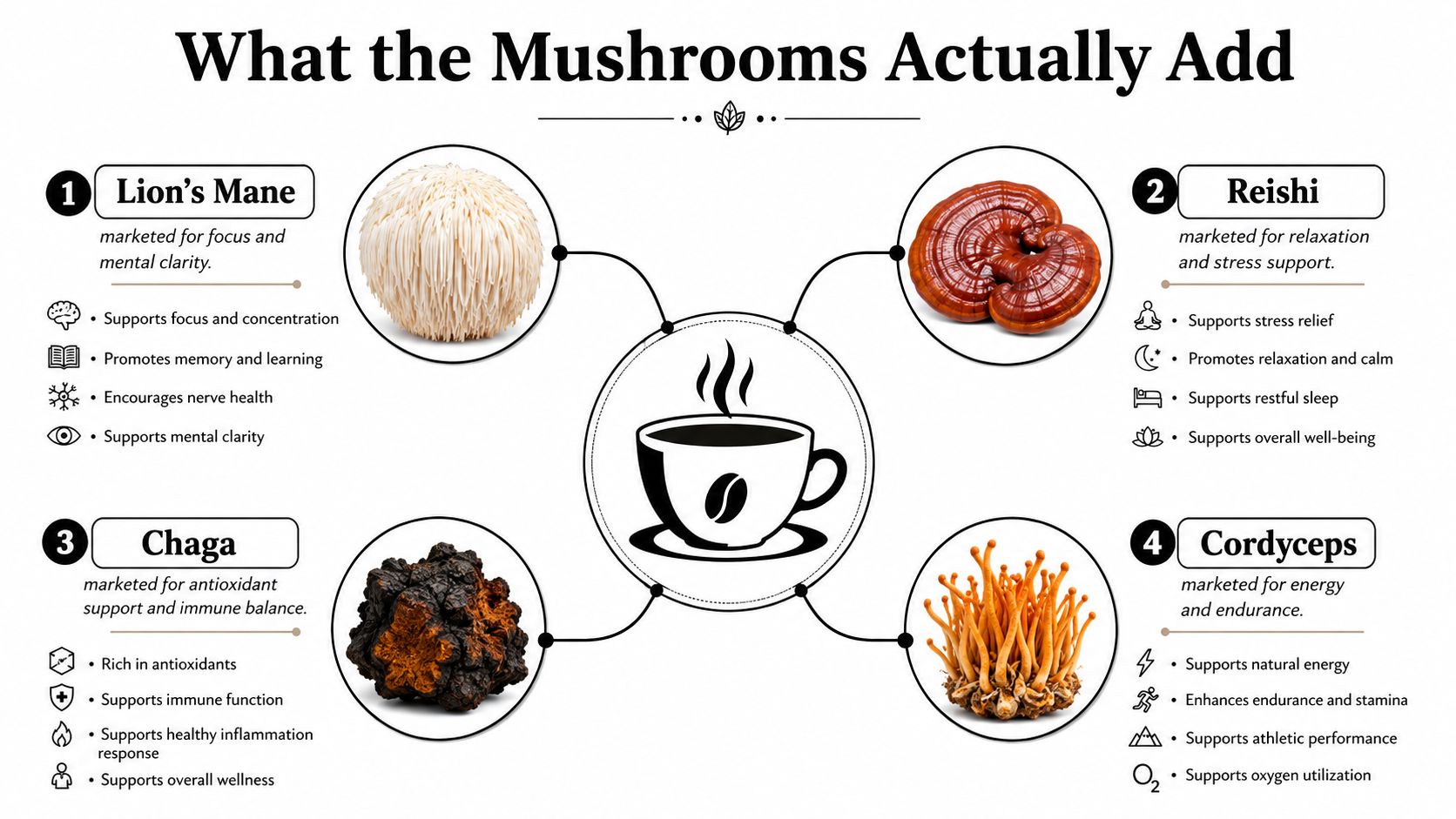
The mushroom ingredients create the category's distinctive identity, but they also create its biggest evidence problem. Brands commonly combine several species and associate them with broad goals, yet human research usually concerns a specific extract, dose, preparation, and outcome, not a generic cup of mushroom coffee.
Lion's mane, also known as Hericium erinaceus, is commonly marketed for focus and mental clarity. Reishi, or Ganoderma lucidum, is often positioned around relaxation and stress support. Chaga tends to appear in antioxidant and immune-support language, while cordyceps is frequently associated with energy and endurance.
Those descriptions explain how the ingredients are marketed, not what every serving has clinically demonstrated. A coffee containing a mushroom blend may use very different amounts of each species, and some labels don't disclose those amounts at all.
The dose is more informative than the headline
A double-blind, placebo-controlled trial evaluated 3 grams per day of lion's mane for 16 weeks in adults with mild cognitive impairment and reported improved cognitive-function scores, as summarized in this review of lion's mane evidence. That finding doesn't prove that a decaf coffee with an unspecified amount of lion's mane will produce the same result.
The difference is practical. A capsule or powdered extract may disclose its daily amount clearly. A coffee may list “lion's mane extract” among several ingredients. Without the serving quantity, you can't tell whether the product resembles the preparation studied in humans.
For a deeper look at what may appear in a blend, compare the common mushroom coffee ingredients and look for exact species names rather than a generic “mushroom complex.”
What to inspect on the label
- Species identity: A label naming Hericium erinaceus provides more information than “mushroom blend.”
- Material used: Fruiting body and mycelium aren't interchangeable descriptions. The label should tell you which one is present.
- Extraction details: Water extraction, alcohol extraction, and plain mushroom powder can represent different materials.
- Serving quantity: Look for milligrams of each extract per serving, not only a total blend amount.
- Beta-glucan content: Beta-glucans can act as a marker for mushroom-derived polysaccharides, but independent testing matters because carrier materials and cereal starch can distort results.
The strongest buying signal is not the number of mushroom species on the front of the package. It's whether the manufacturer tells you which extract is present, how much you receive, and how the amount was verified.
Decaf vs Caffeinated Mushroom Coffee
The choice between decaf and caffeinated mushroom coffee depends less on which product sounds more functional and more on what you want the drink to do during a particular part of the day.
A caffeinated blend can provide the familiar immediate alertness associated with coffee. In a decaf version, that effect is reduced, so claims about energy or focus need to be separated from the coffee's stimulant effect. The available evidence indicates that the most predictable immediate alertness effect comes from caffeine when it's present, while evidence for the finished mushroom-coffee beverage remains limited, as discussed in this review of mushroom coffee benefits.
| Attribute | Decaf Version | Caffeinated Version |
|---|---|---|
| Caffeine profile | Low caffeine, not automatically zero | Noticeable caffeine from the coffee base |
| Alertness | Gentler stimulant effect | More immediate lift |
| Flavor | May taste flatter or earthier, depending on the bean and process | Often closer to conventional coffee |
| Best timing | Afternoon, late morning, or evening for many drinkers | Morning or before activity |
| Best fit | Caffeine-sensitive drinkers and people protecting sleep | People seeking a stronger coffee substitute |
Decaf can taste different because the coffee has undergone an additional processing step. Some drinkers notice a flatter profile, while others enjoy the softer roast character alongside earthy mushroom notes. Preparation also matters, especially when an instant powder is compared with freshly brewed ground coffee.
For a broader comparison of the beverages themselves, see this guide to mushroom coffee versus regular coffee.
Choose according to the moment
Pick decaf when your priority is the ritual, flavor, and lower stimulation. It makes the most sense for late-day use, for people who react strongly to caffeine, or for anyone replacing a second or third coffee.
Choose a caffeinated blend when you want a morning substitute or a pre-workout-style lift. The honest dividing line is simple: decaf changes the stimulant profile, while the mushroom ingredients don't automatically replace caffeine's immediate effect.
Dosing and Timing That Actually Works
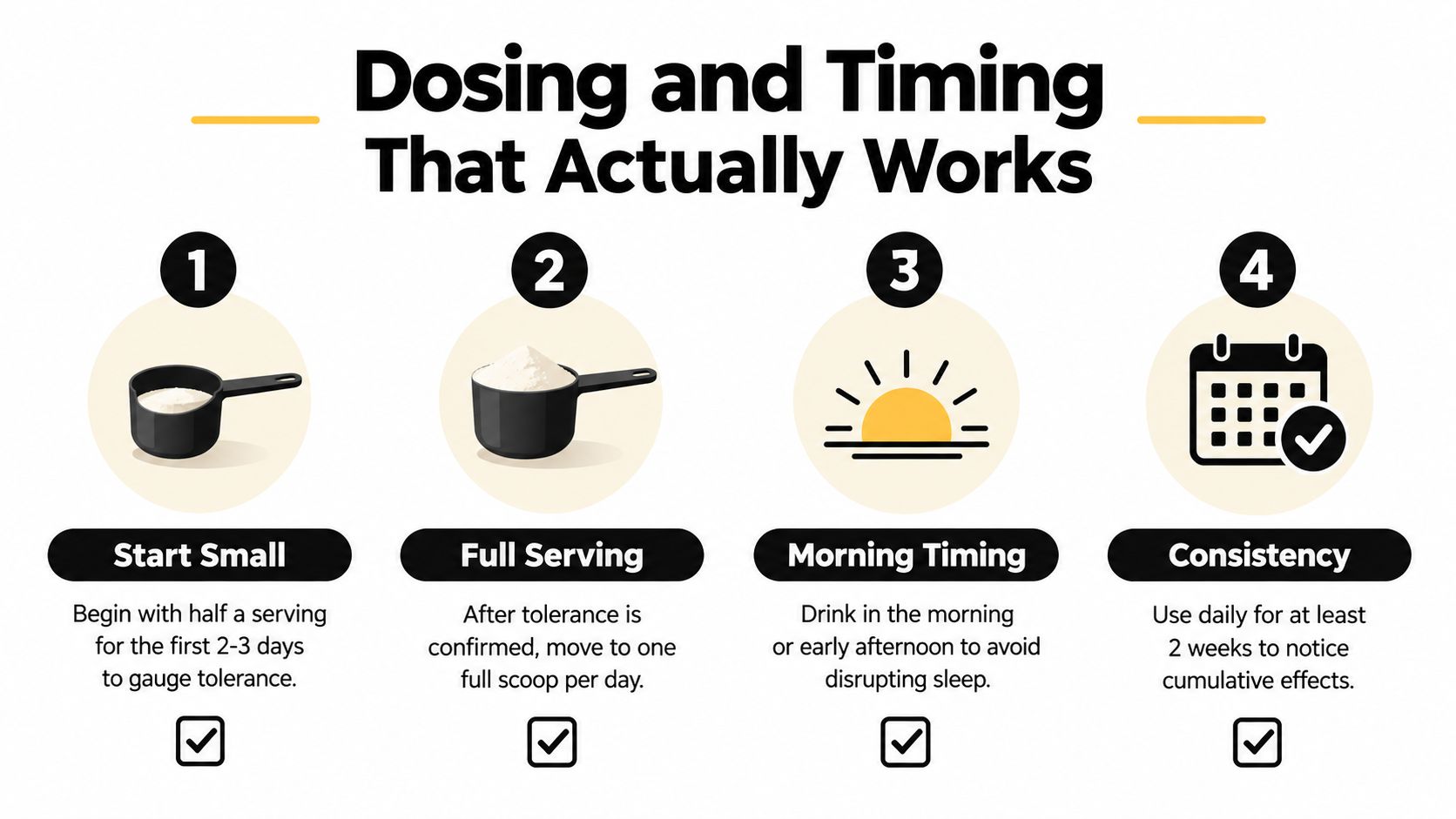
A sensible approach starts with the product label, not the marketing promise. Use the recommended serving size, and introduce the blend gradually if you're unsure how your body will respond.
For a new product, begin with half a serving for the first few days. If you tolerate it comfortably, move to the full scoop or sachet specified by the manufacturer. This approach helps you notice reactions to the coffee, sweeteners, fibers, mushroom extracts, or other ingredients separately instead of taking a large serving and having to guess what caused discomfort.
Match the cup to the clock
Morning is the easiest starting point because it gives you time to observe your response. Pairing the drink with food may make it more comfortable for people who find coffee harsh on an empty stomach.
Afternoon can work well for decaf drinkers who want a coffee ritual after lunch. Still, don't assume a late cup is harmless if you're highly sensitive. Trace caffeine can remain, and some formulas include extracts that feel activating to particular users.
Evening is more individual. A low-caffeine product may be preferable to regular coffee, but it's not guaranteed to be sleep-neutral. If the label doesn't state caffeine per serving, treat that uncertainty as a reason to choose an earlier time.
Avoid stacking the drink with regular coffee, energy products, or other caffeine sources if you're sensitive. Also use extra caution if you're pregnant or nursing, taking stimulant-sensitive medication, or allergic to mushrooms. A healthcare professional can help evaluate personal risks, especially when medication or pregnancy is involved.
Before your first full serving: Check the caffeine amount, confirm the serving size, review the mushroom species, and stop if you notice an allergic or troubling reaction.
Pairing Decaf Mushroom Coffee With Other Products
Decaf mushroom coffee works best as a base ritual, not as a product expected to provide every possible effect. You might choose a lion's mane blend earlier in the day for its flavor and routine, then use a separately labeled reishi product at night if that fits your preferences and you tolerate both ingredients.
Pairing can also solve a dosing problem. Gummies and capsules often disclose the milligrams of extract more clearly than coffee powders do. A consumer who wants a defined mushroom dose may use the coffee for taste and convenience, then rely on a separately labeled product when precise intake matters.
The principal technical uncertainty in this category is whether the mushroom ingredient delivers a defined bioactive dose. No randomized clinical trial has tested mushroom coffee as a finished product, so evidence from isolated extracts shouldn't automatically be transferred to every blended beverage, as explained in this discussion of mushroom coffee evidence.
Avoid two kinds of stacking
Caffeine stacking defeats the purpose of choosing decaf. Adding regular coffee, caffeinated tea, or an energy product can turn a low-stimulation routine into something much stronger than intended.
Extract stacking can also become excessive. More mushroom ingredients aren't automatically better, and combining several products makes it harder to identify which one causes stomach discomfort, headache, allergy symptoms, or another unwanted response.
A layered routine should have a reason for each product. Let the coffee serve the beverage role, and choose a gummy or capsule only when its disclosed dose and purpose add information the coffee label doesn't provide.
How to Spot a Quality Decaf Mushroom Coffee
A useful label should let you answer two separate questions quickly: How much caffeine is in this serving? and How much of which mushroom extract am I getting?
Start with species names. “Lion's mane” is helpful, while Hericium erinaceus is more precise. A product that lists only “functional mushroom blend” leaves you unable to compare it with research on a particular species.
Signals that deserve attention
- Extract form: Look for fruiting body or mycelium disclosure, rather than assuming all mushroom material is equivalent.
- Extraction method: Water or alcohol extraction should be identified when relevant. Plain powder isn't the same as a concentrated extract.
- Milligrams per serving: Each mushroom should have a stated amount, or the total blend should be clearly quantified.
- Beta-glucan testing: A percentage or laboratory result can provide a more useful quality marker than a species count alone.
- Caffeine per serving: The finished product should state caffeine for the serving you'll prepare.
- Certificate of analysis: A batch-specific document can address caffeine, heavy metals, microbes, and testing methods.
Independent verification is especially useful for products combining coffee and concentrated extracts. Learn why third-party lab testing matters when you're evaluating ingredient identity and contamination controls.
Red flags on the package
A proprietary blend that hides individual amounts prevents meaningful dose comparison. Vague phrases about energy, immunity, calm, or focus also tell you less than a species name paired with a measured serving.
Be cautious with “100% caffeine-free” language on a coffee-based product unless the formula contains no coffee or the manufacturer provides credible product-specific testing. The FDA's decaf standard is based on removing at least 97% of original caffeine, not proving that every finished serving contains zero.
The fastest decision rule is straightforward: if the label won't tell you how many milligrams of which mushroom are in one serving, treat the functional language as marketing rather than evidence of a defined dose.
Where Decaf Mushroom Coffee Fits in Your Routine
Decaf mushroom coffee makes the most sense for someone who wants a coffee-like ritual with a lower stimulant load. Caffeine sensitivity, evening use, and transparent labeling are stronger reasons to choose it than the word “functional” on the front of a package.
The mushroom side deserves the same care. Human evidence is tied to specific extracts, doses, and outcomes, while the finished coffee format hasn't been tested as one standardized intervention. If a coffee doesn't disclose its mushroom amount, a separately labeled gummy or capsule may provide more useful dosing information.
Before your next brew, spend five minutes checking your current product's label. Look for caffeine per serving, mushroom species, extract type, and milligrams of extract, then decide whether the cup matches what you want from it.
The Magic Mushroom Delivery offers mushroom coffee alongside gummies, capsules, and other mushroom products, giving shoppers different formats when a beverage label doesn't provide the extract detail they want. Visit The Magic Mushroom Delivery to compare available options and choose a product that fits your routine.