

Functional mushroom coffee blends regular coffee with medicinal mushrooms such as lion's mane and reishi for potential cognitive and immune support. The practical catch is that clinical studies often use gram-level mushroom extracts, while a typical coffee packet may contain only roughly 200–500 mg.
So, what makes a mushroom coffee functional if the amount in your cup may be far smaller than the amount used in research?
The answer depends on more than the mushroom name printed on the front of the package. Species, extraction method, serving size, caffeine content, and active-compound disclosure determine what you're really buying. A coffee blend may fit easily into a morning routine, but it shouldn't automatically be treated as a clinical-strength supplement.
Interest is growing because functional mushroom coffee sits at the intersection of familiar coffee habits and demand for products with a specific wellness purpose. The 2024 International Food Information Council Food & Health Survey found that 43% of consumers actively seek foods or beverages that provide energy or reduce fatigue, while 62% say healthfulness influences their purchasing decisions. Twenty-eight percent actively seek products that support brain function, including memory and focus. These figures describe broader consumer motivations, not proof that mushroom coffee produces those outcomes. (The 2024 consumer motivation summary)
What Is Functional Mushroom Coffee?
Many people hear “mushroom coffee” and think either of ordinary coffee with a mushroom flavor or a psychoactive product. Functional mushroom coffee is neither. It's generally roasted coffee or instant coffee combined with extracts or powders from non-psychoactive medicinal mushrooms selected for their potential wellness properties.
The most familiar ingredients include lion's mane, chaga, reishi, and cordyceps. Some blends also use turkey tail or maitake. Each species has a different research history, so a product containing one mushroom shouldn't be assumed to provide the same potential effects as a blend containing another.
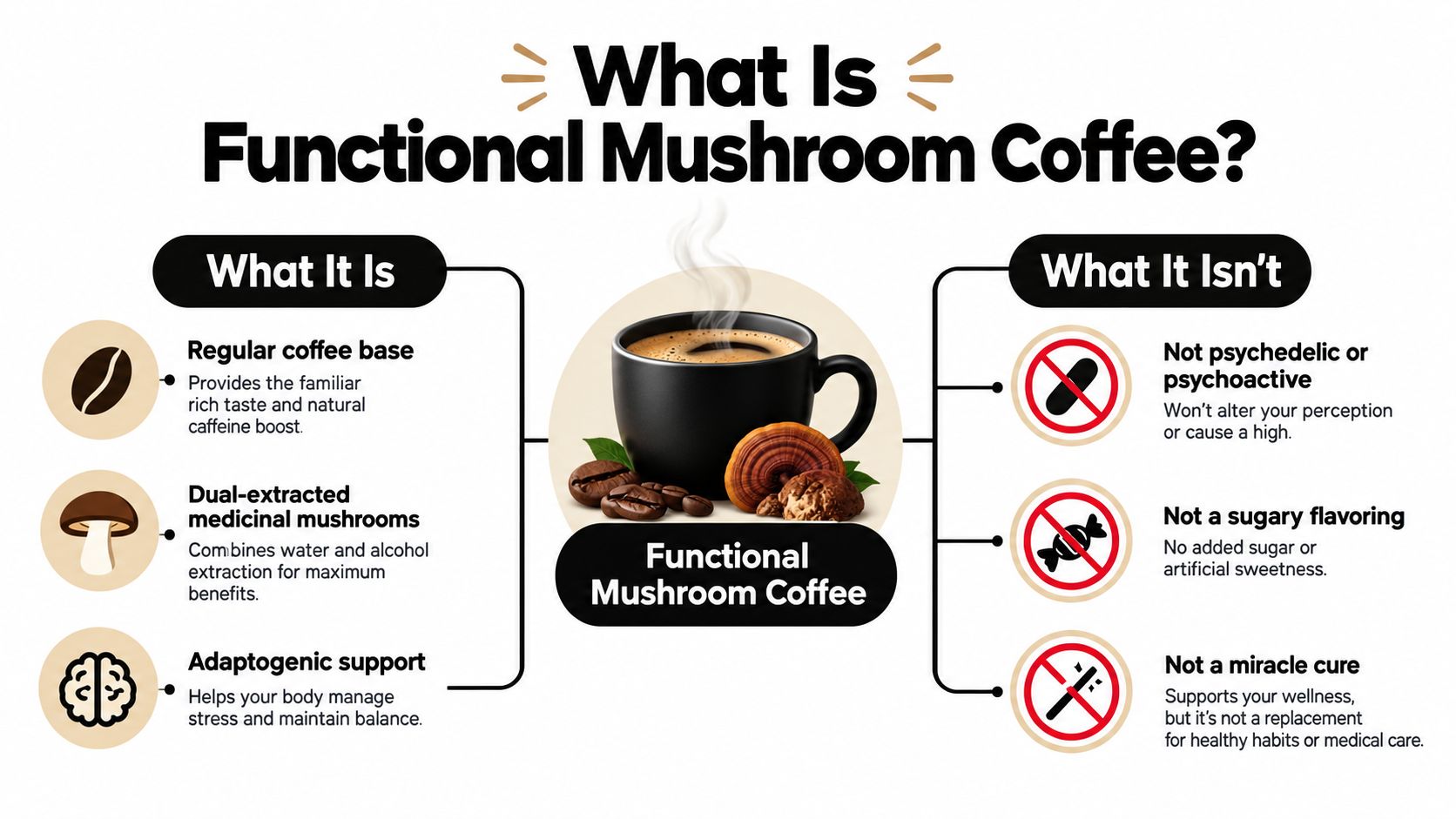
A useful way to understand the product is to separate it into two parts:
- The coffee base: This supplies the familiar flavor and caffeine-related alertness.
- The mushroom component: This supplies extracts or powders associated with research into cognition, immune signaling, antioxidant activity, stress response, or exercise support.
- The formulation: This determines whether the mushrooms are present in meaningful, clearly disclosed amounts.
The word functional refers to a food or beverage designed to offer a purpose beyond basic taste and calories. It doesn't mean the drink is a medicine, and it doesn't guarantee a measurable health outcome. “Adaptogenic” is also used widely in marketing, but it shouldn't be treated as a promise that a blend will normalize stress, improve sleep, or create balanced energy for every person.
For a simple explanation of the broader category, see this guide to what functional mushrooms are. The key distinction is that functional mushroom coffee uses mushroom ingredients for their proposed wellness role, while the coffee itself remains the main source of caffeine and much of the immediate sensory experience.
Taste varies by formula. A well-made blend may retain a recognizable coffee profile with earthy or woody notes, while reishi can add bitterness and cordyceps may be comparatively subtle. Milk, creamer, or a small amount of sweetener can soften those differences, but additives don't change the underlying dose or evidence.
Key Mushroom Ingredients and Their Benefits
The right question isn't “What does mushroom coffee do?” It's which mushroom is included, in what form, and at what dose? Evidence for lion's mane can't be transferred automatically to reishi, chaga, cordyceps, or an unnamed proprietary mixture.
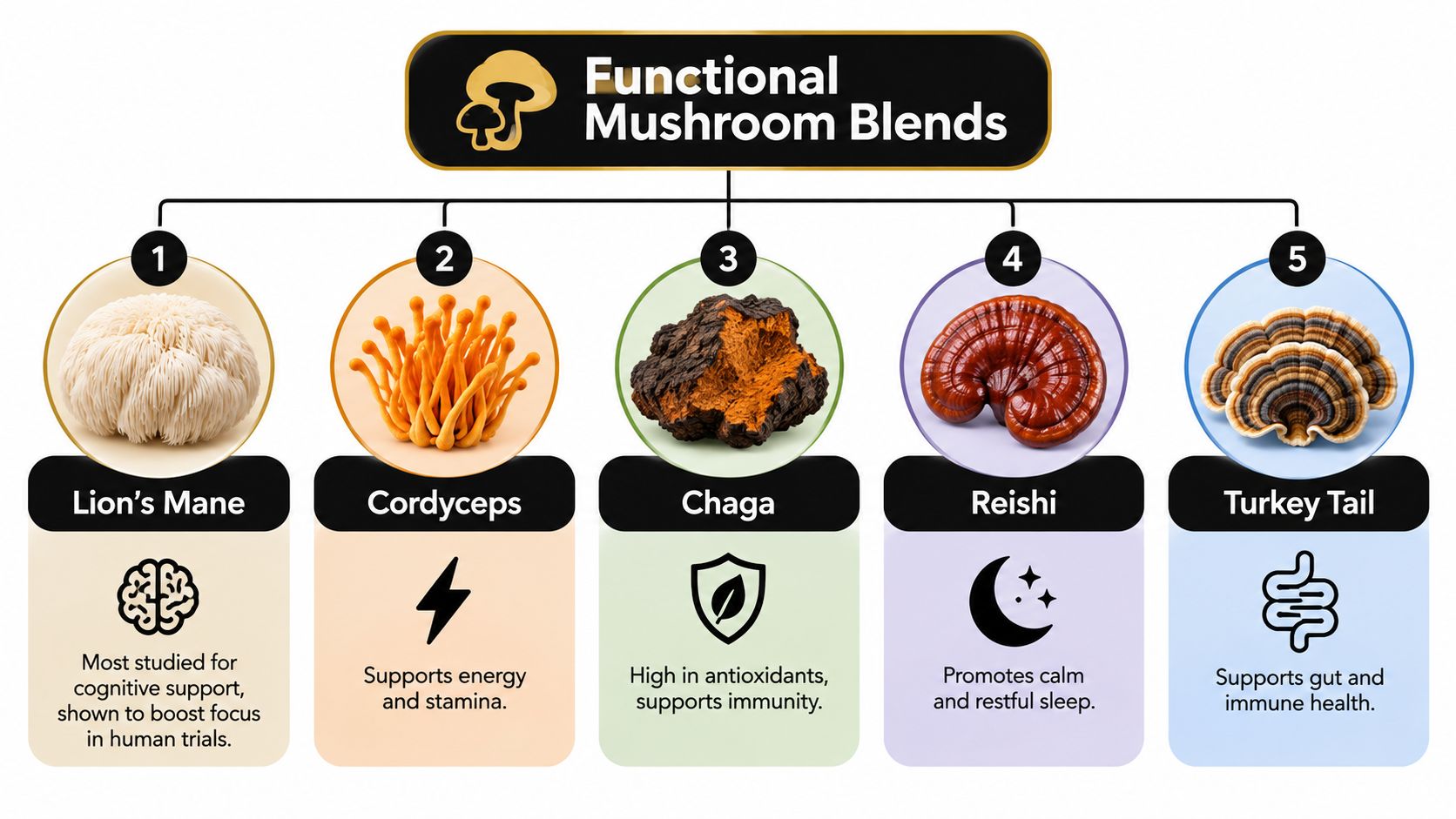
Lion's mane and cognitive research
Lion's mane, or Hericium erinaceus, has the most relevant human cognitive research among common coffee mushrooms. A double-blind randomized trial in 31 adults over age 50 used 3.2 g daily for 12 weeks and reported improvement on the Mini-Mental State Examination, but not on all cognitive measures tested. (Details of the lion's-mane trial)
Another controlled trial enrolled 41 healthy adults aged 18–45 and provided 1.8 g of lion's mane. After a single dose, testing 60 minutes later showed faster Stroop-task performance, with p = 0.005. After 28 days of supplementation, researchers observed a trend toward lower self-reported stress, but it narrowly missed conventional statistical significance at p = 0.051. (The controlled young-adult study)
Those results are interesting but mixed. They don't show that every lion's-mane product improves memory or focus, and they don't establish that a coffee serving reproduces the same effect.
Chaga and antioxidant interest
Chaga, or Inonotus obliquus, is commonly included for antioxidant and immune-related positioning. Laboratory antioxidant activity can help researchers understand a mushroom's chemistry, but an antioxidant assay isn't the same as a demonstrated clinical benefit in people. Chaga's presence on a label therefore supports an ingredient description, not a promise to prevent disease or reduce inflammation.
Reishi and calm-oriented formulations
Reishi, or Ganoderma lucidum, is often chosen for stress, relaxation, and immune-modulating positioning. Its traditional use and laboratory research make it a popular addition to evening-oriented or lower-stimulation blends. Still, reishi isn't a guaranteed sleep aid, and the caffeine in the coffee base may work against restful sleep if you drink it too late.
Cordyceps and energy positioning
Cordyceps is usually associated with energy, stamina, and exercise performance. Those ideas relate to research into its compounds and physiological pathways, but a coffee blend shouldn't be marketed as an automatic performance enhancer. The immediate lift you feel after drinking it may come primarily from caffeine, while any mushroom-specific effect depends on the species, extract, and dose.
Turkey tail and broader blends
Turkey tail appears less often in coffee than the four ingredients above, but brands may include it for immune and gut-health positioning. Its presence makes the label more complex, not necessarily more effective. More species can mean broader ingredient coverage, yet it can also mean that each mushroom receives less of the total serving.
A practical label question is: Does the product identify each mushroom's amount separately? If it lists only a total proprietary blend, you can't tell whether the named species are present in useful quantities or merely included for marketing appeal. A closer look at common mushroom coffee ingredients can help you compare formulas without treating every ingredient claim as equivalent evidence.
Understanding Dose and Evidence Gaps
The largest gap in this category is simple: the dose studied in humans may not match the dose in your cup.
Human research often evaluates an isolated extract at gram-level daily amounts. Consumer-facing reviews report that typical mushroom coffee packets may provide roughly 200–500 mg of extract, while cited human trials often use 1–3 g daily. (A dose comparison for mushroom coffee)
That difference doesn't prove the coffee is useless. It means you need to describe its likely role accurately. A coffee blend may provide a convenient, modest daily exposure, while a standalone supplement may be designed to deliver the higher amount used in a specific study.
Practical rule: A study on a concentrated lion's-mane extract is evidence about that extract at that dose. It isn't automatically evidence about a coffee sachet containing an undisclosed blend.
The gap becomes wider when a formula contains several mushrooms. Suppose a label names lion's mane, reishi, chaga, and cordyceps but gives only one combined amount. You don't know how much of each species you're consuming, whether one dominates the formula, or whether the extract is standardized for beta-glucans or another measurable compound.
What evidence can and can't tell you
Research on an isolated mushroom can answer a narrow question. It may show what happened when people consumed a named extract, at a stated dose, for a stated duration, and completed specific tests. It usually can't answer whether a finished beverage with coffee, sweeteners, other botanicals, and a lower mushroom dose creates the same outcome.
The lion's-mane evidence illustrates this clearly. One trial found improvement on one cognitive measure but not others, while a separate 2025 controlled study of a standardized fruiting-body extract found no significant effect on composite global cognition or mood. (The evidence review on lion's mane)
Use the evidence to set expectations, not to decorate a label. “Contains lion's mane” identifies an ingredient. It doesn't establish clinical equivalence.
Brewing and Dosing Best Practices
Start with the product's stated serving size, then treat the first cup as a tolerance check rather than a test of promised benefits. Coffee affects people differently, and mushroom extracts can vary in concentration, flavor, and digestibility.
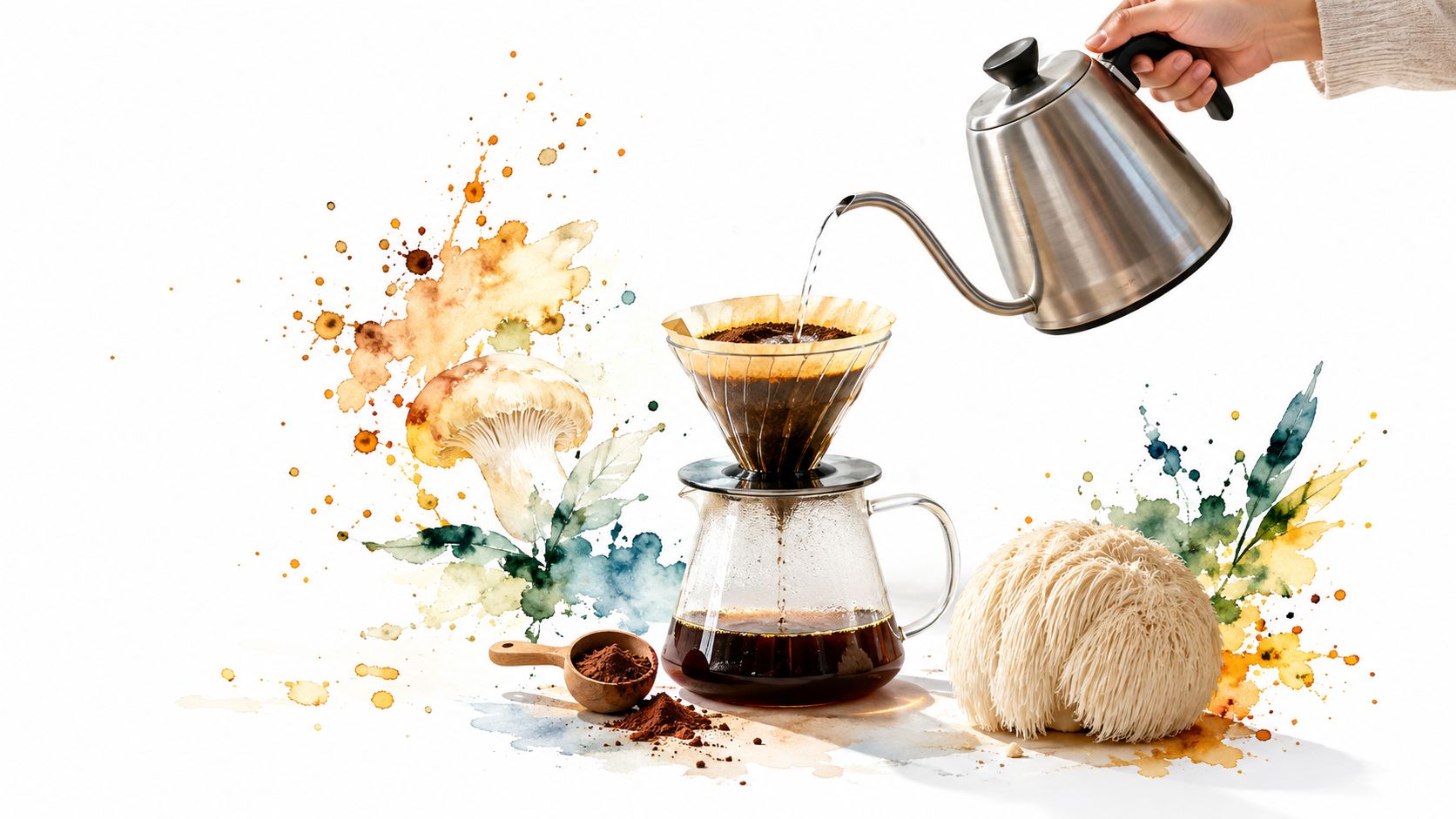
Build a repeatable routine
Use the preparation method recommended on the package. Instant blends are convenient and generally make dose measurement straightforward, while ground coffee requires attention to how much powder you use per cup. Don't add extra mushroom powder just because the drink tastes mild. Taste isn't a reliable measure of active content.
Drink it early enough to observe how caffeine affects your sleep. If you're sensitive to stimulation, begin with less than a full serving only when the label and preparation method make that practical. Keep the rest of your routine stable so you can tell whether the drink causes digestive discomfort, jitters, headaches, or no noticeable change.
Milk or creamer is a preference decision. Black coffee makes it easier to assess the blend's flavor, while a small amount of milk can make earthy notes more approachable. Sweeteners change the nutritional profile, but they don't make an under-dosed mushroom formula more effective.
Match timing to your goal
For morning alertness, drink it when you'd normally have coffee. For a focus experiment, keep the timing consistent and separate the immediate caffeine sensation from any longer-term expectation about lion's mane. A one-hour response tested in a controlled study shouldn't be turned into a universal promise about ordinary coffee use.
Brewing can alter measurable chemistry. In a peer-reviewed Cordyceps coffee study, the finished beverage contained approximately 2.03% beta-glucan and 3.11% total glucans, compared with 3.79% beta-glucan in the Cordyceps material tested. The beverage's DPPH radical-scavenging activity was 82.21%, compared with 80.56% for the coffee control. These are laboratory composition and antioxidant-assay results, not proof of a clinical benefit. (The Cordyceps coffee composition study)
For a visual brewing demonstration, use the following video as a preparation reference:
Safety Considerations and Who Should Avoid It
A mushroom coffee label combines two safety questions: What does the mushroom extract contain, and how much caffeine does the coffee provide? Marketing language such as “gentle energy” doesn't answer either question.
Caffeine varies widely by formulation. Some available reporting places many products around 40–70 mg per serving, compared with roughly 95 mg for an 8-ounce brewed coffee. Another analysis found tested products ranging from about 82 to 102 mg per serving. (A comparison of mushroom coffee caffeine levels)
That range is why “low caffeine” shouldn't be assumed. Check the exact milligrams and serving size, especially if you experience insomnia, anxiety, palpitations, or caffeine-related digestive symptoms.
Medicines and medical conditions
Reishi deserves particular caution. Memorial Sloan Kettering Cancer Center advises people taking anticoagulant or antiplatelet medicines, such as warfarin, to consult a healthcare professional because reishi may increase bleeding risk. (MSK's reishi safety guidance)
Talk with a clinician before regular use if you take immunosuppressants, blood-thinning or antiplatelet medicines, diabetes medication, or other prescriptions. You should also seek individualized advice if you have cardiovascular disease, an autoimmune condition, kidney concerns, upcoming surgery, or a history of reactions to mushrooms.
Pregnant or breastfeeding people should obtain medical advice before using concentrated functional mushroom products because safety information may be limited. Anyone with a known mushroom allergy should avoid a product containing the relevant ingredient.
Read the back label before the front-label promise. Species, extract type, caffeine, allergens, and testing information tell you more than words such as “natural” or “clean energy.”
How to Choose Quality Products
A credible product makes its formula easy to inspect. Look for the exact mushroom species, whether the material comes from fruiting bodies or mycelium, the extraction method, the amount per serving, and measured caffeine content.
A proprietary blend that hides individual amounts makes dose comparison difficult. Prefer products that disclose beta-glucan or total-glucan content and explain how the finished product is tested. Because processing can change the chemistry of the beverage, testing only incoming mushroom powder isn't enough. A stronger specification evaluates the final brewed product as well.
Use third-party lab testing information as a buying criterion, not a decorative badge. Check whether testing addresses species identity, contaminants, microbial quality, heavy metals, and consistency between batches.
The Magic Mushroom Delivery offers mushroom coffee alongside other functional mushroom products through its online store, so shoppers can compare a coffee-format option with different product formats. Whichever brand you choose, treat transparent dosing as more important than a long list of mushroom names.
The Magic Mushroom Delivery offers coffee-format mushroom products and educational resources for adults comparing functional mushroom options. Visit The Magic Mushroom Delivery to review the available products, ingredient details, and delivery information before choosing your next cup.