

You've placed an order, closed the checkout page, and now you're watching an inbox that hasn't changed yet. One message confirms payment, but there's no carrier scan, no moving map, and no clear answer about when the parcel will arrive. That quiet period can feel unsettling, especially when you've chosen next-day, 2-day, or tracked nationwide delivery.
The key is understanding what happens between checkout and the door. Shipping and tracking are built around handoffs and barcode scans, not a continuous GPS signal, so each update marks a checkpoint in the parcel's journey. The guide below follows that journey from payment confirmation through discreet delivery, age verification, and practical steps for handling a quiet tracking page.
What Happens After You Place Your Order
After checkout, your order moves through a short sequence of operational milestones. It is like a relay race. The payment system starts the race, the fulfillment team prepares the parcel, and the carrier takes it through the delivery network.
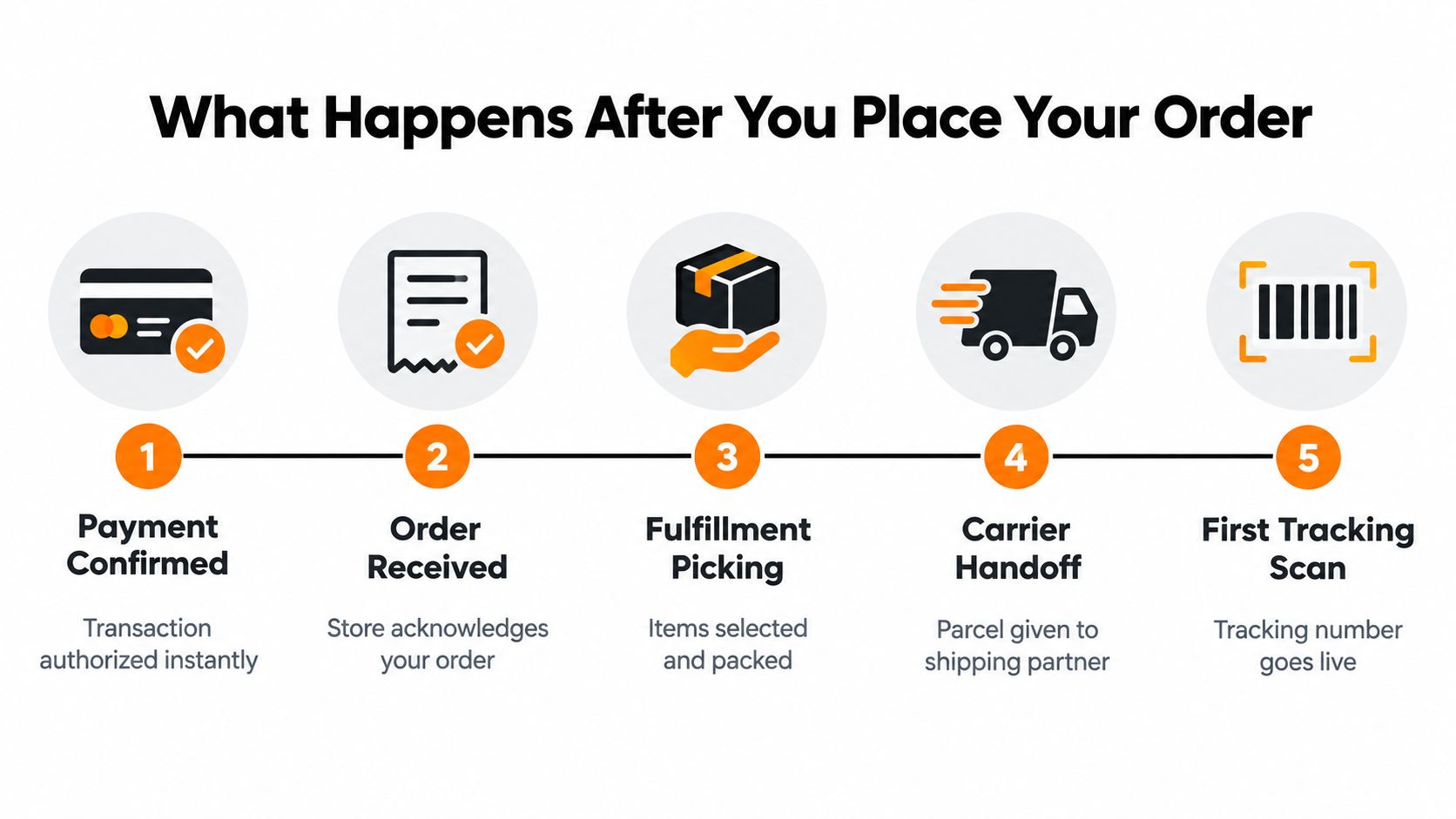
The five milestones after checkout
- Payment confirmation: Your transaction is authorized, and the checkout system records the order.
- Order receipt: The store acknowledges the purchase and sends an order confirmation email.
- Fulfillment picking: The warehouse selects the products, prepares the inner packaging, and seals the parcel.
- Carrier handoff: The parcel is given to the shipping partner selected for the destination and service level.
- First tracking scan: The carrier records the parcel at its first facility, making the tracking number active in its system.
The first email may arrive before the parcel receives its first physical scan. That's normal. An order confirmation means the purchase was received, while a shipping notification usually follows after dispatch and should include the carrier name and tracking number. In many shipping workflows, the first scan appears within 12 to 24 hours after the order is sealed for dispatch, although the exact timing depends on the fulfillment cutoff and carrier collection schedule.
If you're comparing delivery windows, use the information on the delivery timing page alongside the option shown at checkout. The tracking page may initially display only a label-created or shipment-registered status. That means the shipping record exists, not necessarily that the parcel has already moved through a carrier facility.
Practical rule: Don't treat the first email and the first scan as the same event. They confirm different parts of the journey.
Shipping Options for Every Timeline
The checkout page presents the shipping methods available for your destination ZIP code. That menu can change by location because local courier coverage, carrier routes, cutoff times, and national service availability aren't identical everywhere.
Next-day delivery suits an urgent order in a supported California metro area. It may involve a local courier for the final handoff, so the experience can look different from a conventional national parcel route. A same-day or next-day service also depends heavily on placing the order before the applicable fulfillment cutoff and providing an address that the courier can access without clarification.
2-day delivery is the practical middle option for buyers who want a defined short window without relying entirely on a local route. The parcel may travel through a regional hub before reaching the destination area, and tracking can show a combination of warehouse, line-haul, and last-mile events.
Tracked nationwide shipping is designed for addresses outside the fastest local service area. It provides scan visibility across the shipping journey, so you can follow the parcel from carrier acceptance through delivery. The displayed arrival estimate remains dynamic because carriers adjust it when new scan data or routing conditions change, as described in carrier delivery estimate guidance.
| Option | Delivery Window | Tracking | Best For |
|---|---|---|---|
| Next-day delivery | Next business delivery window where available | May combine local courier events with carrier scans | California buyers with immediate timing needs |
| 2-day delivery | Short national or regional delivery window | Carrier scans and handoff events | Buyers balancing speed and shipping flexibility |
| Tracked nationwide shipping | Carrier-dependent nationwide window | End-to-end shipment scan visibility | Addresses outside the next-day service area |
Cutoff times matter because fulfillment and carrier collection happen in sequence. An order placed after the day's dispatch cutoff may enter preparation later, even if the selected service normally operates on a next-day or 2-day schedule. The checkout option is therefore a promise tied to both destination eligibility and order timing, not just the moment payment is accepted.
Read the service name carefully before confirming the purchase. If the option references tracking, expect a tracking number after dispatch. If it refers to a local delivery service, the updates may use courier-specific events rather than the same scan language used by a national carrier.
How Scan-Based Tracking Actually Works
Package tracking usually works like a series of airport checkpoints. You don't receive a live video of a suitcase moving through every corridor. You see a record when the bag is accepted, loaded, transferred, or delivered. Parcel tracking follows the same principle.
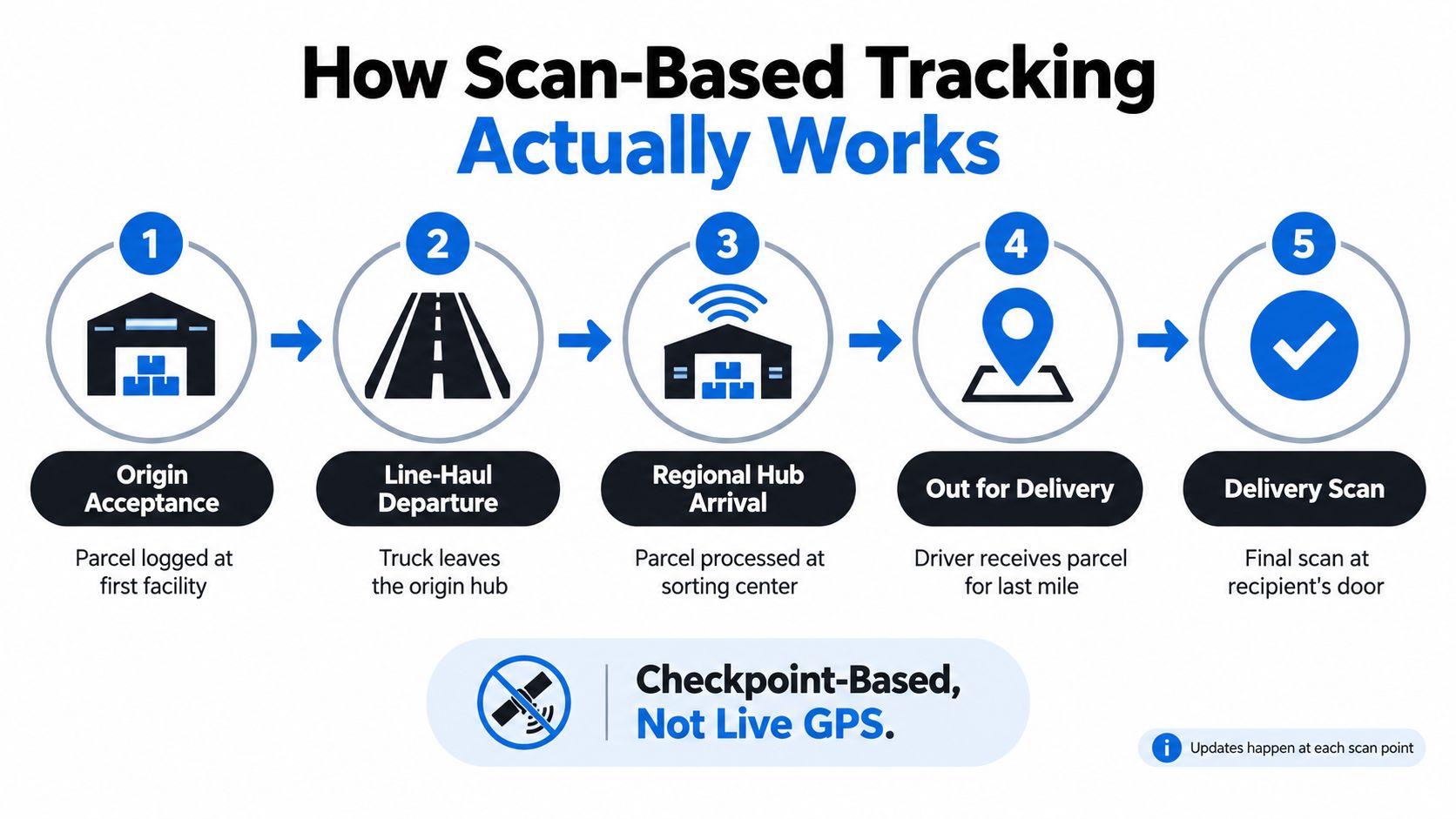
The usual scan sequence
- Origin acceptance: The first facility records the parcel.
- Line-haul departure: The package leaves the origin hub for another facility.
- Regional hub arrival: A sorting center receives and processes it.
- Out for delivery: A local driver receives the parcel for the final route.
- Delivery scan: The carrier records the completed handoff.
These events appear as a chronological activity list on the carrier's tracking page. Some services also send email or SMS notifications when a new event is registered. They generally don't send a message for every minute the parcel spends in a truck, warehouse cage, or sorting lane because those moments don't create a new scan event.
A gap between updates can therefore mean the parcel is traveling between checkpoints, waiting for the next facility to process it, or moving through a route where no intermediate scan is published. Package tracking guidance explains that tracking pages are scan-based rather than continuous GPS feeds, and that hours or days can pass between recorded events.
How to read common statuses
Label created means the shipment record has been prepared. It doesn't confirm that the carrier has physically scanned the parcel.
Accepted or received means a carrier facility has recorded possession. This is the first meaningful movement checkpoint.
In transit usually means the package is moving between facilities, although the page may keep that status while the parcel waits for the next scan.
Out for delivery indicates that the final-mile driver has received the parcel for that route. It's more specific than a general in-transit status, but delivery can still depend on route order and access to the address.
Delivered is the final scan. Check the delivery details for the stated location, especially if the parcel was left in an approved spot or accepted by another person.
For a direct tracking lookup, use the tracking page and compare its information with the carrier's own page when a carrier link is provided.
Discreet Packaging and Privacy at the Door
Discreet shipping is about reducing visible information on the outside of the parcel. In practice, that means a plain, unmarked box, a sealed inner pouch, and a neutral shipping label that doesn't identify the product or include a product description.
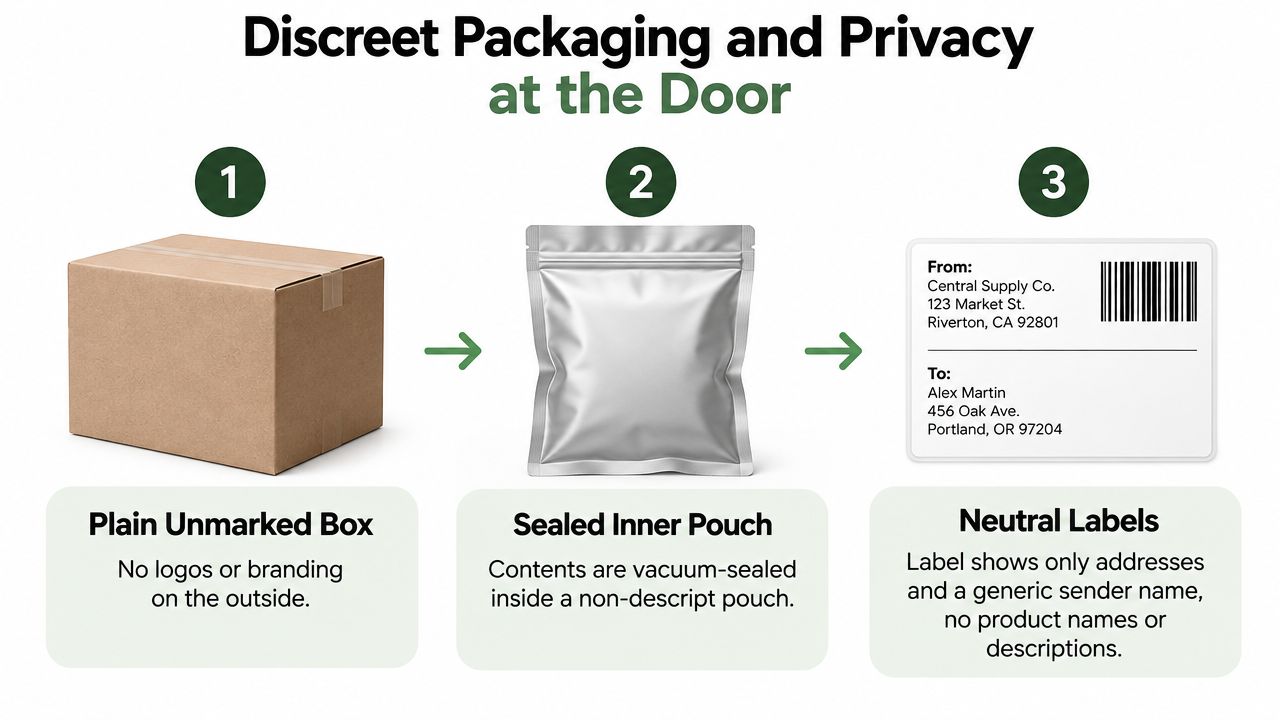
What someone at the address can see
A neighbor, roommate, family member, or property manager who sees the parcel should see the exterior box and the ordinary courier label. The outward label contains delivery information and a generic sender identity rather than a product name or descriptive contents. The box itself doesn't advertise what's inside through logos, graphics, or retail wording.
The inner pouch serves a different purpose. It keeps the contents enclosed inside the outer parcel, so opening the package is required to see the product. That separation matters in apartment buildings, shared houses, dorm-style residences, and workplaces where another person may handle the box before you collect it.
Privacy check: Tracking reveals the parcel's movement, while the exterior packaging limits what other people can learn from the parcel itself.
Planning the handoff
Check whether the selected service requires a signature or adult handoff. If you won't be home, review the carrier's available delivery-management tools before the parcel reaches the final route. Depending on the carrier and destination, you may be able to redirect a package to a pickup point such as a UPS Store or FedEx location.
Locker availability also depends on the carrier, address, package dimensions, and service rules. An Amazon-style locker may not accept every shipment, so confirm eligibility in the carrier's delivery-management portal rather than assuming a locker will be available.
If a signature is required, a courier may not leave the package unattended. Arrange a time when you can receive it, or use an approved hold or redirect option. The exterior should remain neutral, but delivery control still depends on the carrier's signature and address rules.
Age Verification from Checkout to Delivery
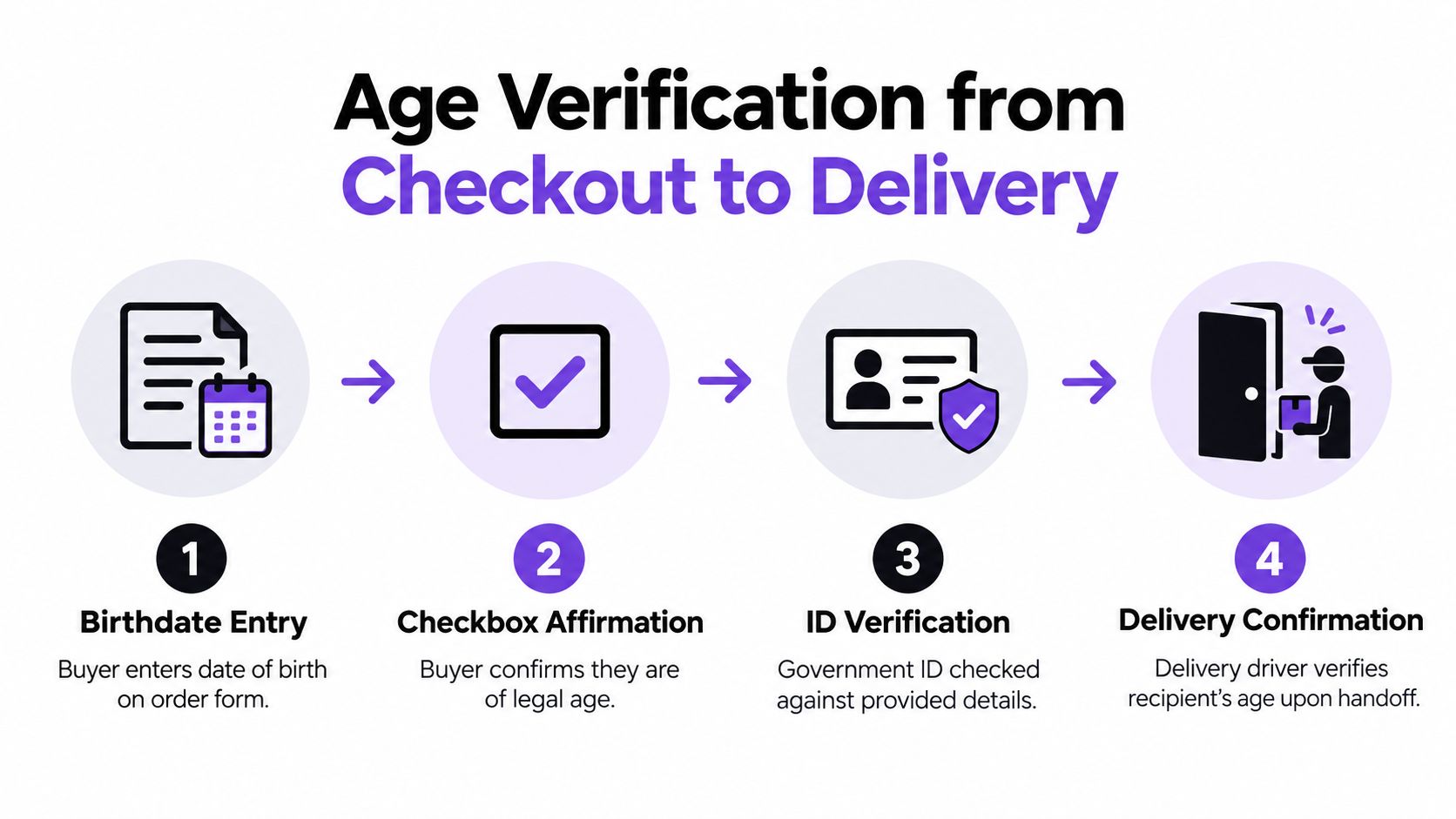
Age verification works as a layered process rather than a single question at checkout. Direct-shipping programs commonly combine age affirmation, date-of-birth collection, and carrier ID inspection at delivery, as outlined in age-verification guidance for direct shippers.
What happens during the order
At checkout, the buyer enters a birthdate and confirms the required age affirmation. The order form uses that information to determine whether the purchase can proceed. The shipping workflow can then carry the required delivery instruction forward, including the carrier's adult-signature or ID-check service flag when that service is used.
The important distinction is that checkout approval doesn't replace delivery verification. It records the buyer's declaration and allows the order to move into fulfillment, while the carrier's handoff confirms that the recipient is the person authorized to receive the age-restricted parcel.
What to expect at the door
Keep a valid government-issued photo ID accessible before the estimated delivery window. The courier may ask to see it, check the birthdate, and confirm the recipient before completing the handoff. A roommate, neighbor, or family member who happens to be home may not be able to accept the parcel just by signing for it if the delivery requires recipient age verification.
If you're away when the courier arrives, the driver may leave a notice or record an attempted delivery rather than completing the handoff. Follow the instructions on that notice, check the carrier's redelivery options, and arrange a time when you can present the required ID.
A successful checkout doesn't guarantee that anyone at the address can receive the package. The final handoff is a separate control point, so plan around your availability and have the identification required by the delivery service ready.
When Tracking Goes Quiet and What to Do
A quiet tracking page often reflects the way parcel networks report information, not a lost shipment. Carriers scan packages at operational checkpoints, such as the origin facility, a regional hub, local sorting, and the delivery route. The parcel can continue moving between those points without generating a visible update.
Domestic tracking gaps of 2 to 3 days can be normal, while 7 or more days without an update is a reasonable point to escalate, according to shipping guidance on stalled tracking. International parcels can have silent periods of 5 to 10 days, and a label-created status can remain unchanged for 24 to 72 hours before the first physical scan. Those ranges describe normal possibilities, not guarantees for every route.
Separate ordinary silence from warning signs
| Signal Type | What It Looks Like | Action To Take |
|---|---|---|
| Normal scan gap | No new event while the parcel is between facilities | Wait for the next checkpoint and monitor the carrier page |
| Label-created status | Tracking number exists, but no physical acceptance scan appears | Allow the initial processing period, then check order details |
| Extended silence | No update reaches the carrier's escalation point | Contact support with the order and tracking details |
| Exception alert | Weather, address, transport, or operational problem appears | Read the carrier instruction and respond promptly |
| Failed attempt | Delivery was attempted, but no reattempt is listed | Use carrier redelivery, hold, or pickup options |
Start with the carrier's tracking page because it may show an event before the retailer's order page refreshes. Then check the retailer's order details for the second tracking reference. If neither page explains the delay, contact support with your order number, tracking ID, and delivery address.
Support can help determine whether the parcel is still moving, whether the address needs correction, or whether the carrier should open a trace. If the carrier confirms that the package is lost, ask about the available reship or resolution process rather than placing a duplicate order immediately.
Escalation rule: Silence becomes more meaningful when it combines with an exception, a failed delivery attempt, or a tracking gap that exceeds the carrier's normal route window.
Practical Tips for Faster California Delivery
Fast delivery starts with clean information. A carrier can move a correctly labeled parcel efficiently, but a missing apartment number or inaccessible delivery point can create a delay that no shipping upgrade fixes.
Before you submit the order
- Use the complete address: Include apartment, unit, suite, building, and access details where the checkout form allows them.
- Verify the ZIP code: A small ZIP-code error can send the parcel toward the wrong regional sortation path.
- Order before the cutoff: If you need next-day dispatch, submit the order before the daily fulfillment deadline shown or communicated at checkout.
- Choose an accessible address: A staffed workplace or home where someone can receive an age-verified delivery may prevent a failed first attempt.
- Avoid unsuitable PO boxes: Don't use a PO box when the selected carrier requires a street address, signature, or direct handoff.
If contactless drop-off is available for your service, select a location that's sheltered and less visible from the street, such as a side door or a safe porch area. That choice should still comply with the carrier's delivery rules, particularly when the service requires an adult signature or ID inspection.
After the label is generated
Save the tracking number and check it once the carrier record appears. You don't need to refresh the page continuously. A normal scan sequence will show meaningful events when the parcel reaches a facility or changes delivery stage.
Keep your government-issued photo ID ready on the expected delivery day. If the carrier can't complete the required age check, the parcel may be held or sent through another delivery attempt instead of being handed over.
For California buyers comparing faster local options, review same-day delivery in California and confirm that the service is available for your ZIP code before ordering. Wildfire conditions, holiday volume, and carrier network disruptions can affect routes, so ordering a day earlier can create useful breathing room when timing matters.
The most effective approach combines accurate address data, an eligible cutoff time, a reachable recipient, and quick attention to exception notices. Those habits reduce avoidable friction while still leaving room for conditions outside the buyer's control.
The Magic Mushroom Delivery offers next-day, 2-day, and tracked nationwide shipping with discreet packaging and age verification for eligible adult customers. Visit The Magic Mushroom Delivery to review available products, confirm the shipping option for your ZIP code, and prepare for a clearer delivery journey from checkout to handoff.