

Put simply, neuroplasticity is your brain's incredible ability to reorganize itself by creating new neural pathways throughout your life. It means your brain isn't a static, unchangeable organ. Instead, it’s constantly adapting in response to your experiences, thoughts, and even your environment. This is the very process that lets you learn a new language, recover from an injury, or kick a bad habit.
Your Brain Is a Dynamic City Map
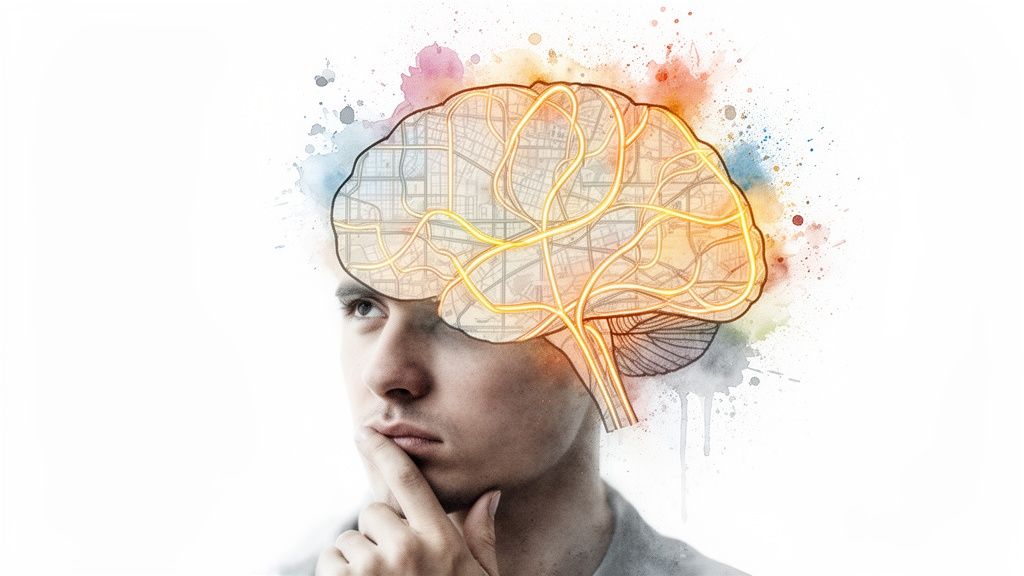
For a long time, scientists thought the adult brain was pretty much set in stone after childhood. The common belief was that once development wrapped up, the structure was fixed for good. But modern neuroscience has completely overturned that idea, showing us that our brains are far more like a dynamic, ever-changing city map than a rigid blueprint.
Think of your thoughts, habits, and skills as the roads on this map. Every time you learn something new, practice a skill, or even just repeat a thought, you're paving a new road or widening an existing one. The more you travel down a certain mental path, the bigger and more efficient it becomes. A skill you practice daily, like playing a guitar chord, can turn a tiny dirt path into a neural superhighway.
Use It or Lose It
On the flip side, pathways that you stop using begin to weaken and fade. This fundamental principle of neuroplasticity is often summed up in a simple phrase: “use it or lose it.” If you stop practicing a language you once knew, the neural circuits dedicated to it can degrade over time, making it harder to pull up vocabulary and grammar. Your brain is smart—it reallocates precious resources to the connections you use most.
This has profound implications for just about everything we do. It’s the very reason why:
- Musicians who practice daily develop faster, more precise finger movements.
- London taxi drivers famously develop larger brain regions associated with spatial memory from navigating the city's complex streets.
- People recovering from brain injuries can often regain lost functions by training other parts of their brain to pick up the slack.
At its core, neuroplasticity is the biological engine driving all learning and adaptation. It’s the mechanism that lets us grow and quite literally change our own minds, proving that personal development is on the table at any age.
To help break this down even further, here’s a quick look at the core concepts.
Neuroplasticity at a Glance Key Concepts
| Concept | Simple Explanation | Real-World Example |
|---|---|---|
| Synaptic Plasticity | The strengthening or weakening of connections (synapses) between neurons. This is a short-term change. | Recalling a new phone number a few minutes after hearing it. The connection is temporarily stronger. |
| Structural Plasticity | The brain's ability to physically change its structure by creating or removing connections. This is a long-term change. | Learning to juggle. Studies show the gray matter in brain areas related to visual motion processing actually increases. |
| "Use It or Lose It" | Neural pathways that are used frequently become stronger, while those that are neglected become weaker. | Forgetting how to play a musical instrument you haven't touched in 20 years. |
| Experience-Dependent Plasticity | The ongoing process of creating and organizing neural connections as a direct result of life experiences. | A person who becomes blind may develop a heightened sense of hearing as the brain rewires the visual cortex to process auditory information. |
This table shows just how active and responsive your brain truly is. It's not just passively recording information; it's actively reshaping itself based on what you do.
Building a Better Brain
Understanding neuroplasticity hands you a powerful tool. It confirms you aren't just a passenger watching your brain's processes unfold—you are the driver. By consciously choosing your actions, habits, and what you focus on learning, you can directly influence the physical layout and function of your brain.
This guide will take you deeper into the fascinating science of how your brain rewires itself. We’ll explore the mechanisms that make these changes happen and uncover practical ways to apply this knowledge to learn faster, boost your well-being, and build a more resilient mind. Your brain is ready to adapt—all you have to do is learn how to guide it.
The Surprising History of a Revolutionary Idea
It’s easy to think of neuroplasticity as a brand-new concept, something that could only have been discovered with modern brain scans and high-tech labs. But the truth is, the idea that our brains can change has a surprisingly long and scrappy history. For centuries, the prevailing wisdom was that the adult brain was a finished product—once you grew up, the structure was set in stone.
This "fixed brain" theory was scientific dogma, painting a bleak picture of a mind that could learn new facts but never fundamentally rewire itself. Overturning an idea that powerful took more than just a few clever experiments; it took decades of persistence from researchers who dared to question what everyone else took for granted.
Early Glimmers of a Malleable Mind
Long before we had the technology to see neurons in action, a few observant scientists started noticing clues that the brain was far more adaptable than anyone thought. The first whispers of this radical idea actually emerged back in the late 18th century, challenging the status quo with simple, elegant observations.
One of the first documented experiments came from an Italian anatomist named Michele Vincenzo Malacarne way back in 1783. He trained one group of birds and dogs extensively, leaving another group untrained. When he later compared their brains, he found that the trained animals had developed physically larger and more complex cerebellums. It was a groundbreaking discovery, suggesting that our experiences could literally bulk up parts of our brain. You can dig deeper into these early findings on brain plasticity.
Even with this evidence, the idea just didn’t stick. The scientific community was heavily invested in the static brain model, and it would take a lot more to change their minds.
The Pioneers Who Challenged Dogma
Fast forward to the 20th century, and a few key figures began to seriously push back against the old paradigm. One of the most important was the Polish neuroscientist Jerzy Konorski, who officially coined the term "neural plasticity" in 1948. He was the one who proposed that neurons could strengthen or weaken their connections based on how often they were used, laying the theoretical foundation for much of what we know today.
Then, in the 1960s, Marian Diamond delivered one of the first knockout blows to the old theory. In a series of now-famous experiments, she showed that rats raised in an "enriched" environment—full of toys, challenges, and social interaction—developed thicker cerebral cortices than rats kept in boring, isolated cages. Her work provided undeniable proof that our environment and experiences directly shape our brain's anatomy.
These early researchers were often met with skepticism and resistance. Their findings directly contradicted decades of accepted scientific doctrine, making their work a true uphill battle for recognition and acceptance.
This slow but steady trickle of evidence eventually became a flood, completely washing away the old, rigid model of the brain. The work of these pioneers was crucial in taking the concept of what is neuroplasticity from a fringe theory to a core principle of modern neuroscience. It fundamentally changed how we think about everything from learning and memory to recovery from injury, proving that the brain is, and always has been, a work in progress.
How Your Brain Actually Rewires Itself
Knowing your brain can change is one thing. Seeing how it pulls off this incredible feat is something else entirely. This isn't some abstract, magical process—it’s a series of tangible, biological events happening on a microscopic scale. Neuroplasticity relies on two core mechanisms that work in tandem, constantly refining your brain's wiring diagram based on everything you do, think, and experience.
These mechanisms allow your brain to adjust its communication patterns and even alter its physical layout. One process is like fine-tuning the volume on an existing connection; the other is like building a new road from scratch. Together, they form the foundation of all learning, habit formation, and recovery.
Synaptic Plasticity: The Volume Control
The most common form of change is synaptic plasticity. Picture your brain as a massive communications network with trillions of connections, or synapses, between its neurons. Synaptic plasticity is the art of strengthening or weakening these individual links, basically turning the volume up or down between two brain cells.
When you learn something new or repeat an action, the synapses involved in that task fire more often. This repeated firing makes the connection more sensitive and efficient in a process called long-term potentiation (LTP). The more you use a pathway, the louder and clearer its signal becomes. On the flip side, when you neglect a skill or memory, those connections weaken through long-term depression (LTD), and the signal fades. This is the "use it or lose it" principle in action, right down at the cellular level.
This old vs. new view of the brain shows just how far we've come.
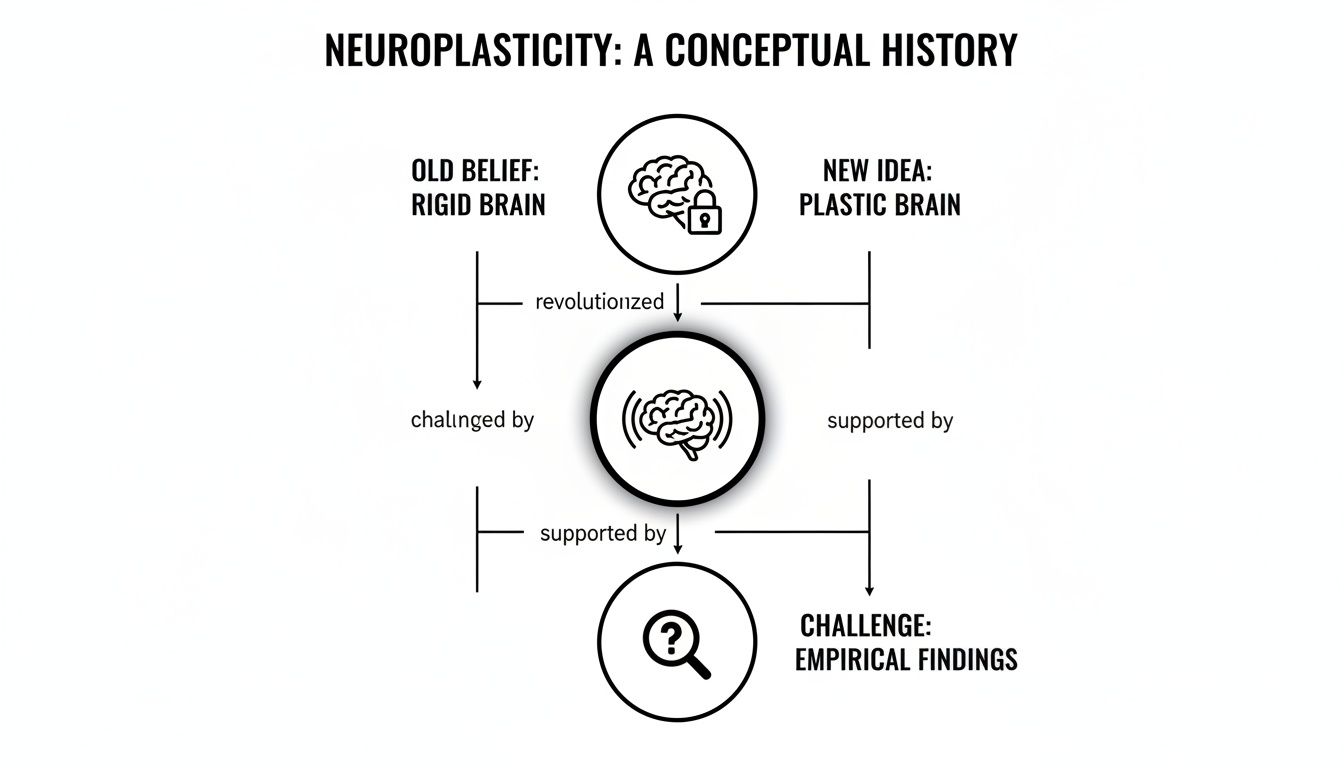
We had to completely abandon the old, rigid model to even begin studying these amazing rewiring mechanisms.
Structural Plasticity: Building New Highways
While synaptic plasticity adjusts existing connections, structural plasticity is the brain’s power to change its physical structure. This is a much bigger deal. It involves creating entirely new synapses (synaptogenesis) or tearing out old, unused ones (synaptic pruning). It’s a slower, more profound process—less like adjusting volume and more like building new highways or demolishing abandoned roads on our city map.
Synaptic pruning, in particular, is vital. Think of it as the brain's spring cleaning service. It clears out weak or redundant connections to make the whole network faster and more efficient. This process runs wild during childhood and adolescence, but it keeps going throughout our lives, making sure the brain dedicates its resources to the pathways that truly matter.
At its core, structural plasticity is the physical evidence of learning and growth. When you master a new language or a musical instrument, your brain isn't just strengthening old connections—it's physically building new ones to support that skill.
Not long ago, this idea of a physically changing brain was considered scientific heresy. Dr. Michael Merzenich's critical research in the 1970s helped flip that script, though funnily enough, his discoveries happened while he was trying to prove the exact opposite. He ran experiments to confirm the brain was fixed, including one where a ferret's eye and ear nerves were switched. Instead of the animal staying blind and deaf, its brain rewired itself over a few months. The ferret began to see and hear normally, completely demolishing the hypothesis Merzenich set out to prove. You can read more about this groundbreaking experiment that shaped our modern view.
Myelination: Paving the Neural Superhighway
There's one more piece to this puzzle: myelination. Myelin is a fatty substance that wraps around nerve fibers, acting just like the insulation on an electrical wire. This coating dramatically speeds up the signals zipping between neurons, making communication incredibly fast and efficient.
The process of myelination is what solidifies skills and habits. As you practice something over and over, your brain responds by adding more layers of myelin to the neural circuits involved.
This is the real reason practice makes perfect. It’s not just about mindless repetition; it’s about physically reinforcing and speeding up the specific brain pathways dedicated to that skill.
- Learning a new skill: Initial attempts are slow and clunky as the brain forges a new pathway.
- Consistent practice: The synaptic connections get stronger (LTP).
- Deep mastery: The pathway becomes heavily myelinated, turning it into a super-fast, almost automatic circuit.
Together, these mechanisms—synaptic tweaks, structural overhauls, and myelination—are the biological tools your brain uses to constantly adapt and evolve. They ensure your mind remains a dynamic system, capable of incredible change at any stage of life.
Neuroplasticity in Action Across Your Lifespan
Neuroplasticity isn't some abstract concept happening in a lab; it's a process you’ve been living since the day you were born. It’s the force that’s constantly at work behind the scenes, shaping your skills, your memories, and the very core of who you are. While it looks a little different at each stage of life, its presence is a powerful, unending constant.
By looking at how this process unfolds from childhood to old age, we can get a real feel for what it means. It’s the engine behind a kid's lightning-fast learning, an adult picking up a new hobby, and an elder's remarkable recovery after an injury. Each example paints a vivid picture of a brain that is anything but static.

Childhood: The Brain as a Sponge
During childhood, the brain is in a state of supercharged plasticity. A young kid's mind is like a sponge, soaking up information from the world and building its core wiring at an incredible pace. This phase is known as developmental plasticity, and it’s when the brain is most open to being molded by experience.
This is exactly why children can pick up new languages so easily or learn to play an instrument with surprising speed. Their brains are firing on all cylinders, forming trillions of new connections (synapses) in response to every sight, sound, and feeling. It's a period of explosive growth where the very architecture of the mind is being built from the ground up.
Contemporary research demonstrates that neuroplasticity extends across the entire human lifespan, with critical periods of heightened plasticity occurring during early childhood and adolescence. During early childhood, the nervous system must receive specific sensory inputs to develop properly, while adolescence involves a massive 'pruning back' of excess synapses to strengthen the most important connections. Discover more insights about these critical developmental windows on Britannica.
Adulthood: Refining and Mastering Skills
That explosive growth might slow down after childhood, but neuroplasticity is far from over. In adulthood, the process shifts into what’s called experience-dependent plasticity. This is the mechanism you tap into every time you learn a new skill for your job, start a new workout routine, or even just figure out a new route to work. Your brain is actively strengthening the neural pathways you use the most.
Think about these common adult experiences—they’re all driven by neuroplasticity:
- Learning a Language: As you master new vocabulary and grammar, you are physically changing the language centers of your brain, making them stronger and more efficient.
- Mastering a Musical Instrument: That consistent practice isn’t just about muscle memory. It actually thickens the myelin sheath around the relevant neurons, allowing signals to travel faster for more fluid playing.
- Changing a Habit: Breaking a bad habit and building a good one is neuroplasticity in real time. You’re consciously weakening an old, unhelpful neural pathway while forging a new, positive one.
This constant adaptation proves that learning and growth are truly lifelong pursuits. Even small, consistent efforts can create real, lasting changes in your brain's structure and function. For those exploring different avenues of wellness, you might also be curious about the benefits of functional mushrooms and their role in supporting overall health.
Compensatory Plasticity: Bouncing Back from Injury
One of the most incredible demonstrations of neuroplasticity is its role in recovering from brain injury. This is known as compensatory plasticity, where the brain literally reorganizes itself to make up for lost function. When one part of the brain is damaged, like after a stroke, healthy areas can often take over the jobs the injured section used to handle.
For instance, someone who loses function in their left hand can, with intensive physical therapy, train nearby motor cortex regions to take over control of that hand's movements. In the same way, a person who loses their sight may find their hearing and touch become much sharper. This isn't magic; it's the brain reallocating its neural real estate, using the now-dormant visual cortex to process sound or touch instead.
These amazing stories of recovery shine a light on the brain's deep-seated resilience. They show us that even when faced with significant damage, the brain has an incredible capacity to adapt, reroute its wiring, and find new ways to keep going. Understanding what is neuroplasticity means recognizing this constant, powerful force for adaptation that shapes who we are at every age.
Emerging Research on Psilocybin and Brain Plasticity
Neuroscience is constantly pushing into fascinating new territory, and one of the most talked-about frontiers right now involves compounds like psilocybin. We're starting to build a scientific picture of how psilocybin might interact with the brain's incredible ability to rewire itself, potentially boosting both synaptic and structural plasticity.
Here, we're sticking strictly to the science—the current models and early findings that are lighting up this field of research.
A "Window of Opportunity" for the Brain
The current thinking is that psilocybin may temporarily put the brain into a state of heightened flexibility. Researchers believe it does this by stimulating specific serotonin receptors, particularly the 5-HT2A receptor. When these receptors are activated, it sets off a chain reaction of downstream effects that seem to directly influence the mechanisms of neuroplasticity.
This process appears to open a "window of opportunity" where the brain becomes unusually adaptable and receptive to change. It's a period where rigid, deeply ingrained neural circuits might become more malleable, making it easier to forge new connections and ways of thinking.
How Psilocybin May Promote Neural Growth
Emerging evidence points to a couple of key ways psilocybin could encourage the brain to build and change.
The first involves synaptogenesis—the actual creation of new synapses between neurons. Lab studies have shown that psilocybin can increase the density of dendritic spines, which are the tiny protrusions on neurons that form these critical connections. Simply put, more spines mean more opportunities for neurons to talk to each other.
The second is by enhancing neural growth factors. A crucial protein here is the Brain-Derived Neurotrophic Factor (BDNF). You can think of BDNF as fertilizer for the brain; it’s vital for the survival, growth, and maintenance of our neurons. Early research suggests psilocybin may ramp up BDNF levels, which in turn helps create and strengthen new neural pathways. You can learn more about the intricate psilocybin effects on the brain in our detailed guide.
This potential for rapid structural change is a big deal. While traditional ways of boosting neuroplasticity, like learning a new language, require sustained effort over weeks or months, psilocybin is being studied for its ability to trigger noticeable changes in a much shorter timeframe.
Loosening Rigid Cognitive Patterns
One of the most compelling pieces of the puzzle is how psilocybin seems to affect the brain's large-scale networks. It has been shown to temporarily quiet down activity in the Default Mode Network (DMN), a collection of brain regions that hums along when we're daydreaming or thinking about ourselves. An overactive DMN is often linked to the kind of rigid, repetitive, and ruminating thought loops seen in conditions like depression.
By turning down the volume on the DMN, psilocybin may allow for more flexible and novel patterns of brain activity to bubble up. This creates a state where different brain regions can communicate in new ways, breaking down old mental habits and paving the way for fresh perspectives.
This disruption of old patterns, combined with the promotion of new connections, forms the scientific foundation for its potential applications.
- Increased Synaptic Density: Studies suggest psilocybin can increase the number and strength of connections between neurons within just 24 hours.
- Enhanced Brain Communication: It appears to foster a temporary state of "hyperconnectivity," where brain regions that don't typically talk to each other form temporary links.
- Cognitive Flexibility: By disrupting rigid neural circuits, it may help individuals break free from ingrained patterns of thought and behavior.
The ongoing research into psilocybin and neuroplasticity continues to uncover the complex ways this compound interacts with our brain. These early findings are giving us a scientific framework for understanding how profound and lasting changes in brain structure and function might be possible, opening new doors in our quest to understand the adaptable mind.
Harnessing Neuroplasticity for a Better Life
Really understanding the science of neuroplasticity is a game-changer. It means you aren’t just a passenger along for the ride as your brain develops; you're actually in the driver's seat. You have the power to steer its growth and actively shape your own mind through the habits you build.
It all comes down to connecting your everyday actions to the core principles of how the brain adapts. Small, consistent efforts can strengthen the neural pathways you want to keep, leading to better mental resilience, quicker learning, and an overall sense of well-being. The secret is being intentional with your daily choices.
Practical Ways to Promote Positive Brain Change
Building a more adaptable brain doesn't mean you have to completely overhaul your life. It's more about weaving specific, science-backed strategies into your daily routine—little signals that tell your brain it's time to build and reinforce new connections. Think of them as daily workouts for your neural circuits.
A few powerful activities include:
- Learn Something New: Seriously challenge your brain. Pick up a new language, learn to play an instrument, or take a deep dive into a subject you know nothing about. Novelty and dedicated learning force your brain to forge entirely new pathways.
- Get Moving: Aerobic exercise is a powerhouse for brain health. It gets your blood flowing and triggers the release of brain-derived neurotrophic factor (BDNF). This protein is like fertilizer for your neurons, helping them grow and thrive.
- Practice Mindfulness: Activities like meditation give you more control over your attention. This practice strengthens the prefrontal cortex—your brain's hub for focus and decision-making—while simultaneously calming down overactive stress circuits.
The powerful takeaway is that you have a significant role in fostering your own mental growth. The potential for change is always within reach, and it starts with the small, deliberate actions you take each day.
The Power of Sleep and Social Connection
It's easy to overlook two of the most fundamental pillars of brain health: quality sleep and genuine social connection. Both play a direct and crucial role in how well your brain rewires itself. When you're in a deep sleep, your brain is hard at work consolidating memories, pruning away unimportant information, and reinforcing the neural connections that truly matter.
Likewise, social interaction is a surprisingly complex mental workout. A good conversation requires attention, empathy, and memory recall, lighting up multiple brain regions at once. Staying socially connected helps build what's called cognitive reserve, making your brain more resilient over the long haul.
If you're exploring ways to support your journey of self-exploration and connection, you might find it helpful to learn more about micro-dosing mushrooms and the intentional practices that often accompany it. By integrating these simple yet profound habits, you can effectively work with your brain's natural plasticity to build a healthier, more adaptable mind.
Your Neuroplasticity Questions, Answered
Even after diving into the science, a few common questions tend to pop up. Let's clear up any lingering curiosities you might have about how your brain really adapts and changes.
Can Neuroplasticity Be a Bad Thing?
You bet it can. Neuroplasticity is a completely neutral process—it doesn't care if a habit is "good" or "bad." Just as you can build pathways for learning a new skill, you can also strengthen the neural circuits behind chronic anxiety, addiction, or those nagging pessimistic thought loops.
Your brain simply reinforces whatever circuits you use most often. This is exactly why being intentional about your thoughts and actions is so crucial for steering the ship in a positive direction and letting those unhelpful connections weaken over time.
How Fast Can the Brain Actually Rewire Itself?
The speed of change really depends on what we're talking about. Tiny adjustments, the kind we call synaptic plasticity, can happen in just minutes or hours. This is what's happening when you remember a new phone number just long enough to dial it.
But for the big, meaningful changes? That's a different story. Structural plasticity—the kind you need to master a new language or become a decent guitar player—takes consistent practice over weeks, months, or even years. You're not just making temporary connections; you're building and paving brand-new neural superhighways.
The bottom line is this: while small tweaks are happening constantly, significant and lasting change is a marathon, not a sprint. It’s the direct result of showing up and putting in the reps over time.
Are There Limits to Neuroplasticity?
Yes, while the brain is incredibly flexible, it's not infinitely so. The brain's capacity for change is at its peak during childhood and adolescence, and it does gradually slow down as we age. But—and this is a big but—it never stops completely. An adult brain is still more than capable of incredible learning and adaptation.
Also, the brain can't just regrow large sections that have been wiped out by a severe injury or disease. What it can do, however, is pretty amazing. Healthy regions can often learn to take over the jobs of the damaged ones. This process, known as compensatory plasticity, is a powerful testament to the brain's built-in resilience.
At The Magic Mushroom Delivery, we believe in the power of natural compounds to support personal exploration and well-being. We offer a curated selection of high-quality psilocybin and functional mushroom products, delivered discreetly to your door. https://themagicmushroomdelivery.com