
Trying to get a straight answer on psilocybin mushroom legality in the United States can feel like chasing shadows. It's not a simple yes-or-no question; instead, it’s a shifting patchwork of rules that change drastically depending on what state—or even what city—you're in. While the federal approach has been consistent for decades, a groundswell of local reform is carving out new paths for access and decriminalization. Getting a handle on this dynamic is the first step to understanding where things truly stand.
The Evolving Landscape of Psilocybin Legality
The conversation around psilocybin is changing fast. What was once a uniform approach across the country has fractured into a fascinating, and often confusing, collection of state and local policies.
Think of it like planning a cross-country road trip. The federal highway system provides the main arteries, but the actual rules of the road—speed limits, traffic laws, what's permitted—can change the moment you cross a state line or enter a new city. Psilocybin legality works the same way; your specific location dictates everything.
A Grassroots Movement Shaping Policy
This shift didn't come from the top down. It was sparked by a grassroots movement that started in cities and is now bubbling up to state legislatures. Over the last few years, this cascade of local reforms has completely redrawn the legal map. It all kicked off in 2019 when Denver became the first U.S. city to decriminalize psilocybin, a bold move that inspired other cities to follow suit.
That local momentum quickly built into state-level action. In 2020, Oregon made history by passing Measure 109, creating the nation's first regulated therapeutic psilocybin program. By mid-2025, states like Oregon, Colorado, and New Mexico had all rolled out their own significant reforms, opening the door to legal access for therapy and decriminalizing personal possession for millions.
To help you get a clearer picture of these different approaches, here's a quick breakdown of the main legal frameworks you'll encounter.
Understanding Different Legal Approaches to Psilocybin
This table provides a quick summary of the primary legal frameworks for psilocybin being adopted across the United States.
| Legal Approach | What It Means in Practice | Example Jurisdictions |
|---|---|---|
| State-Regulated Therapy | Psilocybin can be legally administered by licensed facilitators in supervised clinical settings. This is not legalization for recreational use. | Oregon, Colorado |
| Decriminalization | Personal possession and use are made the lowest law enforcement priority. It doesn't make it legal, but it means police are directed not to pursue enforcement action for it. | Denver (CO), Oakland (CA), Ann Arbor (MI) |
| Federally Unregulated | Psilocybin use falls under federal guidelines that do not permit possession, cultivation, or sale. | The majority of U.S. states at the state and federal level. |
Each of these models represents a totally different way of thinking about psilocybin, from a tool for healing to a public safety issue.
The core takeaway is that psilocybin policy is no longer monolithic. It's a localized issue where states and municipalities are charting their own paths, creating a unique legal framework that continues to develop.
As you'll see, the most important factors determining legality today are:
- State-Regulated Therapeutic Access: These are highly structured programs where psilocybin can be used in supervised therapeutic sessions.
- Local Decriminalization: These policies effectively tell law enforcement to look the other way when it comes to personal possession.
- Active Legislative Debates: Many states have ongoing discussions that could lead to new laws in the near future.
Decriminalization and Legalization Explained
When you start digging into psilocybin laws, two words pop up constantly: decriminalization and legalization. They sound similar, but in reality, they mean vastly different things. Getting this distinction right is the key to understanding the tangled web of mushroom legality across the U.S.
Think of it this way: decriminalization is like getting a parking ticket instead of having your car impounded. The act is still technically subject to rules, but the consequence is massively reduced. Legalization, on the other hand, is like getting a driver's license—it creates a fully regulated system where the activity is allowed under specific rules. One lowers the stakes; the other changes the entire game.
What Is Decriminalization?
Decriminalization is all about telling law enforcement to cool it. It means a city or county has officially made possessing and using psilocybin for personal use their lowest enforcement priority. It's a formal way of saying, "We have bigger fish to fry than someone with a small bag of mushrooms for their own journey."
You'll see this in places like Denver, Oakland, and Ann Arbor. They haven't rolled out the welcome mat for mushroom shops, and selling them is still very much regulated. The whole point is to stop penalizing people for personal possession and to free up police resources for more serious matters.
Decriminalization is a harm-reduction strategy. It doesn't create a legal market. It just removes harsh consequences for personal use, often turning a potential charge into something more like a minor ticket—if anything at all.
This approach is about being practical. It keeps people out of the justice system for non-violent activities and lets police focus on what matters. But let's be crystal clear: you can't just buy or sell mushrooms in these areas.
What Is Legalization?
Legalization is a whole different beast. It goes way beyond just lowering penalties. This is where the government steps in to build a complete, regulated framework for everything from growing mushrooms to consuming them in a supervised setting.
With a legalization model, states create an entire ecosystem with strict rules and licensing. It’s a serious, structured approach that typically includes:
- Licensed Growers: Cultivating psilocybin in controlled, state-approved facilities.
- Testing Labs: Making sure products are clean, safe, and have a consistent potency.
- Licensed Service Centers: Providing safe, supervised spaces for administration.
- Trained Facilitators: Guiding people through their therapeutic psilocybin experiences.
Oregon and Colorado are the trailblazers here. Their programs are built around therapeutic use, not a free-for-all recreational market. You can't just stroll into a dispensary and buy an eighth of mushrooms like you can with cannabis in some states. Instead, you participate in a structured program at a licensed facility.
Comparing the Two Approaches
So, what does this all look like on the ground? The day-to-day reality of these two policies couldn't be more different. Here’s a quick breakdown to make it simple.
| Feature | Decriminalization | Legalization (Therapeutic Model) |
|---|---|---|
| Primary Goal | Stop penalizing personal use and redirect police resources. | Create a safe, regulated system for therapeutic access. |
| Sales | Not allowed. There is no open market for buying or selling. | Allowed, but only through licensed and heavily regulated centers. |
| Possession | Consequences are drastically reduced or eliminated for personal amounts. | Allowed, but only within the specific rules of the state program. |
| Oversight | Very little. It's basically an order for law enforcement to stand down. | Massive. The state oversees everything with strict safety protocols. |
Knowing whether your town has decriminalized or legalized psilocybin is absolutely critical. One means you're less likely to get in trouble for personal possession, while the other offers a formal, supervised path to access. This single distinction is the most important piece of the puzzle when navigating the current psilocybin landscape in the United States.
Your State-by-State Guide to Psilocybin Policies
When it comes to psilocybin mushroom legality, there’s no single, nationwide rulebook. The United States has become a patchwork of different policies, with a handful of pioneering states acting as laboratories for change. This has created a landscape that shifts from structured therapeutic programs in one state to simple decriminalization in another.
This move away from a one-size-fits-all federal policy shows just how much things are changing. Different regions are now writing their own rules, creating a legal environment that’s more diverse and dynamic than ever before. Let's dive into the key states leading this charge.
States with Regulated Therapeutic Programs
A few states have moved beyond just decriminalizing shrooms. They've built formal, state-regulated programs for psilocybin services. It's important to understand these aren't about recreational sales—they are laser-focused on providing supervised access in therapeutic or wellness settings.
This chart helps visualize the two main paths states are taking right now.
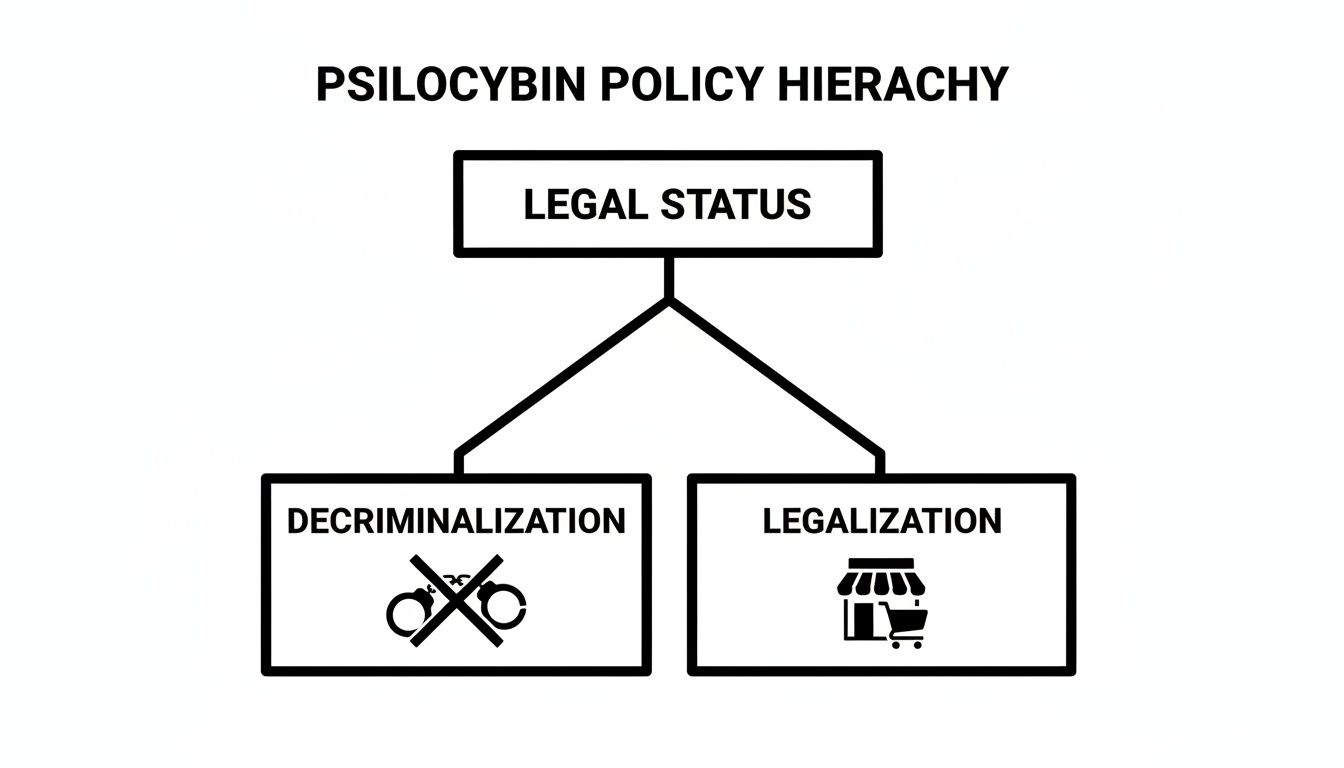
As you can see, the legal status of psilocybin is splitting into two very different policy directions: decriminalization and legalization, each offering a different level of regulated access.
Oregon: The Trailblazer
Oregon truly blazed the trail here, becoming the first state in the nation to create a regulated psilocybin program after voters passed Measure 109 back in 2020. This groundbreaking system, which officially kicked off in 2023, allows adults 21 and over to consume psilocybin in supervised settings.
Here’s a breakdown of the Oregon model:
- Licensed Service Centers: Psilocybin can only be consumed at state-licensed facilities, guided by a trained and licensed facilitator.
- No Prescription Needed: You don't need a medical diagnosis or a doctor's prescription. Any adult can participate after a prep session.
- Focus on Safety: The entire framework is built around safety, with strict rules for product testing, facilitator training, and client support.
What's really interesting is how Oregon's approach completely separates these services from the traditional medical system. It's a wellness model, designed to give people a supportive space for personal growth and exploration.
Colorado: The Natural Medicine Model
Colorado followed in Oregon's footsteps by passing Proposition 122 in 2022, also called the Natural Medicine Health Act. While it looks similar to Oregon’s program on the surface, Colorado's framework has some key differences and is expected to be up and running in 2025.
The Colorado model features:
- Supervised Use: Just like Oregon, it establishes "healing centers" where adults can access psilocybin services with trained facilitators.
- Personal Use Provisions: Here’s the big difference: the law also lets adults grow and share psilocybin mushrooms for their own personal use, which is a major departure from Oregon's more restrictive approach.
- Expanded Substances: The program is designed to potentially expand in the future to include other natural psychedelics like DMT, ibogaine, and mescaline.
Colorado’s framework really blends therapeutic access with personal freedom, creating a hybrid model that works for both supervised journeys and private use.
The Financial and Legislative Momentum
These pioneering moves by states haven't gone unnoticed by investors or market analysts. The shift toward regulated access has ignited serious economic interest, shaping financial forecasts and pushing for even more legislative action. As states build these structured frameworks, they are also laying the groundwork for what could become a multi-billion-dollar industry. Naturally, the question of where to buy psilocybin mushrooms is becoming more common as people try to navigate these new rules.
The global market for psychedelic mushrooms was projected to hit about $1.8 billion in 2025, with some analysts predicting it could grow to nearly $3.6 billion by 2032. A huge chunk of that growth is being driven by the expanding acceptance in North America, where progressive state laws and venture capital are pouring fuel on research and development. This financial buzz is being echoed in state capitols, with hundreds of city measures and state bills introduced between 2020 and 2025. A 2025 Connecticut bill, for example, proposed making possession of up to 14 grams a simple civil infraction.
States with Active Decriminalization Measures
While some states are busy building regulated systems from the ground up, others are taking a different first step: decriminalization. This approach is all about reducing the penalties for personal possession, essentially telling law enforcement to make psilocybin enforcement their lowest priority. It's often the first move a city or state makes on the long road to broader reform.
California: A City-Led Movement
California is the perfect example of a bottom-up reform movement. Psilocybin is still regulated at the state level, but several major cities have decided to take matters into their own hands.
- Oakland: In 2019, Oakland became one of the first cities in the U.S. to decriminalize entheogenic plants, including psilocybin mushrooms.
- Santa Cruz: Wasting no time, Santa Cruz followed Oakland's lead by passing a similar resolution.
- San Francisco: Voters here passed a measure in 2022 to decriminalize psychedelics.
These local actions have created pockets of decriminalization across California, even while statewide efforts have stalled.
Washington State: Deprioritization in Seattle
Much like in California, Washington's reform efforts have been concentrated at the city level. In 2021, the Seattle City Council passed a resolution making the investigation and enforcement related to people possessing or growing psychedelics the lowest enforcement priority for police.
This move puts Seattle right alongside other progressive cities that have decided to shift resources away from penalizing personal psychedelic use.
Michigan: The Ann Arbor Model
Ann Arbor, Michigan, has been a leader in drug policy reform for a long time. In 2020, its city council voted unanimously to decriminalize psychedelic plants and fungi. This resolution made the personal possession and cultivation of psilocybin the absolute lowest priority for local law enforcement.
As these state-by-state examples show, there’s no single path to psilocybin reform. From Oregon’s highly structured therapeutic system to the grassroots decriminalization movements in California's cities, each approach reflects a unique philosophy on how to best welcome these powerful substances back into modern society.
How Local Action is Driving National Trends

While groundbreaking state laws tend to grab all the headlines, the real engine of psilocybin policy reform started much closer to home—in city halls and at community meetings. The entire national conversation around magic mushroom legality owes its momentum to pioneering cities that decided to chart their own course.
This grassroots energy really started to build in 2019 when Denver, Colorado, became the first city in the U.S. to decriminalize psilocybin. That single vote sent ripples across the country, showing other communities that local action was a viable path forward. It was proof that activism and city council votes could create pockets of progressive policy, creating a varied landscape where the rules can change dramatically from one town to the next.
Instead of waiting for slow-moving state legislatures, local leaders are responding directly to what their communities want. This creates a hyper-local approach where knowing a specific city’s ordinance is just as important as knowing the state law.
What “Deprioritizing Enforcement” Actually Means
So, what happens when a city decriminalizes psilocybin? The most common tool they use is deprioritizing enforcement. This is just a formal way of telling local police departments to make pursuing people for personal possession of shrooms their lowest possible priority.
Think of it like this: a city decides to focus its traffic cops on major highways instead of quiet cul-de-sacs. The speed limit is technically the same everywhere, but they’re putting their resources where they feel it matters most for public safety. Deprioritization tells law enforcement to spend their time and budget on more pressing issues.
This is exactly the approach Seattle took. In 2021, its city council passed a resolution making personal possession and cultivation of psychedelic substances the lowest enforcement priority. The real-world effect is that residents are far less likely to face legal trouble for simple, personal use.
The Trailblazing Cities and Their Rules
The movement Denver started spread quickly. A wave of cities, each with its own unique vibe and political climate, followed suit. These early adopters became living case studies, showing how different communities could adapt the idea of decriminalization to fit their local needs.
Here are some of the key cities that helped shape this trend:
- Oakland, California: Hot on Denver's heels in 2019, Oakland's City Council voted to decriminalize all entheogenic plants, including psilocybin. Their ordinance was notably broad, reflecting a focus on cognitive liberty and traditional plant medicine.
- Santa Cruz, California: Following Oakland’s lead, Santa Cruz passed its own decriminalization resolution, helping solidify California's role as a hub of city-led reform.
- Ann Arbor, Michigan: In 2020, Ann Arbor's City Council unanimously voted to decriminalize a wide range of psychedelic plants. The city has a long history of progressive drug policies, so for them, this was a natural next step.
These local actions are far from symbolic. They have a real impact on residents and police, fundamentally changing the day-to-day reality of mushroom legality on the ground.
City-level decriminalization is the frontline of policy reform. These local initiatives often serve as testing grounds for ideas that eventually bubble up to influence statewide legislation. They can even inspire bigger moves, like when a governor signs a bill enabling the prescription of psychedelics after seeing how well local models have worked.
As more cities join this movement, they build a powerful case that these policies can be implemented successfully. This creates a feedback loop: local success stories encourage more cities to act, which in turn puts pressure on states to consider larger-scale reforms. The national trend we're seeing today was truly born in these forward-thinking communities.
A Global Perspective on Psilocybin Policy
While the state-by-state and city-by-city reforms across the United States are picking up steam, it’s important to remember this isn’t just an American story. The movement to rethink psilocybin mushroom legality is a global phenomenon. Countries all over the world are carving out their own unique paths, creating a fascinating and diverse international landscape.
Looking beyond our own borders gives us some much-needed context. These international models offer a glimpse into different regulatory frameworks and cultural attitudes that are shaping psilocybin access worldwide. From tightly controlled medical systems to long-standing traditional use, the global view shows just how many possibilities are on the table.
Regulated Medical and Commercial Models
Several nations have already put formal systems in place for accessing psilocybin, each with its own set of rules. Australia, for example, made a huge move in 2023 by allowing authorized psychiatrists to prescribe psilocybin for treatment-resistant depression. This approach puts psilocybin squarely in a clinical, medicalized framework.
Then you have the Netherlands, which offers a totally different, yet still regulated, model. There, you can legally buy psilocybin-containing "magic truffles" (sclerotia) in specialized smart shops. The system treats truffles as their own distinct product, allowing for an open and regulated commercial market with clear guidelines for consumers.
The global legal status of psilocybin mushrooms is highly heterogeneous, with a small number of countries permitting regulated medical use and a handful allowing open commercial activity. This patchwork has significant commercial and clinical consequences, with the global psychedelic mushrooms market estimated at around $1.8 billion in 2025. You can find more details on the varying global psilocybin policies on The Buena Vida.
Tolerant and Unregulated Environments
Beyond these formal systems, many regions simply have policies of tolerance or operate in a legal gray area. Jamaica is a classic example where psilocybin mushrooms were never designated as a restricted substance. This legal openness has allowed a thriving wellness retreat industry to flourish without any formal government oversight.
Spain is another interesting case. Personal cultivation and use are often tolerated thanks to interpretations of privacy laws. This has created a culture where private consumption is basically accepted, even without an official, state-approved market. It really goes to show how cultural norms can shape access just as much as the laws on the books.
- Australia: Medical access is granted only through psychiatrists for specific conditions.
- Netherlands: Magic truffles (not mushrooms) are sold commercially in regulated shops.
- Jamaica: An unregulated environment where mushroom retreats operate openly.
- Spain: A tolerant approach toward private cultivation and personal use.
This variety proves there’s no single "right" way to handle psilocybin policy. Each country's framework is a reflection of its unique history, culture, and public health priorities. As the conversation around psilocybin mushrooms keeps growing, these international examples will undoubtedly shape the future of policy here in the United States and around the world.
Frequently Asked Questions About Psilocybin Legality
Diving into the world of psilocybin mushrooms can bring up a lot of practical questions, especially when it comes to the law. With policies changing so quickly, it’s easy to get confused. Let's clear up some of the most common questions people have.
What Does Decriminalization Actually Mean for Me?
When a city decriminalizes psilocybin, it’s not giving you a green light—think of it more like a yellow one. It simply means that possessing a small, personal amount of mushrooms becomes the lowest priority for law enforcement.
Instead of facing serious charges, you might get something closer to a traffic ticket, like a small civil fine. But here’s the key thing to remember: this does not create a commercial market. Selling, manufacturing, or possessing large quantities fall outside these new, softer policies. Always look up the exact wording of your local laws to know where the lines are drawn.
Can I Access Psilocybin for Therapeutic Use?
Right now, getting psilocybin for therapy is only possible in a handful of states with highly regulated programs, like Oregon and Colorado. This isn't a situation where you can just get a prescription from your doctor and head to the pharmacy.
Instead, it’s a structured, intensive process. You have to go to a licensed service center and work with trained facilitators who guide you through preparation, the experience itself, and integration afterward. For every other state, this kind of therapeutic access is still just a conversation, though it's a topic that’s gaining a lot of traction in legislatures.
How Does Possession Differ in Various Places?
The rules for possessing psilocybin can change dramatically just by crossing a city or state line. How much you can have on you without getting into trouble varies a ton, even between places that have both embraced reform.
- In Decriminalized Cities: You can typically hold a small amount for personal use, but the exact quantity is often left vague. The spirit of the law is focused on personal consumption, not distribution.
- In States with Therapeutic Models: Possession is tied directly to the state-regulated program. Colorado’s model, for example, is unique because it allows for personal cultivation and even sharing, which is a world away from Oregon’s more controlled, clinical system.
Knowing these local differences is absolutely critical. What’s perfectly fine in one town could be treated very differently in the next. This is exactly why you have to stay plugged into what’s happening in your specific area.
How Can I Stay Current on Evolving Psilocybin Laws?
The legal landscape for psilocybin is constantly shifting, and staying on top of it requires a little effort. A great way to keep up is by following reputable advocacy groups that live and breathe this stuff. Organizations like the Multidisciplinary Association for Psychedelic Studies (MAPS) and local Decriminalize Nature chapters are always posting updates.
You can also keep an eye on your state's legislative websites to see what new bills are being debated. For anyone thinking about growing their own, our guide on growing psilocybin mushrooms at home offers some great insights that tie into understanding personal cultivation rules where they apply. And of course, local news outlets in states with active reform movements are often the first to report on the very latest changes.
At The Magic Mushroom Delivery, we are dedicated to providing both high-quality psilocybin products and the educational resources you need to use them responsibly. Explore our curated selection of mushroom chocolates, gummies, and more, all available for discreet, nationwide delivery. https://themagicmushroomdelivery.com