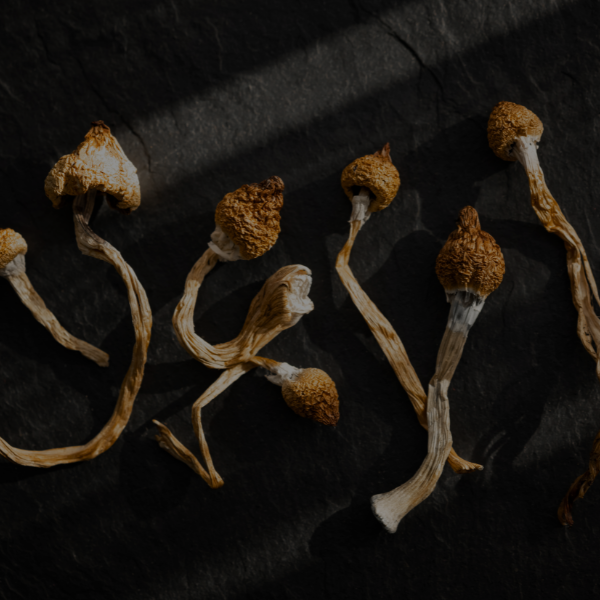

When you hear people talk about magic mushrooms, two names always pop up: psilocin and psilocybin. The difference is actually pretty simple. Psilocybin is the stable compound you find in the mushrooms themselves, but it's psilocin—the compound your body creates from it—that delivers the actual psychedelic effects.
Think of it this way: psilocybin is like a sealed envelope containing a message. The envelope itself doesn't tell you anything, but once you open it, you can read the message inside. Your body is what "opens the envelope," turning psilocybin into psilocin.
Your Guide to Psilocin and Psilocybin
Getting into the world of psychedelic mushrooms really starts with understanding these two key compounds. Though they're often mentioned in the same breath, psilocin and psilocybin play very different roles in your journey.
Psilocybin is what's known as a "prodrug"—a stable, inactive substance that mushrooms produce and store. It’s remarkably tough, which is why it stays intact in dried mushrooms for a long, long time.
But on its own, psilocybin does nothing. The real magic happens after you consume it. Your body's metabolism kicks in and converts the stable psilocybin into the active, psychoactive compound: psilocin. This transformation is the critical step that unlocks the whole experience.
The Foundation of Your Experience
This chemical relationship isn't just a cool science fact; it's practical knowledge that directly shapes what you feel. This conversion process influences several key parts of your trip:
- Onset Time: How fast your body turns psilocybin into psilocin dictates how quickly you start to feel the effects.
- Intensity: The efficiency of this conversion can impact the overall strength of your journey.
- Duration: How long psilocin stays active in your system determines the length of your experience.
This is the fundamental reason why different methods—like making tea versus eating raw mushrooms—can feel so different. Once you grasp how psilocybin and psilocin work together, you can make more informed choices for a journey that’s both predictable and positive.
Interest in these compounds is exploding. The psychedelic API market, which includes psilocybin and psilocin, was valued at USD 4.75 billion in 2025 and is expected to soar to USD 16.93 billion by 2034. The market segment for these two compounds alone is projected to grow at a staggering CAGR of 22% during that time.
Let's break down this fascinating process a bit more.
Psilocybin vs Psilocin At a Glance
To make it even clearer, here’s a quick side-by-side look at the two compounds. This table cuts right to the chase, highlighting the core differences so you can see exactly what sets them apart.
| Characteristic | Psilocybin (The Prodrug) | Psilocin (The Active Compound) |
|---|---|---|
| Role | Inactive precursor found in mushrooms | The psychoactive substance that causes the trip |
| Stability | Highly stable, survives drying and storage | Unstable, quickly degrades when exposed to oxygen |
| Psychoactivity | Not psychoactive on its own | Directly responsible for all psychedelic effects |
| How It Works | Converted into psilocin by the body's metabolism | Binds to serotonin receptors (5-HT2A) in the brain |
| Presence | Abundant in fresh and dried magic mushrooms | Created in the body after consumption; minimal in fungi |
As you can see, they are two sides of the same coin—one can't work without the other to create the experience.
This guide will walk you through everything from the molecular journey to practical dosing, giving you a solid foundation. And if you're curious about which mushrooms contain these powerful compounds, check out our guide on the different types of Psilocybe mushrooms.
The Chemical Journey from Mushroom to Mind
When you eat a magic mushroom, you’re kicking off a fascinating biological chain reaction. The mushroom itself is loaded with psilocybin, a remarkably stable compound that’s really just the opening act. Think of psilocybin as a securely locked package—it holds all the potential for the journey ahead, but it can't do anything on its own.
Your body is the key. The trip from the mushroom in your hand to the experience in your mind is a metabolic one, turning your digestive system into a tiny, highly efficient chemical lab. This natural process is what makes everything possible.
The Great Conversion: Psilocybin to Psilocin
The magic really starts the moment psilocybin hits your system. The intensely acidic environment of your stomach, along with some specialized enzymes, immediately gets to work on the psilocybin molecule. Their one job is to snip off a tiny, but absolutely critical, piece called a phosphate group.
This chemical makeover is called dephosphorylation. It sounds technical, but it’s a simple reaction that changes absolutely everything. By cleaving off that phosphate group, your body transforms the stable, inactive psilocybin into the star of the show: the psychoactive compound psilocin. This is the molecule that actually gets to work in your brain.
This visual breaks down that amazing transformation, showing how a stable molecule becomes the active one that fuels your experience.
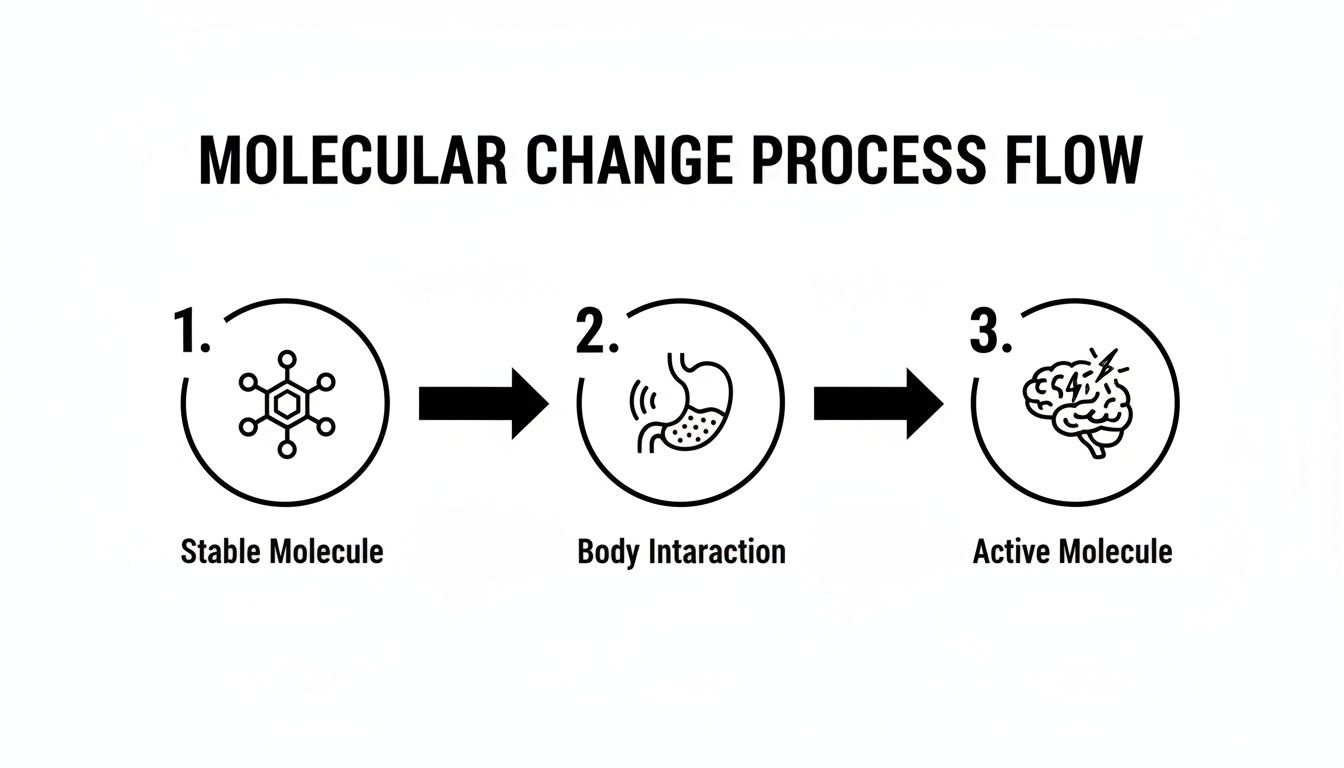
It’s a perfect illustration of how your body’s own metabolic functions are essential to unlocking the mushroom's potential, turning a dormant compound into a powerfully active one.
Unlocking the Brain’s Receptors
Once psilocin is created, it hitches a ride in your bloodstream, zips across the blood-brain barrier, and gets ready to interface with your neurological hardware. This is where the old "key in a lock" analogy really shines. Your brain is covered in countless receptors, each designed to fit specific neurotransmitters like a lock is designed for a specific key.
As it turns out, psilocin’s molecular shape is almost a dead ringer for serotonin, one of your brain's most important neurotransmitters for regulating mood, perception, and how you process thoughts. Because of this uncanny resemblance, psilocin slides perfectly into certain serotonin receptors—most importantly, the 5-HT2A receptor.
By binding to these receptors, psilocin essentially hijacks the brain’s serotonin system. This interaction is the direct trigger for the profound shifts in perception, thought, and emotion that define the psychedelic experience. It is the final, critical step in the journey from mushroom to mind.
The whole process is a beautifully simple, three-step dance:
- Consumption: You eat the mushroom, introducing stable psilocybin into your body.
- Conversion: Your digestive system's acids and enzymes strip away a phosphate group, converting psilocybin into active psilocin.
- Activation: Psilocin cruises into the brain and docks with serotonin 5-HT2A receptors, kicking off the psychedelic effects.
This elegant biological hand-off is how a simple fungus can create such deep and meaningful shifts in consciousness. Without this conversion, psilocybin would just pass right through you with no effect at all. It’s the creation of psilocin that makes the entire journey possible, turning a chemical potential into a deeply felt reality.
How This Chemistry Shapes Your Experience
Understanding the molecular dance between psilocybin and psilocin isn't just a science lesson—it's the key to knowing exactly what your journey will feel like. This conversion process is what maps out the entire experience, from the moment you start feeling something to the nature of the peak itself.
Think of it as a predictable arc. Knowing how things will unfold can make you feel more grounded and prepared, turning what might feel like an unknown into a manageable and familiar progression of stages.
The Three Stages of Your Journey
A psilocybin experience almost always unfolds in three distinct phases, each one directly tied to the concentration of psilocin in your brain. While everyone's trip is unique, this general timeline is a super helpful guide.
- The Onset (20-60 Minutes): This is when your body gets to work, converting psilocybin into psilocin. You’ll start to notice the first subtle shifts—maybe a light body feeling, a little giddiness, or just a sense of anticipation building.
- The Peak (2-4 Hours): Now the show really begins. Psilocin levels hit their max, binding to serotonin receptors and bringing on the full effects. This is the heart of the journey, where you'll experience the most noticeable changes in your perception, emotions, and thoughts.
- The Return (1-2 Hours): During this final phase, your body starts to clear the psilocin from your system. The intensity gently fades, often leaving you with a feeling of profound calm, clarity, and a chance to reflect on everything you just experienced.
Of course, this is all deeply personal, and your own body chemistry is a huge factor. To get a better sense of what's happening on a neurological level, check out our article on psilocybin effects on the brain.
How Your Consumption Method Changes the Timeline
The way you take your magic mushrooms can seriously change how quickly things start and how intense the ride is. The big difference comes down to how much of that psilocybin-to-psilocin conversion happens before it even hits your bloodstream.
Think of it like making coffee. You could chew on whole coffee beans and wait for your body to break them down, or you can grind them up and brew them. That brewed coffee hits you way faster because the active compounds are already extracted and ready to go.
It's the exact same principle with shrooms.
- Eating Dried Mushrooms: When you eat whole dried mushrooms, your digestive system has to do all the heavy lifting. First, it breaks down the tough mushroom material (called chitin) just to get to the psilocybin. This means a slower, more gradual come-up, usually taking 30-60 minutes or even longer.
- Drinking Mushroom Tea: Making tea kick-starts the extraction process for you. The hot water pulls the psilocybin out of the mushroom fibers, making it instantly available for your body to absorb. This leads to a much faster onset, sometimes in as little as 15-20 minutes.
Because tea gets the psilocin into your system so quickly, a lot of people find the experience feels more intense, but it might also have a slightly shorter duration than eating the mushrooms raw.
The Subjective Effects of Psilocin
Once psilocin gets to your brain and starts interacting with your serotonin receptors, it can kick off a whole spectrum of profound and meaningful effects. We can usually break them down into three main categories.
Perceptual Shifts:
- Visuals: Colors might seem to pop with incredible vibrancy. You could see intricate patterns emerge on surfaces, watch objects appear to gently "breathe," or notice tracers following lights.
- Sounds: Music often takes on a whole new dimension, feeling incredibly rich and emotional. Even everyday sounds can seem fascinating.
Emotional Shifts:
- Feelings: It’s common to feel waves of pure joy, a deep sense of connection to nature or other people, and a powerful sense of empathy.
- Introspection: Psilocin can also bring buried emotions to the surface, giving you a chance for some really deep self-reflection and personal insight.
Cognitive Shifts:
- Thought Patterns: Your thinking can become way more creative and fluid, letting you connect ideas in ways you never have before.
- Perspective: Many people talk about a feeling of "ego dissolution," where their usual sense of self fades away. This can lead to completely fresh perspectives on life, relationships, and personal challenges.
This incredible range of effects is exactly why psychedelic mushrooms are getting so much attention. Research shows Psilocybe species are projected to grab over 67% of the market share by 2026. A huge part of that is their potential for mental wellness, with applications for depression making up 45% of the revenue, as studies show psilocybin can tackle symptoms in hours, not weeks.
A Practical Guide to Potency and Dosing
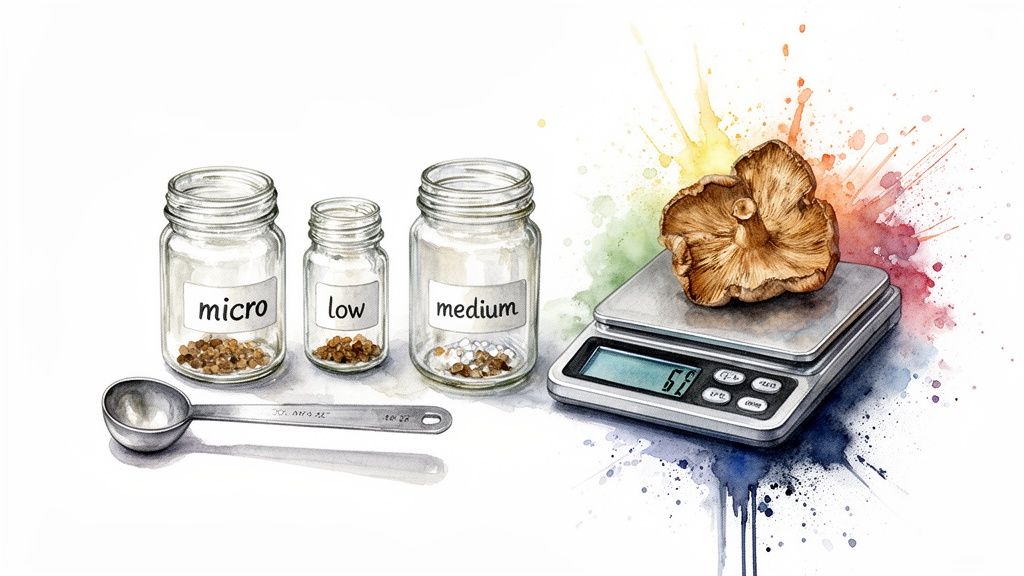
Figuring out potency is absolutely critical for having a predictable, positive experience with psilocybin. The concentration of these active compounds can be all over the map in raw mushrooms, influenced by everything from the specific strain and how it was grown to when it was harvested. Believe it or not, even the cap and stem of the very same mushroom can pack a different punch.
This natural inconsistency is a huge reason why so many people are turning to precisely dosed products. Things like our chocolates, gummies, and capsules are made to take the guesswork out of the equation, offering a much more reliable and consistent experience every single time.
Why Consistency Matters
When products are created with consistency as the top priority, you don't have to guess what you're getting into. The process usually involves grinding large batches of dried mushrooms into a super-fine, uniform powder. By homogenizing the raw material this way, any "hot spots" of high or low potency are completely evened out across the entire batch.
That standardized powder is then carefully measured and infused into each product, whether that’s a piece of chocolate or an individual capsule. This is how we ensure that every single serving contains a dependable and accurate amount of the good stuff.
Navigating Different Dosing Levels
Dosing is a deeply personal choice. The right amount for you depends entirely on your goals, your experience level, and your overall comfort. What sends one person on a profound journey might be a barely-there experience for someone else.
That said, there are some general dose ranges that can help you find your footing. These levels are usually tied to different intensities of experience, from subtle, mood-lifting enhancements to full-blown psychedelic explorations.
Remember the golden rule: start low and go slow. You can always take more on another day, but you can never take less once you've started. This simple approach lets you safely gauge your own sensitivity and discover what works perfectly for you.
For a much deeper dive into finding your ideal amount, check out our complete psilocybin dosage guide. Getting a handle on these guidelines is the best way to make informed decisions that align with what you want out of the experience.
General Dosing Guide for Psilocybe Cubensis
To give you a clearer picture of how dose relates to effect, here’s a general framework based on dried Psilocybe cubensis, one of the most common and beloved species out there. It’s important to see this as a starting point, not a strict set of rules—everyone’s body and mind will react a little differently.
| Dose Level | Typical Dried Mushroom Amount (grams) | Expected Experience |
|---|---|---|
| Microdose | 0.1 – 0.3 grams | Sub-perceptual effects. Designed to boost mood, creativity, and focus without any noticeable psychedelic feelings. |
| Low Dose | 0.5 – 1.5 grams | Mild euphoria, brighter senses, and some light visual alterations. Often called a "recreational" or introductory dose. |
| Moderate Dose | 1.5 – 3.0 grams | A full psychedelic experience with clear visual patterns, deeper introspection, and significant shifts in emotion. |
| High Dose | 3.0 – 5.0+ grams | An incredibly intense and immersive journey. Often involves strong ego dissolution, profound insights, and mystical-type experiences. |
Starting with a low or moderate dose is the standard path for anyone new to mushrooms or just trying a new product. It’s the smart way to get familiar with the effects in a controlled and comfortable way. Ultimately, the goal is always to create a safe, positive, and meaningful journey, and thoughtful dosing is the first—and most critical—step in getting there.
Cultivating a Safe and Positive Mindset
The chemical journey of psilocin and psilocybin is only half the story. The other, equally crucial part, is the psychological foundation you build before you even begin. A positive, insightful trip isn’t just about what you take; it’s built on a bedrock of safety, intention, and mental preparedness.
This is where the concepts of ‘set and setting’ come in. Think of them as the two pillars supporting your entire experience. They aren't just casual suggestions—they're essential ingredients for a responsible and deeply rewarding journey.

Crafting Your Ideal Setting
Your ‘setting’ is your physical environment, and its importance is impossible to overstate. The ideal setting is one where you feel completely safe, comfortable, and free from any potential interruptions or outside stress.
Think about these key elements when choosing your space:
- Familiarity: Stick to a place you know well, like your own home or a quiet, secluded spot in nature. Unfamiliar environments can sometimes create a background hum of unease.
- Comfort: Make sure the space is physically cozy. We’re talking soft blankets, plenty of pillows, and a comfortable temperature.
- Privacy: You need to be sure you won’t be disturbed. Turn off your phone and let trusted friends or family know you'll be offline for a few hours.
A thoughtfully chosen setting acts as a stable anchor, giving you the freedom to explore your inner world with confidence and peace of mind.
Nurturing a Positive Mindset
Your ‘set,’ or mindset, is the internal landscape you bring with you. This covers your mood, your thoughts, and your intentions for the experience. Walking into a journey with a positive, open, and curious mindset can completely shape its direction.
An intention isn’t a rigid goal but more of a gentle guide for your experience. It could be as simple as, "I want to feel more connected," or "I am open to whatever comes up." This simple act can add a powerful layer of purpose and focus to your journey.
Take some time before your experience to just relax and clear your head. Things like meditation, listening to calming music, or spending a little time in nature can help you feel grounded and centered. A calm mind is a receptive mind.
The interest in these experiences is growing fast. In the broader psychedelic space, psilocybin is projected to claim a massive 40% market share by 2035, which really highlights its prominence. By 2023, over 100,000 North Americans had turned to psilocybin for support, with an incredible 60% reporting relief from symptoms of depression and anxiety. You can learn more about what’s driving this growth in the psychedelic drugs market.
Navigating Challenging Moments
Even with the best preparation, difficult thoughts or feelings of anxiety can sometimes bubble up. This is a totally normal part of the process and can often lead to some of the most significant personal breakthroughs. The key is to approach these moments with curiosity rather than resistance.
If you start to feel overwhelmed, try these simple grounding techniques:
- Focus on Your Breath: Close your eyes and take slow, deep breaths. This simple act can calm your nervous system right down and bring you back to the present moment.
- Change Your Scenery: If you can, just moving to a different room or stepping outside for some fresh air can make a huge difference. A simple change in your environment can shift your entire perspective.
- Listen to Calming Music: Have a playlist of peaceful, instrumental music ready to go. Sound can be an incredibly powerful tool for guiding your emotional state.
These moments aren't something to be feared. Instead, think of them as opportunities for growth and self-discovery. By being mindful of your personal health history and preparing a supportive environment, you empower yourself to have a safe and profoundly meaningful experience with psilocin and psilocybin.
Answers to Your Burning Questions
Dipping your toes into the world of psilocybin mushrooms naturally brings up a lot of questions. We get it. To help you feel confident and ready for your journey, we’ve put together some straightforward answers to the most common things people ask about psilocin and psilocybin.
Think of this as your friendly guide. We're cutting through the complex science to give you the practical knowledge you need to make the best choices for your experience.
So, Which One Actually Gets You High?
This is the big one, and the answer is surprisingly simple: psilocin is the compound that actually creates the psychedelic experience. Psilocybin is just its precursor, what's known as a 'prodrug.'
When you consume magic mushrooms, you're mostly ingesting the stable psilocybin. But your body has to convert it into psilocin before anything happens. So, while psilocybin is the passenger, it’s the psilocin that gets behind the wheel and takes you on the journey.
Why Do Some Products Kick In Faster Than Others?
The time it takes to start feeling the effects—the onset—is all about how quickly your body can make that psilocybin-to-psilocin conversion and get it into your system. The form you take makes a world of difference.
- Whole Dried Mushrooms: When you munch on dried shrooms, your stomach first has to break down all that tough plant fiber. Only then can it start the conversion process. This takes a while.
- Teas and Extracts: With something like a mushroom tea or a liquid extract, the psilocybin is already freed up and ready to go. This gives your body a huge head start on absorption and conversion, meaning a much faster onset.
- Edibles: Goodies like chocolates or gummies are often the sweet spot. They usually provide a more consistent and predictable come-up than raw mushrooms.
At the end of the day, the more work your body has to do to get to the psilocybin, the longer you'll be waiting.
The key takeaway is that the faster your body can create and absorb psilocin, the quicker the experience will begin. This is a core principle behind the formulation of different mushroom products.
Can You Ever Know the Exact Potency of a Mushroom?
Honestly, with raw, natural mushrooms, it's always going to be a bit of a guessing game. The potency can swing wildly depending on the mushroom's specific strain, how it was grown, when it was harvested, and even which part of the mushroom you eat.
This natural inconsistency is exactly why professionally made products like our chocolates, gummies, and capsules are so valuable. They are created from homogenized mushroom material, which means the active compounds are spread perfectly evenly. This process guarantees a standardized, reliable dose in every single piece, taking all the guesswork out of the equation for you.
Are the Caps Really Stronger Than the Stems?
This is an age-old debate in the mushroom community. You'll hear plenty of stories from people swearing that the caps hit harder than the stems. But what does the science say?
Most lab analyses show that both psilocin and psilocybin are spread pretty evenly throughout the entire mushroom. While one mushroom might be stronger than its neighbor, the difference between its own cap and stem is usually tiny. If you're looking for surefire consistency, professionally crafted and dosed products are always the most dependable choice.
Ready to explore with confidence? At The Magic Mushroom Delivery, we offer a curated selection of premium, consistently dosed mushroom products to ensure a safe and positive journey. Find the perfect fit for your needs by visiting us at https://themagicmushroomdelivery.com.