If you're just dipping your toes into the world of magic mushrooms, one of the first questions you'll likely ask is a simple one: which ones are the strongest? You’ll hear names like Psilocybe azurescens or the legendary Penis Envy strain thrown around as top contenders, but the real story of potency is a bit more complex than just a name.
It’s all about what’s inside the mushroom, specifically the concentration of its psychoactive compounds.
What Makes a Mushroom Potent
Think of it like comparing different kinds of coffee. A tiny shot of espresso can pack a much bigger punch than a large, watered-down Americano. It's not about how much you drink, but how much caffeine is packed into every drop. The strength of a mushroom works the same way; it all comes down to its unique chemical makeup.
The psychedelic experience from mushrooms is powered by two main compounds: psilocybin and psilocin. These are the active ingredients that give each mushroom its unique character and intensity. Psilocybin is the primary, more stable compound found in the mushroom, which your body then converts into the directly psychoactive psilocin after you’ve ingested it.
This chemical duo is what causes the profound shifts in perception, thought, and emotion that define a psychedelic journey. The more of these alkaloids a mushroom has, the more potent it is.
The Role of Psilocybin and Psilocin
While psilocybin and psilocin work as a team, they have slightly different jobs.
- Psilocybin: This is the main event, but it works behind the scenes as a "prodrug." It’s stable and acts like a reservoir of potential psychoactive effects waiting to be unlocked.
- Psilocin: This is the star of the show. Once your body metabolizes psilocybin, it turns into psilocin, which then gets to work interacting with serotonin receptors in the brain to produce the trip.
Some mushrooms naturally contain more raw psilocin, which can mean the effects come on a little faster. The catch is that psilocin is far less stable and breaks down quickly when exposed to heat or oxygen. That’s actually why you see that characteristic blue bruising on many potent mushrooms—it's the psilocin oxidizing.
At the end of the day, a mushroom's potency is just a measure of its total psychoactive alkaloid content. A higher percentage of psilocybin and psilocin per gram means you need a much smaller dose to get where you want to go. Knowing this is key to having a predictable and safe experience.
Potency Is a Spectrum
Here's something critical to remember: potency isn't a fixed number. It’s a spectrum. Even within the same species or strain, the strength can vary significantly from one mushroom to the next.
Things like genetics, the specific conditions they were grown in, and how they were harvested and stored all have a huge impact on the final concentration of these powerful compounds.
For example, you could have two Golden Teacher mushrooms from the exact same batch, and one could be noticeably stronger than the other. This natural variability is precisely why it’s always smart to start with a low dose, especially when you’re trying a new variety. Getting a handle on what makes a mushroom potent is the first real step toward navigating your journey with confidence and respect.
Exploring the Most Potent Wild Species
While growers have cooked up some seriously impressive strains, Mother Nature is still the original master chemist. If you venture into the right forests and grasslands across the globe, you'll find wild mushroom species packing astonishingly high levels of psilocybin. These are the titans of the psychedelic world, revered by seasoned enthusiasts for their profound and powerful effects.
For many, the hunt for the most potent mushroom begins and ends with Psilocybe azurescens. This legendary species holds a special status, thanks to its consistently high concentration of psychoactive alkaloids. It sets a high bar that few other mushrooms can reach, making it the benchmark for extreme potency.
Understanding the differences between these wild powerhouses is key. Not all magic mushrooms are created equal, and potency exists on a wide spectrum from mildly active to incredibly strong.
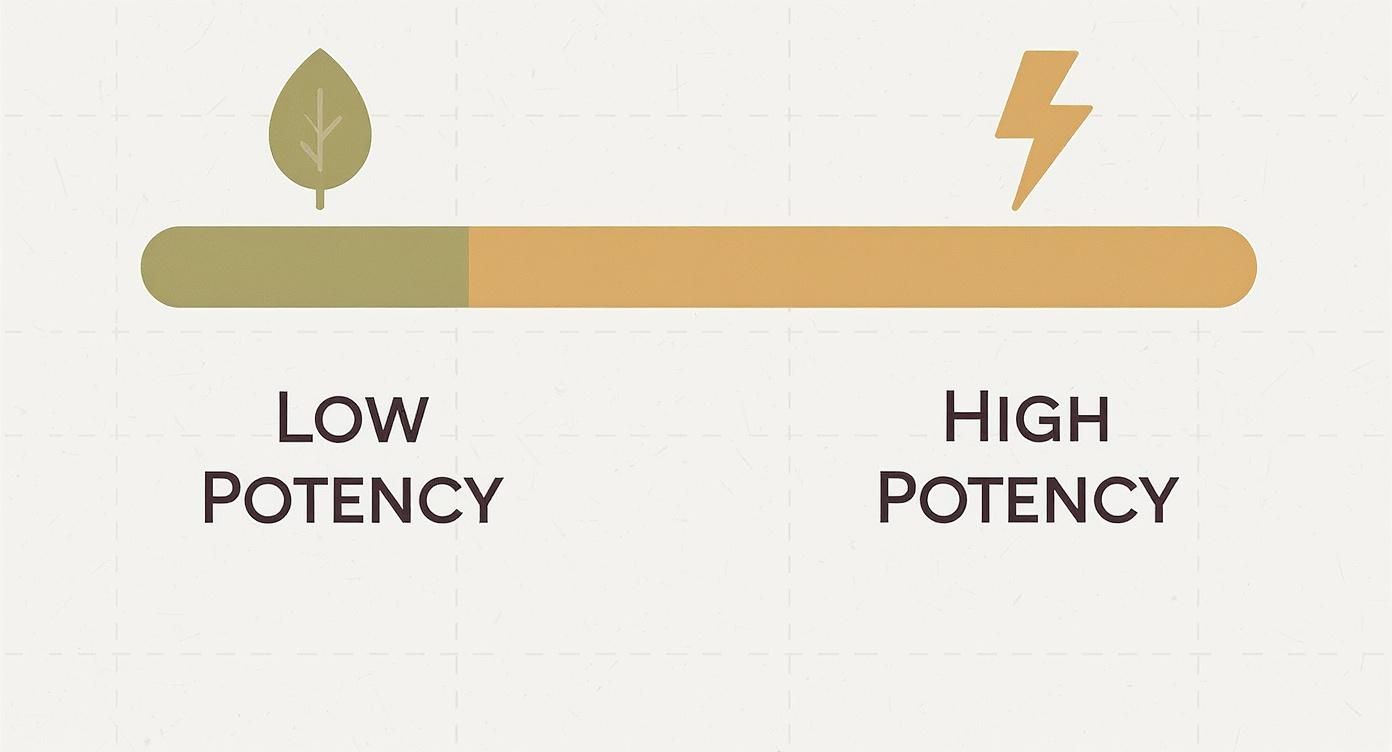
This just goes to show that potency isn't an on-or-off switch. It’s a vast range, and a few special species sit way out on the far end of the scale.
To get a clearer picture of how these top-tier wild species stack up, here’s a quick comparison of the heavy hitters. This table lays out their typical alkaloid content and where you might find them growing naturally.
Comparing the Most Potent Mushroom Species
| Species Name | Typical Psilocybin % (Dry Weight) | Psilocin % (Dry Weight) | Natural Habitat |
|---|---|---|---|
| Psilocybe azurescens | Up to 1.78% | Up to 0.38% | Pacific Northwest (USA) |
| Psilocybe cyanescens | 0.85% – 1.68% | 0.28% – 0.51% | Widespread (PNW, Europe, NZ) |
| Psilocybe bohemica | Up to 1.34% | Up to 0.11% | Central Europe |
| Psilocybe semilanceata | Around 1.0% | Trace amounts | Temperate grasslands (Global) |
As you can see, the percentages can vary quite a bit, but these species consistently rank among the most powerful found in the wild, each with its own unique chemical signature.
The Undisputed Champion: Psilocybe Azurescens
Often nicknamed "Azzies" or "Flying Saucers" because of their unique caramel-colored, saucer-like caps, Psilocybe azurescens are found almost exclusively along the northern coast of Oregon and southern Washington. They love popping up in dune grasses and on decaying wood, where they often form dense, impressive clusters.
What truly sets them apart is their chemical profile. While the widely cultivated Psilocybe cubensis typically contains between 0.5% and 1.0% psilocybin, P. azurescens blows it out of the water, with samples containing up to a staggering 1.78% psilocybin by dry weight. To learn more about the diverse world of psilocybin-containing fungi, you can discover more about psilocybin mushroom species on Wikipedia.
Because of this extreme concentration, a dose of P. azurescens can be significantly smaller than what you’d take of more common mushrooms. Experienced users report that this species produces intensely visual and deeply profound spiritual journeys, demanding respect and careful preparation.
The Wavy Cap Contender: Psilocybe Cyanescens
Hot on the heels of azurescens is another wood-loving species known for its distinctive wavy cap: Psilocybe cyanescens. Commonly called "Wavy Caps," these mushrooms are much more widespread. You can find them across the Pacific Northwest, the East Coast of the United States, Central Europe, and even parts of Australia and New Zealand.
They're incredibly adaptive and often show up in urban environments, colonizing wood chips used in landscaping and garden beds. This knack for city living has made them one of the more common, yet incredibly powerful, wild psilocybin mushrooms out there.
Their potency is formidable, and they almost always pack a bigger punch than most cultivated P. cubensis strains. Key things to know about P. cyanescens include:
- Appearance: They have caramel-to-chestnut brown caps that become wavy and rippled as they get older.
- Habitat: They grow almost exclusively on lignin-rich materials like wood chips, mulch, and decaying hardwood.
- Potency: Known for delivering powerful visual experiences and a strong sense of connection with nature.
- Bruising: They show a very strong blue bruising reaction when handled—a dead giveaway of their high psilocin content.
This mix of accessibility and strength makes "Wavy Caps" a favorite among foragers, but be warned: their look-alikes require expert identification skills to ensure safety.
Central Europe's Potent Treasure: Psilocybe Bohemica
Journeying over to Central Europe, we find Psilocybe bohemica, another one of the most potent mushrooms growing in the wild. First identified in what is now the Czech Republic, this species is a close relative of Psilocybe serbica and shares its love for decaying wood in forests.
P. bohemica might be less famous than its American cousins, but it's no less powerful. It contains significant levels of both psilocybin and psilocin, which often results in a fast-acting and intense experience. Foragers typically find these mushrooms growing in both deciduous and coniferous woods during the autumn months.
Like other potent wild species, P. bohemica demands a cautious approach. Its strength makes precise dosing critical for safely navigating the deep, and often transformative, experiences it can provide. These wild species are a powerful reminder that nature has produced its own class of incredibly potent fungi, each with a unique personality and habitat.
The Power of Cultivated Mushroom Strains
Wild species like Psilocybe azurescens might be nature's heavy hitters, but human ingenuity has completely changed the game. Through dedicated cultivation, we've dramatically expanded the world of potent mushrooms. Within the incredibly popular Psilocybe cubensis species, a few special strains have been bred to pack a punch that leaves their common cousins in the dust.
Think of it like the difference between a wild wolf and a dog bred for a specific purpose. The wolf is powerful, no doubt, but selective breeding gives us dogs with amplified traits. In the same way, mycologists have isolated and stabilized mushroom genetics to consistently pump out higher levels of psychoactive compounds.
The result is a fascinating scene where the strain name can be just as crucial as the species name. And among these cultivated titans, one name always rises to the top: Penis Envy.
The Legend of Penis Envy
The Penis Envy (PE) strain is the undisputed king of potent Psilocybe cubensis. Its origin is the stuff of mycological lore, a story wrapped up with legendary figures and a special specimen supposedly found deep in the Amazon rainforest. Through years of careful cultivation, this unique genetic mutation was stabilized, giving us a mushroom totally unlike any other cubensis.
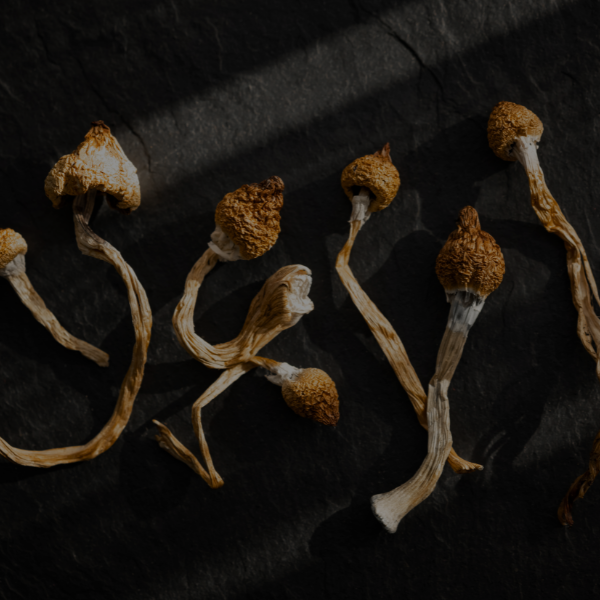
You can spot a PE right away. It has a thick, dense stipe (the stem) and a bulbous, underdeveloped cap that doesn't always open fully, giving it that memorable phallic look. But its appearance isn't its claim to fame—its chemistry is. Lab tests consistently find that the Penis Envy family has way higher concentrations of psilocybin and psilocin, often 1.5 to 2 times stronger than common strains like Golden Teacher.
Why so strong? The leading theory is its slow growth cycle. The mushroom takes its sweet time maturing before it drops its spores, which seems to give it more time to produce those active compounds.
The Penis Envy experience is often described as more intensely visual, euphoric, and profound than other cubensis strains. Because of its strength, a standard dose of PE is typically much smaller than what you'd take of another variety.
The Potent Penis Envy Family
The wild success and popularity of the original PE inspired cultivators to create a whole family tree of offshoots. Each one has its own quirks, but they all share that signature potency.
Some of the most well-known PE variants include:
- Albino Penis Envy (APE): Often considered even more potent than the original, APE is a hybrid of Penis Envy and PF Albino. It has a ghostly white appearance and is known for delivering an exceptionally powerful, immersive experience.
- Uncut Penis Envy (UPE): You'll recognize this one by its distinct caps that seem to stick to the stipe, often with a dark blue or black color. They are notoriously strong and respected by even the most seasoned psychonauts.
- Melmac: Believed to be a variation of the original Penis Envy genetics, Melmac (or Homestead PE) has a more alien-like, contorted look. It absolutely maintains the high potency levels the PE name is known for.
Other High-Strength Cultivated Strains
While the Penis Envy family tends to steal the spotlight, cultivators have developed other exceptionally strong varieties that absolutely deserve recognition. These strains prove that incredible strength isn't limited to just one genetic line. The community is always experimenting, so new and powerful options are always on the horizon. Our guide to Psilocybe cubensis strains gives you a much broader look at all the diversity out there.
Two other cultivated strains that consistently test high for potency are Tidal Wave and Enigma.
Tidal Wave: The Record Holder
Tidal Wave is a cross between two absolute fan favorites: Penis Envy and B+. This hybrid was created specifically to blend the raw power of PE with the resilience and easy-to-grow nature of B+. The result was a massive success.
In 2021, a specific culture of Tidal Wave produced a mushroom that clocked in with a staggering total alkaloid content of over 3.8% at the Psilocybin Cup. It's a stunning achievement that shows just how much potential is locked away in cultivated mushroom genetics.
Enigma: The Mysterious Mutation
Enigma isn't what you'd typically picture when you think of a mushroom. It's a blob-like mutation of Psilocybe cubensis that doesn't grow caps or produce spores. Instead, it forms a dense, brain-like cluster of mycelium that is incredibly potent.
Because it can't reproduce with spores, Enigma can only be passed along through cloning, making it a rare and highly sought-after variety. Its strange growth pattern and exceptional strength make it a true novelty, valued for its intense and long-lasting effects. The work of dedicated growers has truly opened up a new frontier of potency within a single, versatile species.
How Scientists Measure Mushroom Potency
When someone says one mushroom is "stronger" than another, it's not just a feeling or a guess. Potency is a measurable science, and these days, anecdotal reports are being backed up by hard data from sophisticated lab analysis.
This process takes the guesswork out of the equation. Think of it like a nutritionist breaking down a meal into its exact protein and calorie content instead of just calling it "filling." Scientists do the same thing for mushrooms, but they're hunting for the specific psychoactive compounds that create the magic.
The gold standard for this kind of work is a technique called High-Performance Liquid Chromatography, or HPLC. This powerful tool is basically a molecular sorting machine that can separate and identify all the different chemical components inside a mushroom sample.
Unpacking The Science Of HPLC
Imagine you made a smoothie with a bunch of different berries and spinach, and you wanted to know exactly how much of each ingredient was in there. HPLC works on a similar principle, just on a microscopic level.
A dissolved sample of the mushroom is pushed through a specialized column under extremely high pressure. As it travels through, different compounds—like psilocybin and psilocin—move at different speeds based on their unique chemical properties. Detectors at the end of the column measure what comes out and when, creating a precise chemical "fingerprint" of that mushroom. This is how chemists can tell you the exact percentage of each active alkaloid.
This scientific precision allows us to make objective, apples-to-apples comparisons. A lab report can definitively show that a particular Penis Envy mushroom contains 1.2% psilocybin, while a Golden Teacher from the same batch might only have 0.7%.
Understanding Total Alkaloid Content
While psilocybin and its more immediate cousin, psilocin, get most of the attention, they aren't the only compounds contributing to the experience. A mushroom's true potential is often better understood by looking at its Total Alkaloid Content. This includes other minor but influential alkaloids like baeocystin and norbaeocystin.
- Synergistic Effects: Many in the community believe these other compounds work in harmony to subtly shape the trip. It's a concept similar to the "entourage effect" you hear about with cannabis, where the whole is greater than the sum of its parts.
- Comprehensive Measurement: Looking at the total alkaloid content gives you a much fuller picture of a mushroom's strength than just focusing on psilocybin alone. For those interested in highly concentrated forms, learning about psilocybin mushroom extract offers a great look into how these compounds are isolated for maximum effect.
- Community Science: This data-driven approach isn't just for academics anymore. Community-led events like the Psilocybin Cup use HPLC testing to rank samples submitted by growers from all over.
These initiatives are building an incredible public database, helping everyone from cultivators to casual users understand which genetic lines consistently produce the most potent mushrooms. This blend of grassroots participation and scientific rigor is completely changing the game, empowering everyone with the knowledge to make better, more informed choices.
What Influences a Mushroom's Strength
A mushroom's potency isn't set in stone. Think of it like grapes from the same vine—one year, the soil and weather might produce an award-winning wine, and the next, something entirely different. It’s the same with magic mushrooms. Their ultimate strength is a cocktail of genetics, environment, and how they’re handled after harvest.
This means two mushrooms, even from the exact same strain, can pack a wildly different punch. It all comes down to how they were grown, when they were picked, and the care taken to preserve them. Understanding what goes into this process is the key to spotting a quality product and making sure it stays that way.
The Role of Genetics and Cultivation
It all begins with the genetic blueprint. Strains like Penis Envy have a reputation for a reason; they are genetically wired to produce high levels of psilocybin. But having the potential and actually reaching it are two different things. That’s where the art of cultivation comes in.
The substrate—the stuff the mushrooms grow on—is their food source. A nutrient-dense substrate is like rich, fertile soil, giving the mushroom everything it needs to synthesize those psychoactive compounds. A mushroom grown on a weak substrate is like a plant stuck in poor soil; it’ll never live up to its full potential.
Beyond just food, the entire growing environment has a massive say in the final product.
- Temperature and Humidity: You have to get the climate just right. Mushrooms have sweet spots for temperature and humidity at each stage of life, and a good grower dials these in to encourage strong, potent growth.
- Fresh Air Exchange (FAE): Mushrooms breathe, just like us. They take in oxygen and push out CO2. Without enough fresh air, that CO2 builds up and can lead to sad, stunted, and less-powerful mushrooms.
- Light Conditions: While they don’t photosynthesize like plants, specific light cues are what tell mushrooms it's time to start growing (a process called "pinning") and help them develop properly.
Think of a master cultivator as a boutique winemaker. They pick the best varietal (genetics), plant it in the perfect terroir (substrate), and meticulously control the climate to coax out every last drop of flavor and character.
Harvest Timing and Preservation Methods
Even if you nail the genetics and grow conditions, all that hard work can be undone with a poorly timed harvest or sloppy storage. The moment of harvest is especially critical. Experts believe that the concentration of active compounds hits its absolute peak just before the veil—that thin little membrane under the cap—tears open.
Harvest too soon, and the mushroom might not have finished producing its alkaloids. Wait too long, and the potency can dip slightly by weight as the mushroom dumps its spores and continues to grow larger.
Once they're picked, the clock is ticking. Psilocin, in particular, is incredibly fragile. It breaks down fast when it’s exposed to heat, oxygen, or light. This is why proper drying and storage are completely non-negotiable if you want to preserve the mushroom’s power.
Effective Preservation Techniques:
- Drying: The mission is to get all the moisture out as fast as possible without blasting them with heat. A food dehydrator on a low setting is the gold standard, leaving you with "cracker dry" mushrooms that snap when you bend them. Just leaving them out to air-dry is a recipe for potency loss.
- Storage: Once they're perfectly dry, they need to be sealed off from the elements. The best move is an airtight container, like a mason jar, with a food-grade desiccant pack thrown in to suck up any lingering moisture.
- Environment: That sealed jar then needs to live somewhere cool, dark, and dry. A closet or a pantry drawer is perfect. Leaving it out on a counter where it gets sunlight or temperature swings is a great way to ruin your stash.
By controlling every variable, from the first spore to the final sealed jar, a cultivator can ensure a mushroom not only reaches its genetic potential but holds onto it.
Dosing Guidelines for Potent Mushrooms
With great potency comes the need for great care. Let's be clear: navigating the world of high-strength mushrooms requires a completely different mindset than you’d use for more common varieties. The core principle is simple but absolutely essential: start low, and go slow. This isn't just a catchy phrase; it's the foundation for a safe, positive, and meaningful experience.
Jumping in with a "standard" dose of something like Penis Envy is not the same as taking a typical dose of a milder strain like Golden Teacher. Not even close. A 2-gram dose of Penis Envy could easily feel as intense as 3 or 4 grams of Golden Teachers. That huge difference in strength makes a cautious, measured approach non-negotiable.
Understanding Dosage Tiers
To build a framework for your journey, it helps to know the general dosage tiers. But think of these as starting points, not strict rules. Your individual sensitivity, metabolism, and even your mood on a given day play a massive role in how you'll respond.
Microdose (0.1g – 0.3g): This is sub-perceptual, meaning you shouldn't feel any overt psychedelic effects. The idea is for it to work in the background, potentially boosting creativity, mood, and focus without getting in the way of your day.
Low Dose (0.5g – 1.0g): Often called a "museum dose," this amount can bring on mild euphoria, sharper senses, and a gentle shift in how you see the world. It’s a fantastic entry point for beginners or for anyone wanting a lighter experience.
Moderate Dose (1.0g – 2.5g): This is where you'll start to see more noticeable psychedelic effects—visual patterns, deeper introspection, and significant changes in your thought processes. This is a common dose for a full psychedelic journey.
High Dose (2.5g+): Reserved for experienced psychonauts in a safe, controlled setting. This level can lead to profound, mystical experiences, ego dissolution, and intense visual and auditory hallucinations.
When dealing with the heavy hitters, you have to adjust these tiers downward. A moderate dose of Psilocybe azurescens or Albino Penis Envy might be closer to 1.0 gram or even less. Using a precise tool can help take the guesswork out of it; our magic mushroom calculator is designed to give you a more accurate starting point.
Essential Harm Reduction Principles
Knowing your dose is only half the battle. Creating a safe and supportive environment is just as critical for a positive outcome. This is where the vital principles of harm reduction come into play, helping you prepare your mind and your space for the journey ahead.
A respectful approach to potent mushrooms isn't just about what you take—it’s about how, where, and why you take it. Preparation is the key that unlocks the door to a constructive and insightful experience.
Your mindset ("set") and your physical environment ("setting") are the two most important factors you can control. A calm, curious, and open mindset will serve you far better than one filled with anxiety or fear. Likewise, a comfortable, private, and familiar setting is ideal—a place where you won't be interrupted.
Finally, never underestimate the benefit of a trip sitter. This is a trusted, sober friend who can provide reassurance and support if you feel overwhelmed. Their calm presence can be an invaluable anchor, allowing you to explore your consciousness with a greater sense of security and peace.
Got Questions About Potent Shrooms? We've Got Answers
When you start digging into the world of high-potency mushrooms, it’s natural for a bunch of questions to pop up. Think of this as your go-to spot for clear, straight-up answers to the things people wonder about most. We want to make sure you feel totally confident in understanding what makes these mushrooms pack such a punch.
Is Penis Envy Really the Strongest Strain Out There?
This is a classic question, and for good reason. Penis Envy has a legendary reputation, and it's well-deserved. When you compare it to other Psilocybe cubensis varieties, PE is consistently a powerhouse, often testing 1.5 to 2 times stronger than beloved standards like Golden Teacher. Its funky genetics are just wired to produce more of the good stuff.
But here’s the twist: if you zoom out to include wild mushroom species, the picture changes. Mother Nature has her own heavy hitters, like Psilocybe azurescens, which can naturally blow even Penis Envy out of the water in terms of psilocybin concentration. So, while PE is definitely the king of the cubensis castle, it’s not the single strongest mushroom on the planet.
How Much Do Drying and Storing Actually Affect Potency?
This is a big one, and the answer is: a lot. Getting the drying and storage process right is absolutely critical if you want to preserve the magic. One of the key active compounds, psilocin, is incredibly fragile. It starts breaking down the second it's exposed to heat, light, or oxygen, and that breakdown directly torpedoes the mushroom's strength.
The gold standard for preservation? Use a food dehydrator on a low-heat setting until your mushrooms are bone dry—we’re talking “cracker dry,” where they snap cleanly. From there, stash them in an airtight container (like a mason jar) with a desiccant pack to suck up any moisture. Keep that jar in a cool, dark place, and you'll lock in their power for a long, long time. Honestly, improper storage is the number one killer of potency.
Quick reminder: Oxygen, heat, and light are the enemies of potency. Protect your mushrooms from these three things, and you'll preserve their magic.
Can You Tell How Strong a Mushroom Is Just by Looking at It?
It's tempting to think so, but it's not a reliable method. You've probably heard that the blue bruising on a mushroom can be a clue. There's some truth to that—the blue color is a chemical reaction that happens when psilocin meets oxygen. So, in theory, heavy bruising might suggest a higher concentration of active compounds.
However, this is just a rough hint, not a scientific measurement. You should never use bruising to make a dosing decision. Two mushrooms can look completely identical but have wildly different strengths because of their unique genetics and the environment they grew in. Appearance alone is never a safe way to judge how potent a mushroom is.
At The Magic Mushroom Delivery, we take the guesswork out of the equation. All our products are lab-tested for quality and consistency, so you know exactly what you're getting. Ready to explore? Check out our curated selection of potent and reliable mushroom varieties, delivered right to your door.