
Recent research is shedding light on lion's mane for depression, suggesting it could be a powerful natural ally for mental wellness. While it's certainly not a replacement for clinical treatment, the evidence is growing, pointing to its fascinating potential to support the very brain pathways tied to our mood and thinking.
Lion's Mane and the Search for Mental Wellness
In the quest for better mental health support, more and more people are looking toward nature. And one of the most talked-about fungi in this space is Lion's Mane (Hericium erinaceus). It’s that weird, shaggy-looking mushroom that has been a staple in traditional Asian medicine for centuries.
For ages, it's been respected for boosting cognitive and neurological health. Now, modern science is finally catching up and seriously exploring its potential as a tool for helping manage symptoms of depression.
This isn't just based on ancient wisdom, either. A major 2021 Penn State study looked at over 24,000 U.S. adults and found a solid link between eating mushrooms in general and having lower odds of depression. Researchers believe a powerful antioxidant in mushrooms called ergothioneine might be the hero here, helping shield our brain cells from stress. You can read more about their findings on the Penn State Health News website. This kind of large-scale research helps build the scientific case for digging deeper into how specific mushrooms, like Lion's Mane, really work.
Your Brain's Gardeners
So, what’s Lion’s Mane’s secret sauce? It comes down to two unique compounds you won’t find just anywhere: hericenones and erinacines.
Think of them as dedicated gardeners for your brain. They are believed to kickstart the production of two crucial proteins: Nerve Growth Factor (NGF) and Brain-Derived Neurotrophic Factor (BDNF). These proteins are like fertilizer for your neurons—they help them survive, grow, and stay in top condition.
A healthy, well-maintained neural network is absolutely vital for stable moods. When these brain pathways are strong and resilient, so are you. The idea that a natural fungus could help "tend the garden" in our heads is exactly why the connection between lion's mane and depression is getting so much buzz.
Instead of just masking symptoms, Lion's Mane appears to work on a foundational level by supporting the brain's actual physical structure and function. The goal is to build long-term neurological resilience, which is a cornerstone of lasting mental wellness.
To give you a quick snapshot of what we're talking about, here's a simple breakdown of how Lion's Mane fits into the conversation around mood support.
Lion's Mane for Depression At a Glance
The table below summarizes the core concepts, giving you a quick reference for how this functional mushroom is thought to support mental well-being.
| Aspect | Summary | Relevance to Depression |
|---|---|---|
| Key Compounds | Hericenones and erinacines are the primary bioactive components. | Believed to stimulate NGF and BDNF, promoting neuron growth and brain plasticity. |
| Primary Mechanism | Neurotrophic effects (supporting neuron growth) and anti-inflammatory action. | May help repair neural pathways and reduce brain inflammation linked to mood disorders. |
| Scientific Evidence | Promising but still emerging, with human studies showing mood improvement. | Research points toward reduced depression scores and increased BDNF levels in some trials. |
| Practical Use | Available as powders, capsules, and tinctures, with doses varying by product. | Offers accessible options for integrating into a daily wellness routine alongside other therapies. |
Ultimately, this is about understanding the potential of Lion's Mane not as a magic bullet, but as one piece of a holistic approach to taking care of your brain and mind.
How Lion's Mane Influences Brain Health and Mood
To get why lion's mane and depression are even in the same conversation, we need to peek under the hood at what's happening in the brain. This mushroom isn't about slapping a band-aid on your feelings. Instead, the science suggests it may work on a deeper level, addressing some of the biological roots of mood disorders.
The research points to three main ways lion's mane might offer support.
First, and what it's most famous for, is its potential to encourage neurogenesis—the actual creation of new brain cells. This is a huge deal for brain plasticity, which is your brain’s ability to rewire itself, learn, and heal. A brain that can adapt is a brain that's resilient, and that's the foundation of solid mental health.
Second, there's growing evidence linking chronic inflammation in the brain to depressive symptoms. Lion's Mane is packed with compounds that have anti-inflammatory properties, which might help dial down that "inflammatory noise." And finally, its influence may even touch the neurotransmitters, the chemical messengers that literally dictate how we feel.
Boosting Your Brain's Natural Fertilizer
Think of your brain's massive network of neurons like an intricate garden. For that garden to really flourish, it needs the right kind of nourishment to grow strong roots and forge new connections. Lion's Mane is thought to stimulate two key proteins that act like a super-fertilizer for this neural garden.
- Nerve Growth Factor (NGF): This protein is vital for keeping existing neurons alive, healthy, and well-maintained. It's like the master gardener, making sure all the current plants are thriving.
- Brain-Derived Neurotrophic Factor (BDNF): This one is the growth engine. BDNF is a powerhouse when it comes to sprouting new neurons and the synapses that connect them. Higher levels of BDNF are consistently linked to better mood and sharper thinking.
Interestingly, people dealing with depression often show consistently low levels of BDNF. By potentially ramping up the production of these "neurotrophic factors," Lion's Mane may help reinforce your neural pathways, making the brain tougher against the biological fallout from stress and mood issues. It’s like helping your brain’s garden thrive, even when the weather is rough.
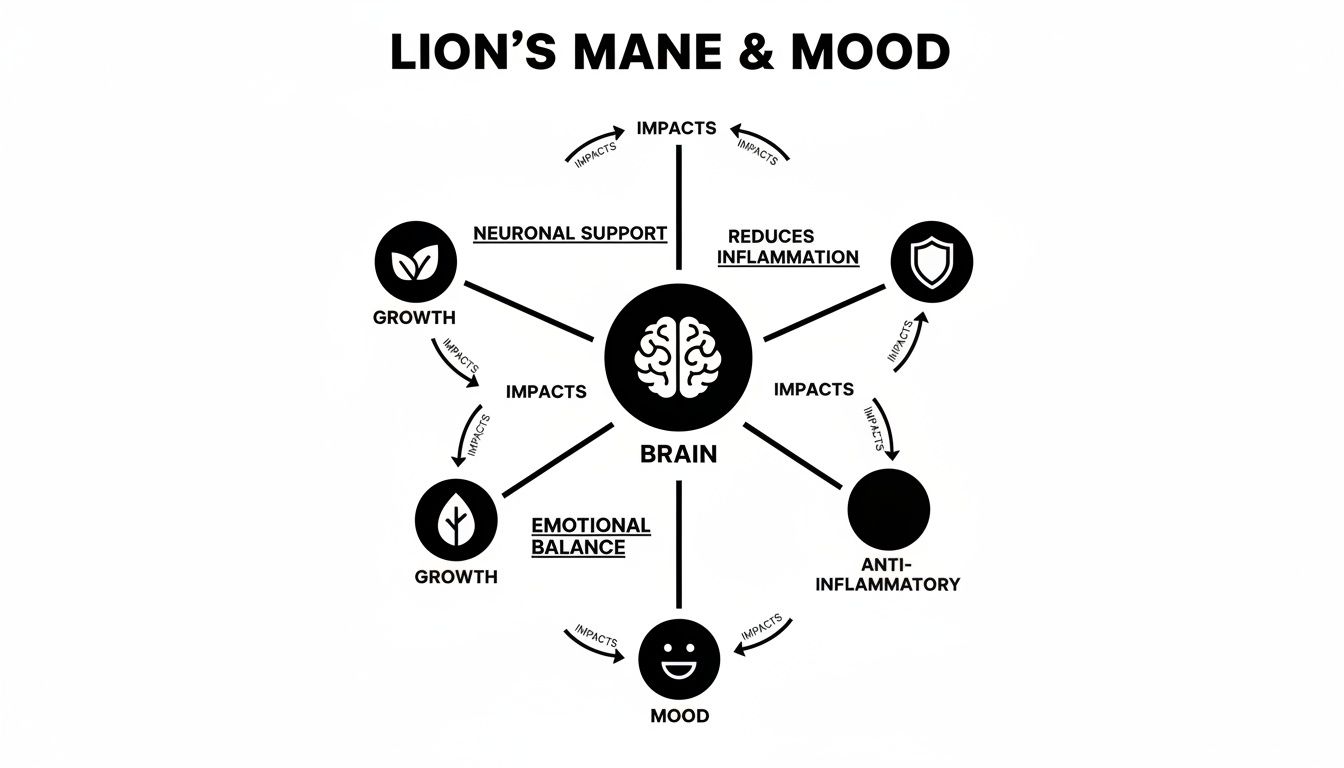
This visual really sums it up: Lion's Mane seems to come at the problem from multiple angles, supporting brain cell growth, calming inflammation, and potentially fine-tuning the chemical pathways that regulate mood.
Calming Brain Inflammation
For the longest time, the conversation around depression was all about chemical imbalances. But a newer, more complete picture is emerging—the "inflammatory hypothesis of depression." This theory suggests that chronic, low-grade inflammation in the brain is a major player.
Imagine it like static on an old radio. When inflammation is high, it can garble the communication between brain cells, messing with everything from mood regulation to your energy levels. Things like chronic stress, a poor diet, or illness can all crank up this inflammation.
Lion's Mane happens to be loaded with antioxidant and anti-inflammatory compounds. Early studies show it can help knock down inflammatory markers like tumor necrosis factor-alpha (TNF-α). By lowering this systemic inflammation, Lion's Mane could help clear that static, allowing for cleaner, more stable brain function.
This anti-inflammatory action is a key reason why Lion's Mane is seen as more than just a nootropic. It addresses a fundamental biological stressor that is increasingly linked to the development and persistence of depressive symptoms.
This fits perfectly with a more holistic view of mental health that recognizes the powerful connection between the mind and body. Tending to physical inflammation can have a real, positive impact on how you feel mentally and emotionally. While Lion's Mane is getting a lot of attention for mood, you can explore the wider benefits of functional mushrooms in our detailed guide.
Supporting Your Mood's Chemical Messengers
Finally, let's talk about the brain's chemical communication network. Neurotransmitters like serotonin and dopamine are the couriers carrying signals related to happiness, motivation, and emotional stability. It's well-established that when this system is out of whack, it's a major factor in depression.
While the research in humans is still catching up, animal studies have given us some exciting clues. This research suggests that certain compounds in Lion's Mane, like erinacine A, may help balance the levels of these critical neurotransmitters.
Here’s a quick rundown of who’s who:
- Serotonin: Often called the "happy chemical," it's essential for feelings of well-being.
- Dopamine: This is your "feel-good" neurotransmitter, tied to reward, motivation, and pleasure.
- Noradrenaline: This one is involved in the "fight or flight" response, but it also plays a big part in focus and mood.
By helping to support the healthy function of the hippocampus—a part of the brain crucial for memory and emotional regulation—Lion's Mane may foster a more balanced chemical environment. This early evidence suggests the mushroom could support mood from multiple angles, both by nurturing the brain's physical structure and by fine-tuning its delicate chemical orchestra.
What Does the Research Say About Lion's Mane and Depression?
All the biological theories are fascinating, but what really matters is the bottom line: does taking lion's mane for depression actually help in the real world?
The science here is still in its early days, but what we've seen so far is definitely encouraging. A growing body of research, spanning both animal and human studies, points toward a genuine, positive impact on mood.
It's important to keep a level head when looking at this research. The evidence is promising, no doubt, and gives scientists a great launching point for future studies. That said, many of the current studies are on the smaller side, and we're still piecing together the full picture.
Let's walk through what the science has uncovered so far, hitting the key findings while being honest about their limitations. This way, you get a clear, no-hype view of where things stand today.
Human Trials and Mood Improvements
The most exciting evidence always comes from studies involving people. While we're still waiting for large-scale clinical trials, the research we have offers some valuable clues into how lion's mane might ease symptoms of depression, anxiety, and stress.
A standout study from 2019 gave us some of the strongest evidence to date. This clinical trial specifically looked at lion's mane's effects on depression and anxiety in overweight or obese individuals—a group often at a higher risk for mood disorders.
Over an eight-week period, the participants taking the mushroom supplement showed significant improvements on standard depression and anxiety scales. Even better, researchers found that their levels of circulating pro-BDNF, the precursor to that brain-boosting BDNF protein, had also increased. You can read the full research about these mood-enhancing findings.
This direct link between better mood scores and a measurable biological change like pro-BDNF is a huge piece of the puzzle. It suggests the benefits aren't just in people's heads; they're rooted in the very neurotrophic processes we talked about earlier.
The real power of this study is how it connects a biological change (more pro-BDNF) with a psychological outcome (less depression). It shifts the conversation from theory to tangible evidence, showing Lion's Mane can influence the brain's "fertilizer" system in a way that truly impacts mood.
Other, smaller human trials have echoed these positive results. For example, a 2010 study with 30 women found that just four weeks of taking lion's mane helped reduce feelings of depression and anxiety. While the group was small, the results were statistically significant and added another layer of support for its mood-boosting potential.
Stress Reduction as a Key Factor
We all know chronic stress is a fast track to depression. When your body is stuck in "fight or flight" mode, it wears down your neural circuits and burns through the chemicals you need for a stable mood. So, it stands to reason that anything that helps manage stress could indirectly help with depression.
Recent pilot studies have started digging into this angle, exploring how lion's mane affects healthy people under stress.
- Feeling Less Stressed: A 2023 study had healthy young adults take lion's mane for 28 days. The big takeaway? Participants reported significantly lower subjective stress scores compared to the placebo group.
- Thinking Clearer Under Pressure: Other research has shown that lion's mane can improve cognitive performance—things like working memory and reaction time—just a few hours after taking it. This hints that it may help the brain stay sharp and efficient, even when you're feeling the pressure.
- A Brighter Outlook: That same study also noted a boost in participants' self-reported feelings of happiness over a two-hour period after taking the supplement.
These findings are important because they frame lion's mane as more than just a potential remedy for existing depression. It could be a tool for building resilience against stress in the first place, helping the mind and body adapt to daily pressures before they snowball.
Animal Studies and Mechanistic Clues
While human trials give us real-world data, animal studies let scientists peek under the hood to see how lion's mane might be working its magic inside the brain. This research has been critical for connecting the dots.
In numerous studies on mice, researchers have consistently seen lion's mane extract kickstart the production of BDNF and cool down key inflammatory markers like TNF-alpha. This lines up perfectly with the neurotrophic and anti-inflammatory theories.
What's more, animal models of depression show that lion's mane can help rebalance key neurotransmitters like serotonin, dopamine, and noradrenaline, especially in the hippocampus. Since the hippocampus is a major hub for emotion and memory, this is a really big deal.
Of course, we have to remember that findings in mice don't always translate perfectly to humans. But what they do provide is a strong scientific foundation for the positive effects seen in people. They confirm that the compounds in lion's mane are biologically active and capable of influencing the exact brain systems tied to depression.
How to Choose and Use Lion's Mane Supplements
With all the buzz around using lion's mane for depression, stepping into the supplement aisle can feel like a pop quiz you didn't study for. The shelves are packed with different products, each promising to be the best. Understanding what makes them different is your first step to finding a quality supplement that actually fits into your life.
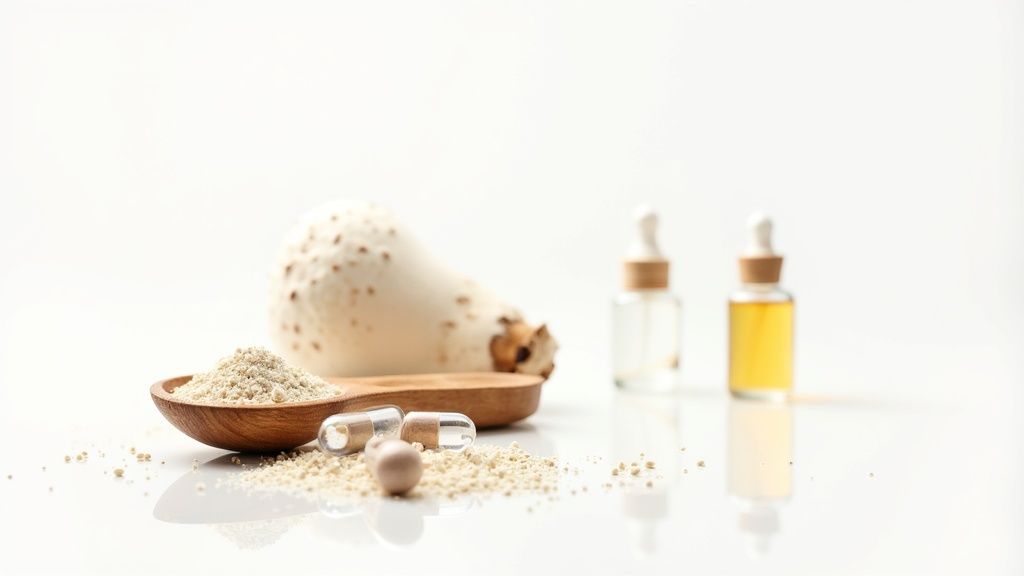
You’ll find powders to mix into your morning coffee, easy-to-swallow capsules, and potent liquid tinctures. The "best" choice really just comes down to what you prefer and what you'll actually stick with. Consistency is everything here, as the benefits of Lion's Mane seem to build up over time.
Decoding Supplement Forms
Let's be clear: not all Lion's Mane supplements are created equal. The form you pick can make a real difference in how well your body absorbs the good stuff and how easy it is to keep up with.
To help you sort through the options, here's a quick rundown of the most common forms you'll find.
Comparing Lion's Mane Supplement Forms
Navigating the world of Lion's Mane can be tricky with all the different forms available. This table breaks down the pros and cons of capsules, powders, and tinctures to help you figure out which one is the right fit for your routine and wellness goals.
| Supplement Form | Pros | Cons | Best For |
|---|---|---|---|
| Capsules | Totally convenient for on-the-go use, pre-measured, and tasteless. | Can have lower bioavailability if not made with a high-quality extract. | Anyone looking for simplicity and a precise, no-fuss dose every time. |
| Powders | Super versatile for mixing into coffee, tea, or smoothies. Often the most budget-friendly option. | Can have an earthy taste you might not love. You have to measure out each dose. | People who enjoy making wellness drinks and want total control over their dosage. |
| Tinctures | Highly concentrated and absorbed super fast when taken under the tongue (sublingually). | Alcohol-based versions can taste pretty strong. Dosing means carefully counting drops. | Those who want the fastest absorption and a potent, easy-to-digest formula. |
Choosing a format you can stick with is the real secret to success. If you know you're not going to blend a powder into a smoothie every single morning, a simple capsule might be the practical choice that keeps you on track.
What to Look for on the Label
Okay, so you've picked a form. Now comes the important part: vetting the actual product. A supplement's label holds all the clues you need to figure out its purity and strength. Don't just grab the first bottle you see—a little detective work will pay off big time.
Here are the key quality markers to hunt for:
- Fruiting Body vs. Mycelium: The fruiting body is the mushroom you'd see growing, and it's packed with beta-glucans. The mycelium is the root system, which has its own unique compounds like erinacines. A good product will tell you exactly what's inside. Many experts prefer supplements made from the fruiting body because it has a higher concentration of the key active ingredients.
- Extraction Method: Look for a dual-extraction process, which uses both hot water and alcohol. This is the only way to pull out the full spectrum of goodies—both the water-soluble beta-glucans and the alcohol-soluble triterpenes.
- Third-Party Testing: This is a non-negotiable. Reputable brands send their stuff to independent labs to prove it's pure and potent. Look for a Certificate of Analysis (COA) that confirms the product is clean from heavy metals and has the amount of beta-glucans it claims.
- Beta-Glucan Content: Don't just look at the total mushroom content. Find the specific percentage of beta-glucans (e.g., ">25% Beta-Glucans"). This number is a direct measure of the supplement's potency and how effective it's likely to be.
Reading a supplement label is just like reading a food's nutrition facts. It gives you the power to make a smart choice based on quality, ensuring you get the active compounds you're actually paying for.
Finding Your Ideal Dosage
There’s no magic, one-size-fits-all dose for Lion's Mane. The right amount for you can depend on the supplement's concentration, the form you're taking, and your own body chemistry. The clinical studies looking at lion's mane for depression have used a pretty wide range, typically somewhere between 500 mg and 3,000 mg of extract per day.
The golden rule is simple: start low and go slow. Begin with the lowest dose recommended on the product label and stick with it for a few weeks to see how you feel. You can slowly increase it from there if you think you need to, but always stay within the manufacturer's suggested range.
Most importantly, always talk to a healthcare professional before you start any new supplement. This is especially true if you have existing health conditions or are taking other medications. A doctor can give you personalized advice to help you add Lion's Mane to your wellness plan safely. For a wider view of what's out there, you can explore our guide to the best functional mushroom supplements to compare products and see what might work for you.
What About Safety and Potential Interactions?
When you're looking into any natural supplement for your mental well-being, especially something like lion's mane for depression, safety should always be top of mind. The good news? Lion's Mane has a fantastic track record. Most people tolerate it extremely well, with very few reporting side effects. It's not some new fad; it's been used for centuries as both a food and a traditional medicine without raising major safety flags.
This long history of safe use is also backed up by modern research. For instance, a 2023 pilot study had healthy young adults take Lion's Mane every day for 28 days. The result? They reported feeling less stressed, and importantly, there were no significant adverse events. This just reinforces its gentle nature, even in a controlled clinical setting. If you're curious, you can dig into the safety findings in the full study.
Common Side Effects Are Minor
For the tiny fraction of people who do notice something, the side effects are usually quite mild and often related to digestion. You can think of it like trying a new type of food for the first time—sometimes your system just needs a moment to get acquainted.
The most commonly mentioned issues are:
- Mild digestive upset: Some people might feel a bit of stomach discomfort or bloating, particularly when they first start taking it.
- Skin irritation: This one is rare, but a few cases of itchy skin or a mild rash have been noted, which could point to an allergic sensitivity.
Again, these effects are uncommon and usually fade as your body adjusts. A good strategy is to start with a lower dose to let your body acclimate, which can help sidestep any potential digestive weirdness.
Interactions with Antidepressants and Other Medications
Okay, this is where being smart and cautious really counts. You absolutely need to involve a professional. While there are no widely reported, severe interactions between Lion's Mane and common antidepressants like SSRIs, the potential for them to influence each other exists, at least in theory.
Here's why: Lion's Mane may have an effect on neurotransmitter systems and inflammation pathways. Since many medications work along these same routes, there's a theoretical chance it could change how your body responds to them. This isn't a red flag telling you to stop, but it is a bright yellow sign telling you to proceed with care.
Always talk to your doctor before adding Lion's Mane—or any new supplement—to your regimen if you are on prescription medication. Your doctor has the full picture of your health and can give you personalized advice to make sure your plan is both safe and effective.
Think of your doctor as the head coach of your health team. Keeping them in the loop ensures all the players in your wellness plan are working together, not against each other. This simple conversation is the single most important step you can take to use lion's mane for depression safely, ensuring it supports, rather than interferes with, your overall treatment.
Building a Holistic Plan for Mental Wellness

Thinking about using lion's mane for depression is a great move toward exploring natural support, but it’s crucial to see it for what it is: one tool in a much larger wellness toolbox. This mushroom isn't a magic bullet or a standalone cure. Real, lasting mental well-being is built on a foundation of consistent, healthy habits. Supplements are meant to complement that essential groundwork, not replace it.
Think of your mental health like a garden. Lion's mane can be a special kind of fertilizer, helping to nurture the soil and strengthen the roots. But that garden still needs the non-negotiables—sunlight, water, and regular weeding—to truly flourish. Without those basics, even the best fertilizer can only do so much.
Pillars of a Strong Mental Health Foundation
The smartest approach is to integrate a supplement like lion's mane into a broader strategy that addresses your mind, body, and lifestyle. This creates a powerful synergy where every positive choice you make supports the others.
Here are the key pillars to focus on:
- Professional Support: Working with a licensed therapist gives you invaluable tools for navigating your thoughts and emotions. This is foundational.
- Mindfulness Practices: Things like meditation or simple deep breathing exercises can help regulate your nervous system and dial down stress.
- Consistent Exercise: Physical activity is a proven mood-booster. It gets endorphins flowing and helps reduce inflammation throughout the body.
- Quality Sleep: Deep, restorative sleep is absolutely non-negotiable for brain health and emotional stability.
- Nutrient-Dense Diet: A balanced diet packed with whole foods provides the essential building blocks your brain needs to function at its best.
Weaving lion's mane into this framework allows it to support the biological pathways you're already strengthening through healthy living. It’s all about building a complete, responsible system for your mental wellness.
Knowing When to Seek Professional Help
While supplements and lifestyle changes are powerful allies, they do have their limits. It is critical to recognize when professional medical help is necessary. If you're dealing with a persistent low mood, a loss of interest in things you used to enjoy, or are having thoughts of self-harm, please reach out to a doctor or mental health professional right away.
These experts can provide a clinical diagnosis and create a treatment plan that's tailored specifically to you. Taking that step is the single most important thing you can do on your wellness journey. For those exploring other natural options to manage daily stressors, you might also find value in learning about mushroom gummies for anxiety as another piece of a well-rounded plan.
Your Questions About Lion's Mane, Answered
As you start looking into lion's mane for depression, it's totally normal for questions to pop up. Getting clear, straight-up answers is the best way to feel good about adding this functional mushroom to your routine. Let's tackle the most common ones with practical, no-fluff info.
How Long Does Lion's Mane Take to Work?
Patience is the name of the game when you start with lion's mane. This isn't like popping a pain reliever. Its effects on mood are gradual, building up over time as it goes to work supporting your brain's deep-down neurotrophic and anti-inflammatory systems.
Based on what we've seen in clinical studies, most people start to feel subtle shifts in mood and mental clarity after four to eight weeks of taking it every day. But remember, everyone's different. Your own body chemistry, the quality of the supplement you choose, and your dosage all play a role. Think of it as cumulative support, not an overnight fix.
Can I Take Lion's Mane With My Antidepressant?
This is a big one, and it's a question for a professional. You absolutely must consult your doctor before mixing any new supplement with prescription meds, especially antidepressants like SSRIs.
While there aren't widespread reports of major negative interactions, the theoretical risk is there. Lion’s mane might influence neurotransmitter levels and inflammation—the very same systems many antidepressants target. A medical pro can help you navigate this safely and make sure your entire treatment plan is working together, not against itself.
Your doctor's guidance is non-negotiable here. They have the full picture of your health and can give you personalized advice to sidestep any potential problems, ensuring your approach to mental wellness is both safe and effective.
What Is the Difference Between Fruiting Body and Mycelium?
Knowing the different parts of the mushroom helps you pick a better product. Each part offers its own unique compounds that contribute to the mushroom's overall benefits.
- Fruiting Body: This is the shaggy, visible part of the mushroom you'd see growing on a tree. It's packed with beta-glucans, which are famous for their immune-supporting and anti-inflammatory power.
- Mycelium: Think of this as the root system, an intricate web that grows under the surface. It contains unique compounds called erinacines, which are thought to be potent stimulators of Nerve Growth Factor (NGF).
A high-quality supplement will be upfront about which parts it uses. Many top-tier products focus on the fruiting body for that beta-glucan content, while others will include mycelium to offer a wider spectrum of the mushroom's active compounds.
Is Lion's Mane a Psychedelic Mushroom?
Absolutely not. Lion's mane is a functional and culinary mushroom, putting it in a completely different category from psychedelic varieties. It does not contain psilocybin or any other psychoactive compounds.
That means it won't get you "high," mess with your perception, or trigger a psychedelic experience. Its benefits are all about supporting your brain's health and function, with zero intoxicating effects.
Ready to explore the potential of functional mushrooms? At The Magic Mushroom Delivery, we offer a curated selection of high-quality mushroom products designed to support your wellness journey. Discover our collection and find the right fit for your routine. Start your journey with us today.