
So, you're wondering how long psilocybin hangs around in your system? It’s a common question. The short answer is that your body processes it pretty quickly, often making it undetectable in a standard urine test within just 24 to 48 hours. But as with most things, the real answer is a bit more nuanced and depends on the test being used and a few things about you.
Psilocybin Detection: A Quick Overview
Here's the most important thing to get your head around: when you get tested, they're not actually looking for psilocybin. Instead, drug tests are designed to find its active metabolite, psilocin. Once you consume magic mushrooms, your body gets to work and rapidly converts the psilocybin into psilocin—that’s the compound that produces the psychedelic effects.
Because your system is so efficient at breaking down and flushing out psilocin, its presence is surprisingly brief. This makes psilocybin one of the faster-clearing substances out there, especially when compared to others. The detection window can change dramatically depending on the testing method. Some tests are way more sensitive and can look further back in time than others. A blood test might only catch it for a few hours, while a hair follicle test could theoretically see it for months.
Psilocybin Detection Windows By Test Type
To really see the difference, it helps to lay out the timelines for each common test type. The method of testing is easily the biggest factor that determines how long psilocybin’s traces can be found.
Here’s a simple breakdown of what to expect from each test:
| Test Type | Typical Detection Window | Notes |
|---|---|---|
| Urine Test | 24 – 48 hours | This is the most common method, but psilocin clears out of urine quickly. |
| Blood Test | Up to 12 hours | Used much less often because the detection window is incredibly short. |
| Hair Follicle Test | Up to 90 days | Offers the longest detection window by far, but these tests are very rare for psilocybin. |
It's crucial to remember that these are just general estimates. We’re all different, and personal factors like your metabolism, the dosage you took, and how often you use shrooms can definitely shorten or extend these timeframes.
With these basics covered, you've got a solid foundation for understanding how this all works. Keep in mind, the time it takes for your body to clear the substance is a totally different thing from the duration of the trip itself. If you're curious about that, you might want to check out our guide on how long do shrooms last, which breaks down the entire experience from onset to comedown.
Next up, let's take a closer look at the metabolic journey psilocybin takes as it moves through your body.
The Metabolic Journey Of Psilocybin
To really wrap your head around how long shrooms stay in your system, you have to follow their path through the body. Think of it like a highly efficient processing plant. The moment you consume magic mushrooms, the journey begins with a crucial chemical hand-off.
The main compound you hear about, psilocybin, isn't actually what gets the party started. Once it hits your digestive system, your body's enzymes rapidly convert it into its active form, psilocin. This process is surprisingly quick, which is why you can often start feeling the effects within 30 to 60 minutes. Curious about how different methods affect this? Our guide on how to consume magic mushrooms breaks it all down.
From Psilocin To Elimination
Once psilocin is circulating in your bloodstream, the liver steps up to the plate. It acts as the central hub, breaking down the compound into smaller, inactive bits (metabolites) that your body can easily filter out. This rapid breakdown is the whole reason the detection window is so short.
The best way to understand this speed is through the concept of half-life. Simply put, a substance's half-life is the time it takes for your body to get rid of half of it.
Psilocin’s half-life is incredibly short, meaning your body clears it out with impressive speed. This is exactly why standard urine and blood tests have such a brief window to catch it.
This infographic gives you a quick visual breakdown of the common detection methods and how long they're effective.
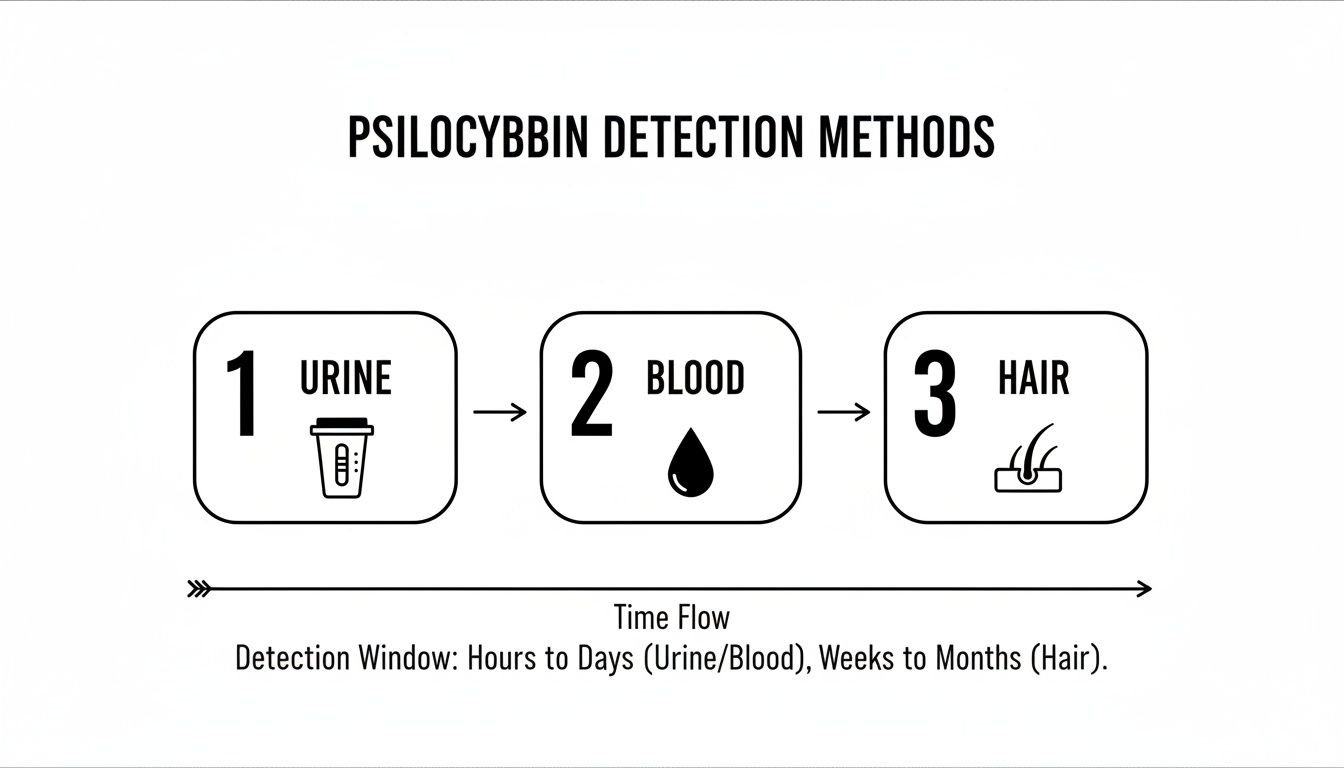
As you can see, hair follicle tests hang on to the evidence the longest, while blood and urine tests are a much shorter affair.
The Science Of A Short Half-Life
So why does psilocin make such a quick exit? It all comes down to its chemical structure and how efficiently your liver goes to work on it. Scientific research on its pharmacokinetics paints a very clear picture of this rapid-fire elimination.
Psilocin's half-life typically ranges from just 1 to 3 hours. Let that sink in. After only an hour, about 50% of the psilocin is already gone. Within 4 to 6 hours, almost all of the active compound has been cleared from your system.
One major review of studies confirmed that psilocin concentration peaks around 2 hours after you take it. From there, about 75% is excreted within 3.5 hours, and it's completely gone from urine within 24 hours.
Ultimately, these inactive leftovers are flushed out, primarily through your urine. This entire metabolic journey—from ingestion to conversion to elimination—is over in a matter of hours. Understanding this biological foundation is key to making sense of the different testing methods we'll get into next.
How Different Drug Tests Detect Psilocybin
When you're trying to figure out how long psilocybin stays in your system, the type of drug test is the biggest piece of the puzzle. Each testing method has a totally different purpose, sensitivity level, and, most importantly, a unique detection window. It's definitely not a one-size-fits-all deal; a test that finds something from months ago works very differently than one that only catches use from the last few hours.
Here’s something important to know: most standard drug screens, like the ones used for pre-employment, don't even look for psilocybin. The typical 5-panel or 10-panel tests are designed to pick up more common substances. To find psilocin (psilocybin's active metabolite), a lab needs to run a special, more sensitive test that isn't part of the routine lineup. Unless someone has a specific reason to look for it, it's unlikely to be found.
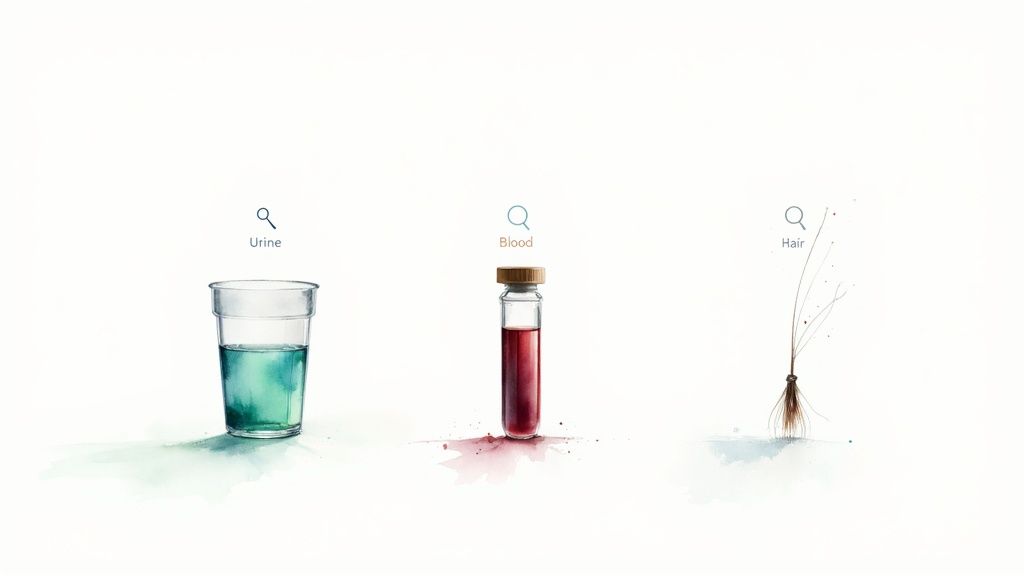
Urine Tests: The Most Common Method
Urine tests are the standard for most drug screenings. They're non-invasive, relatively cheap, and get the job done. For psilocybin, a urine test is specifically looking for the metabolite psilocin.
Because psilocin has such a short half-life, it doesn't hang around in your urine for long. For most people after a single use, it’s typically detectable for only 24 to 48 hours. If you’re a more frequent user or take higher doses, that window might stretch a bit, maybe up to 72 hours. This quick clearance means urine tests are really only good for spotting very recent use, not for building a long-term history.
Blood And Saliva Tests: The Shortest Windows
Blood and saliva tests give an even more immediate snapshot. Think of them as checking for what's happening right now. They're mainly used in situations where determining active influence is critical, since they detect the parent compound or its active metabolites circulating in your bloodstream or oral fluids.
- Blood Tests: While they are incredibly accurate, blood tests have an extremely short detection window for psilocin, usually lasting only up to 12 hours after ingestion. Because this window is so brief, they are almost never used to test for psilocybin.
- Saliva Tests: Much like blood tests, saliva screenings for psilocybin are very rare. If one were performed, the detection window would likely be less than 24 hours.
Simply put, these methods are not practical for detecting shroom use beyond the immediate hours after a trip. This limits their use to very specific, niche scenarios.
Psilocybin Detection Methods: A Comparison
To pull all this together, it helps to see the methods side-by-side. Each test balances factors like its detection window, how invasive it is, and the cost. This comparison gives you a clear picture of what to expect from different types of screenings.
| Test Method | Detection Window | What It Detects | Common Use Case |
|---|---|---|---|
| Urine Test | 24–48 hours | Psilocin | Most common for general screening due to balance of cost and effectiveness. |
| Blood Test | Up to 12 hours | Psilocin | Rare; used in specific situations to confirm very recent use. |
| Hair Test | Up to 90 days | Psilocybin Metabolites | Extremely rare for psilocybin; used for long-term use history. |
As you can see, there's a huge difference in detection times depending on the sample they take. While a urine test might cover the last day or two, a hair follicle test can, in theory, look back much, much further.
Understanding Psilocybin In Hair Follicle Tests
While urine and blood tests give you a snapshot of recent activity, hair follicle testing tells a much longer story. Think of it as the most extensive detection method out there, capable of identifying substance use months after it happened. The process involves analyzing a small sample of hair, usually from the scalp, to hunt for drug metabolites that have been locked into the hair shaft over time.
As your hair grows, it's basically creating a historical record. When you consume something like psilocybin, its byproducts (metabolites) travel through your bloodstream. From there, they get deposited from blood vessels into the hair follicles and become permanently trapped inside the growing hair strand.
Why Hair Tests Are So Different
What really sets hair testing apart is its power to reveal patterns of use over a long stretch of time. Since the hair on your head grows about half an inch per month, a standard 1.5-inch sample can theoretically provide a 90-day history of substance use. This makes it an incredibly powerful tool for spotting chronic or repeated consumption.
But here's the thing: hair testing for psilocybin is extremely rare. These tests are expensive, demand specialized lab equipment, and are usually saved for specific forensic investigations or long-term monitoring—not your average workplace screening. Most standard drug panels just don't bother looking for it.
For a hair follicle test to even have a chance of detecting psilocybin, there usually needs to be a consistent pattern of use. A single, one-off dose is often not enough to deposit a detectable amount of metabolites into the hair strand.
This highlights a critical difference between single use and regular use. An occasional journey might not leave enough of a trace in your hair to trigger a positive result. The test is far more likely to pick up on a consistent pattern where metabolites have had a chance to build up.
For example, while hair tests offer that long 90-day detection window by trapping metabolites, psilocybin actually has a low incorporation rate into hair. This means detecting it requires advanced, sensitive assays, especially weeks after use. It’s the repeated dosing, like microdosing 0.1-0.3g several times a week, that can accumulate detectable levels over a 60-90 day period. If you want to dive deeper into these specifics, you can discover more insights about psilocybin in your system at Wolf Creek Recovery.
Key Factors That Influence Detection Times
You might be wondering why there isn't one simple answer to how long psilocybin stays in your system. The truth is, the detection window isn't a fixed number. It’s more of a flexible timeline shaped by a unique mix of your body and your habits.
Just like two people can have completely different reactions to the same food, our bodies process psilocybin at their own pace. Several key personal traits play a huge role here. Your individual metabolic rate is the main engine—a faster metabolism can process and flush out psilocin more quickly. Things like age, body mass, and your overall health all contribute to this metabolic speed.
Even your hydration level matters. Staying well-hydrated helps your kidneys do their job, which can help clear out metabolites from your system a bit more efficiently.
Dosage And Frequency Of Use
Beyond your body’s baseline, two of the most critical factors are how much you take and how often you take it. A larger dose naturally introduces more psilocybin into your system, which means your body needs more time to fully process and clear it all out.
Think of it like pouring water into a funnel. A small splash goes through almost instantly, but a whole pitcher takes longer to drain. In the same way, your body needs more time to work through a higher concentration of psilocin.
The frequency of use also has an impact. While psilocybin doesn't typically build up in your system like some other substances, frequent use means your body is constantly working on a new batch. This can potentially stretch the detection window, especially for more sensitive tests designed to spot long-term patterns. If you want to get a better handle on your intake, a magic mushroom calculator can be a useful tool for estimating dosage.
Mushroom Species And Potency
Here's something a lot of people overlook: not all magic mushrooms are created equal. Different species, and even different batches of the same species, can have wildly different concentrations of psilocybin.
The specific strain and potency of the mushrooms you consume directly affect the amount of psilocybin entering your system, which in turn influences how long its metabolites remain detectable.
For instance, potent strains like Penis Envy can pack in significantly more psilocybin than a milder variety like Golden Teacher. A higher initial concentration means there's more for your body to metabolize, which can lengthen the time it takes to clear everything out.
Ultimately, figuring out how long psilocybin stays in your system means looking at the whole picture. It’s a combination of your unique physiology, your specific usage habits, and the characteristics of the mushrooms themselves.
A Few More Questions About Psilocybin Detection
Even with the basics down, you might still have a few specific questions floating around. Let's tackle some of the most common ones to give you a clearer picture of how psilocybin detection really works.
Does Microdosing Show Up On A Drug Test?
This is a big one for many people. Microdosing, by definition, involves taking tiny, sub-perceptual amounts of psilocybin. The goal isn't to trip, but to potentially experience subtle benefits.
Because the dose is so small, the amount of psilocin metabolites in your system is usually minimal. For most standard urine or blood tests, this concentration will almost certainly fall below the cutoff level for detection. In short, it’s highly unlikely to trigger a positive result.
The one exception could be a hair follicle test, especially with consistent, long-term microdosing. It's theoretically possible for metabolites to build up in the hair over many months, but this is a rare scenario and not something most people will ever encounter.
Can Hydration Or Exercise Affect How Fast It Clears?
Yes, but probably not as much as you'd think. Staying well-hydrated is always a good idea, and it definitely helps your kidneys do their job of flushing metabolites out through urine. This could potentially shave a little time off the detection window for a urine test.
Likewise, regular exercise is great for your overall metabolic rate, which is the engine that processes everything you consume. A consistently active lifestyle means your body is just more efficient at breaking things down. However, a single workout right before a test won't magically clear your system.
Think of these as minor helpers. They can nudge the timeline slightly, but they won't fundamentally change the outcome of a test. The liver's processing speed is the main driver here.
Do Standard Workplace Drug Tests Even Check For Psilocybin?
For the most part, no. Your average pre-employment or workplace drug screening—like a 5-panel or 10-panel test—is designed to look for the usual suspects: cannabis (THC), cocaine, opiates, amphetamines, and PCP.
Screening for psilocybin requires a completely separate, more specialized (and more expensive) test. Unless an employer has a specific reason to suspect mushroom use, they almost never include it in their standard testing protocol. It’s simply not on their radar.
Ready to explore a curated selection of high-quality psilocybin and functional mushroom products? The Magic Mushroom Delivery offers fast, discreet shipping nationwide on everything from gummies and chocolates to classic dried mushrooms. Visit us at https://themagicmushroomdelivery.com to browse our collection.