
When you start comparing ayahuasca and psilocybin, you're looking at two profoundly different paths to a similar destination. The most immediate difference is in their chemistry and the cultural container they come in. Ayahuasca is a ceremonial South American brew, a complex tea that combines DMT with an MAOI inhibitor, which leads to a long, often overwhelming journey. Psilocybin, on the other hand, is the active compound in 'magic mushrooms,' and it tends to offer a more personal, internally focused experience.

Understanding the Core Differences at a Glance
While both are powerful plant-based psychedelics used for deep personal and spiritual work, they are far from interchangeable. Their origins, the way they work in your body, and the very texture of the experience set them miles apart. Getting a handle on these key distinctions is the first step in figuring out which medicine might align with your personal goals.
Ayahuasca isn’t just one plant. It's a potent brew made by combining the Banisteriopsis caapi vine, which contains a monoamine oxidase inhibitor (MAOI), with the leaves of the Psychotria viridis shrub, which are rich in N,N-Dimethyltryptamine (DMT). This combination is pure jungle alchemy; without the MAOI from the vine, the DMT would get broken down by your stomach and do nothing. The synergy between the two is what creates the powerful, visionary experience that's so deeply rooted in shamanic tradition.
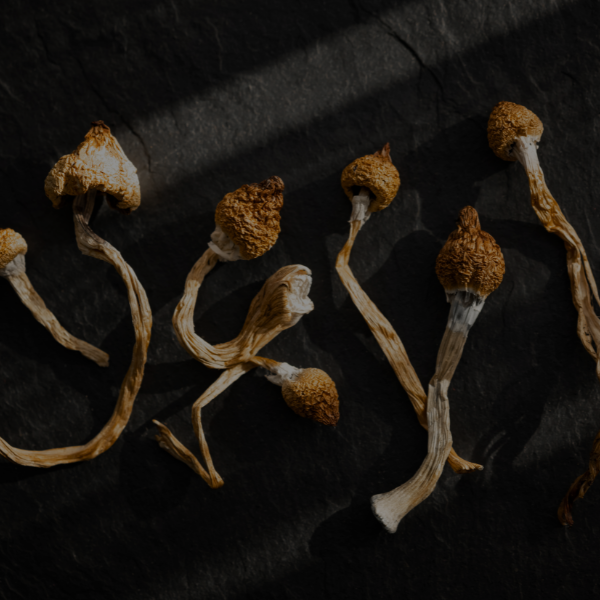
Then you have psilocybin, the famous psychoactive compound found in dozens of species of fungi across the globe. If you want to dive deeper into the basics, you can check out our detailed guide on what shrooms are. Once you eat them, your body gets to work converting the psilocybin into psilocin. It’s the psilocin that interacts with serotonin receptors in the brain, producing those classic psychedelic effects.
Ayahuasca vs Psilocybin Quick Comparison
To give you a quick, high-level snapshot, the table below boils down the main differences between these two profound substances. Think of it as a quick reference to frame the more detailed comparisons we'll get into later.
| Feature | Ayahuasca | Psilocybin |
|---|---|---|
| Origin | A ceremonial brew from the Amazon basin | Naturally occurring in various fungi species worldwide |
| Active Compounds | DMT (N,N-Dimethyltryptamine) & MAOIs | Psilocybin & Psilocin |
| Typical Duration | 4-6 hours | 4-6 hours |
| Administration | Consumed as a liquid tea or brew | Eaten raw, dried, brewed into tea, or in edibles |
| Experiential Theme | Often described as an external, teacher-led journey | Typically an internal, introspective, and personal journey |
| Physical Effects | Intense physical purging (vomiting, diarrhea) is common | Nausea and body load are possible but less frequent |
The journey with ayahuasca is often perceived as being guided by an external intelligence or "spirit," while the psilocybin experience is frequently characterized as a journey into one's own consciousness.
This initial breakdown really just scratches the surface. It sets the stage for a much deeper dive into the specific nuances of each substance. From their chemical mechanisms to their therapeutic applications, the following sections will build on these foundational differences to give you a complete picture of the ayahuasca vs. psilocybin conversation.
Exploring the Chemical and Biological Mechanisms
To really get what makes ayahuasca and psilocybin so different, you have to look under the hood at how they work with our brain chemistry. While both can lead to profound changes in consciousness, they get there through completely separate biological routes. These unique pathways are what shape the very nature of their respective journeys.
Ayahuasca’s magic is all about synergy. The brew is a combination of two plants: one that contains the powerful psychedelic DMT (N,N-Dimethyltryptamine), and another loaded with monoamine oxidase inhibitors (MAOIs). If you just consumed DMT on its own, the monoamine oxidase enzymes in your gut would break it down long before it ever reached your brain.
This is where the MAOIs from the Banisteriopsis caapi vine come in—they essentially tell those enzymes to take a break. This crucial step allows the DMT to cross the blood-brain barrier, activate serotonin receptors (mainly the 5-HT2A subtype), and kick off its famous visionary effects.
Ayahuasca: The DMT and MAOI Combination
This two-part mechanism is the heart and soul of the ayahuasca experience. It’s not about a single compound but a brilliant chemical dance perfected by indigenous Amazonian cultures over centuries.
- DMT (The Vision): This molecule is a dead ringer for serotonin and is what delivers the intense, immersive visual aspects of the journey.
- MAOIs (The Key): These compounds are the key that unlocks DMT’s power when taken orally. They stretch the experience from a few minutes (if smoked) to several hours, allowing for a much deeper dive.
This complex interaction is also why the traditional dietary prep, the dieta, is so non-negotiable for a safe ceremony. MAOIs can have dangerous interactions with certain foods and medications, so a clean system is a must.
Psilocybin: A More Direct Path
Psilocybin, the active compound in magic mushrooms, takes a much more straightforward approach. Once you ingest the mushrooms, your body gets to work metabolizing the psilocybin and converting it into its active form, psilocin. This happens pretty fast, which is why the effects start to come on relatively quickly.
Like DMT, psilocin looks a lot like serotonin. It plugs directly into the serotonin 5-HT2A receptors in the brain, and this is where the action happens. This activation disrupts the brain’s default mode network (DMN), the system tied to our ego, our sense of self, and all those rigid thinking patterns we get stuck in.
By quieting the DMN, psilocin allows the brain to form new neural connections. This leads to those feelings of oneness, ego dissolution, and game-changing insights people often talk about. Think of it as a temporary reboot of your brain's operating system, clearing the cache to make room for new perspectives.
Even though both substances ultimately target the same key receptor, their overall pharmacology creates wildly different experiences. Ayahuasca’s journey typically lasts around 4 hours, with the most intense cognitive effects hitting between 60 to 120 minutes. Psilocybin, on the other hand, tends to be a bit gentler and can last 4 to 6 hours.
Neuroimaging studies show us that psilocybin creates dose-dependent changes in brain network integrity, promoting more flexible thinking—an effect linked to its rapid and lasting antidepressant qualities. You can find more on the brain-rewiring effects of psychedelics on Frontline Genomics. This difference in how they affect brain networks is a huge reason why the subjective feel of ayahuasca versus psilocybin is so distinct, even if their foundational chemistry shares some common ground.
Comparing the Subjective Psychedelic Journey
While the chemistry gives us the "how," the real heart of the ayahuasca vs. psilocybin debate is in the journey itself. The subjective experience—the "trip"—is where these two substances show their distinct personalities. Understanding these differences is absolutely critical for anyone thinking about walking either path.
The experiences often start worlds apart. Ayahuasca’s arrival can be gradual, but it almost always brings a powerful physical component with it. Many people go through an intense "purge," which can mean vomiting or diarrhea. In traditional settings, this isn't seen as a bad side effect; it's a vital part of the process, a cleansing of physical and spiritual baggage to make way for the visions.
Psilocybin, on the other hand, tends to be much gentler on the body. Some people might feel a bit of nausea or a heavy "body load" as things kick in, but it’s rarely the forceful physical release you see with ayahuasca. The shift into the psychedelic state feels more like a slow dissolving of the edges, not a dramatic purge.
The Emotional and Visual Landscape
The whole character of the journey is a major point of difference. An ayahuasca experience often feels like you're being guided by an external intelligence—a spirit or consciousness. People frequently report being "shown" very specific lessons, memories, or visions by a wise, maternal presence often called "Mother Ayahuasca."
Because of this, it can feel very directive, like you're in a classroom. The visuals are typically complex and symbolic, full of geometric patterns, jungle creatures, and cosmic imagery. You often feel like a passenger on a journey being orchestrated for you.
Psilocybin tends to be a much more internal, introspective affair. The journey is often described as a deep dive into your own mind, unlocking personal memories, buried emotions, and your own patterns of thinking. The visuals can be just as stunning but are often more abstract and tied to your inner state—think flowing kaleidoscopic patterns, textures that seem to breathe, and an overwhelming sense of connection to the world around you.
The core distinction often boils down to this: Ayahuasca feels like a dialogue with a powerful, external teacher, whereas psilocybin feels more like a conversation with your own deepest self.
Navigating the Duration and Intensity
The timeline and rhythm of each journey also shape the overall feel. An ayahuasca ceremony usually runs for 4 to 6 hours, but it often feels like one continuous, immersive story. The intensity rolls in powerful waves, often steered by the shaman’s songs (icaros), making for a highly structured and demanding night.
A psilocybin trip lasts a similar amount of time, typically 4 to 6 hours, but its structure feels more personal and fluid. The intensity also ebbs and flows, usually peaking around the two-hour mark before gently coming back down. People often report having more control or agency to navigate their inner landscape, exploring thoughts and feelings as they come up. To get a better handle on this, you can check out our guide on the various levels of a psychedelic high.
In the end, both paths can lead to incredible self-discovery, but they take you down very different roads. Ayahuasca often feels like a challenging, guided lesson that demands complete surrender. Psilocybin offers a gentler, more self-directed exploration that encourages deep introspection. The right choice really depends on the kind of psychological and spiritual work you’re ready to do.
A Look at Therapeutic Applications and Research
When you put ayahuasca and psilocybin side-by-side for therapeutic use, you have to look at both the science and the history. Both are being seriously explored for their ability to get to the root of deep-seated psychological issues, but they’re on completely different tracks when it comes to clinical research.
Psilocybin has really become the star of modern psychedelic science. A growing wave of rigorous studies is highlighting its power to help with a range of tough conditions. This intense focus has made it a front-runner in the movement for psychedelic-assisted therapy.
Ayahuasca, on the other hand, has its therapeutic roots buried deep in centuries of traditional indigenous practice. While modern science is just starting to catch up and study its benefits, its real home has always been a spiritual, ceremonial one. That creates some unique challenges for fitting it into a sterile clinical box.
Psilocybin's Role in Modern Mental Health Research
Psilocybin’s journey from a 60s counter-culture symbol to a serious therapeutic tool is nothing short of remarkable. Top-tier research institutions are running clinical trials, and the results are turning heads in the mainstream medical community.
The main areas where psilocybin is really making a name for itself include:
- Treatment-Resistant Depression: Study after study has shown that psilocybin can produce rapid, lasting antidepressant effects. Often, this happens after just one or two guided sessions.
- End-of-Life Anxiety: For people facing a terminal diagnosis, psilocybin has proven to dramatically reduce the anxiety and depression that comes with it, helping them find a sense of peace.
- Substance Use Disorders: Early research is showing its potential to help people break addictions, especially to nicotine and alcohol, by hitting the reset button on deeply ingrained habits.
You often hear that psilocybin's therapeutic magic comes from its ability to induce a "mystical-type experience." This profound feeling of oneness and the temporary dissolving of the ego is consistently linked to the most positive and lasting breakthroughs.
Ayahuasca's Therapeutic Potential and Traditional Roots
For generations, ayahuasca has been the go-to healing medicine in the Amazon basin for all sorts of spiritual and psychological problems. Its approach is holistic, treating the mind, body, and spirit all at once, usually within a powerful community ceremony.
New research is starting to confirm what indigenous cultures have known all along. Studies are suggesting ayahuasca could be effective for:
- Addiction and Substance Abuse: There’s a mountain of anecdotal reports—and some early studies—pointing to its power in helping people break free from dependency.
- Post-Traumatic Stress Disorder (PTSD): The brew is known for bringing buried memories and emotions to the surface. In a contained, supportive setting, this can help people finally process and heal from trauma.
The ceremonial context is absolutely central to how ayahuasca works. The guidance of a shaman, the sacred songs (icaros), and the shared group energy are all seen as vital parts of the healing process—something that’s incredibly difficult to replicate in a standard clinical trial.
Comparing the Sheer Volume of Scientific Evidence
When you just look at the numbers, the difference in scientific validation is stark. Psilocybin has been studied far more extensively than ayahuasca, which reflects both the global interest and its easier path into therapeutic testing.
As of recently, psilocybin has about 2,460 articles on PubMed and over 134 registered clinical trials. Ayahuasca, by comparison, has around 666 PubMed articles and only an estimated 10 to 20 clinical trials. This gap really shows how psilocybin got a head start in the research world and has a better-understood safety profile, making it a more attractive candidate for global therapeutic use. For a deeper dive, you can explore a comparison of their research status on evolute-institute.com.
This doesn't take away from ayahuasca's profound traditional value, but it does explain why psilocybin is much further down the road to becoming an accepted mainstream medicine.
Understanding Safety Profiles and Preparation
When we talk about ayahuasca versus psilocybin, safety and preparation aren't just casual suggestions—they're the absolute foundation for a responsible journey. The risks, both physical and psychological, are completely different for each, and that means they demand unique ways of thinking about harm reduction. Getting a solid handle on these profiles is the first real step to making sure your experience is both safe and constructive.
Ayahuasca's biggest safety issue comes directly from its chemical makeup. The brew is packed with monoamine oxidase inhibitors (MAOIs), which are the key to unlocking the DMT but can trigger some seriously dangerous interactions with certain foods and medications. This is exactly why a strict preparatory diet, known traditionally as the dieta, is completely non-negotiable.
Psilocybin, on the other hand, is a lot more forgiving on the body. It doesn’t have any MAOIs, which immediately takes the risk of severe food and drug reactions off the table. But that doesn't mean it's risk-free; its challenges are almost entirely in the mind.
The Ayahuasca Dieta and Contraindications
The dieta is more than just a diet; it’s a vital purification process that gets your body and mind ready for the intensity of an ayahuasca journey. It means cutting out specific foods for days, sometimes even weeks, before a ceremony to head off any potentially life-threatening reactions with the brew's MAOIs.
Key things you'll have to avoid typically include:
- Fermented foods like aged cheeses, soy sauce, and tofu
- Pork and red meat
- Spicy, overly salty, or sugary foods
- Caffeine and alcohol
But the biggest danger, by far, is the interaction with pharmaceuticals. SSRIs and other antidepressant medications pose a severe risk, potentially causing a fatal condition called serotonin syndrome when mixed with MAOIs. A thorough, honest screening with a qualified facilitator is absolutely essential to catch and prevent these contraindications.
Psilocybin and Psychological Safety
While psilocybin is much gentler on the body, its primary risks are psychological. The experience can dredge up some tough emotions, unresolved trauma, or lead to moments of intense confusion and anxiety. This is what people often call a "difficult trip" or a "challenging experience."
A key differentiator in the ayahuasca vs psilocybin safety discussion is the nature of the primary risk. For ayahuasca, it's physiological, rooted in MAOI interactions. For psilocybin, it's psychological, centered on navigating the powerful and sometimes overwhelming internal experience.
Proper preparation is just as vital for managing these psychological risks. For anyone new to psilocybin, figuring out the best way to consume magic mushrooms can also help you manage the intensity and how quickly it comes on, which is a huge part of feeling psychologically prepared. Learning about the best ways to consume magic mushrooms can give you some practical ideas on dosing and different methods.
The Universal Importance of Set and Setting
No matter which substance you're considering, the principles of set and setting are the cornerstones of psychedelic safety. This framework is all about recognizing the critical role your internal state and external environment play in shaping the entire experience.
Set (Your Mindset): This is all about your inner world—your intentions, mood, expectations, and overall psychological stability. Going into an experience with a clear, positive intention and a calm mind can make all the difference. It's crucial to stay away from either substance if you're feeling highly anxious, are in the middle of emotional turmoil, or have a personal or family history of psychosis.
Setting (Your Environment): This is your physical world. A safe, comfortable, and supportive environment isn't just nice to have; it's a must. This covers the physical space, the people you're with, and the general vibe. For an ayahuasca ceremony, that means a shaman you trust and a secure location. For a psilocybin journey, it means a cozy room with a sober, experienced sitter or guide. The qualifications and trustworthiness of any facilitator are paramount for both.
Choosing Your Path Based on Context and Intention
Trying to decide between ayahuasca and psilocybin isn't about picking a "winner." It’s a deeply personal choice, and the right answer really hinges on what you’re looking to get out of the experience, your comfort level, and the specific inner work you want to do. Each one offers a different set of tools and a completely distinct environment for growth.
One of the biggest differences comes down to the setting. If you feel drawn to a communal, spiritually guided experience, a traditional ayahuasca ceremony is probably more your speed. These are typically structured events led by an experienced shaman, and the shared group energy can be incredibly supportive for deep emotional and spiritual work.
On the other hand, if your focus is more on personal introspection—maybe you want to explore specific psychological patterns or unlock creative insights—a psilocybin journey might be a better fit. This kind of experience is often done alone or with a close, trusted sitter, which gives you the freedom to explore your own consciousness without the formal structure of a ceremony.
Aligning Your Goals with the Experience
The nature of the journey itself is another key piece of the puzzle. People often describe ayahuasca as a direct, sometimes demanding, teacher. It can present powerful lessons and visions that require you to completely surrender. It can also be a physically intense experience, with a purging element that many believe helps clear negative energy and confront difficult truths head-on.
Psilocybin is often seen as a gentler, more collaborative guide. It can absolutely lead to profound breakthroughs and mystical states, but it typically allows for a bit more personal freedom to navigate your own inner world.
This simple decision tree can help you see how your main intention might point you toward one path over the other.
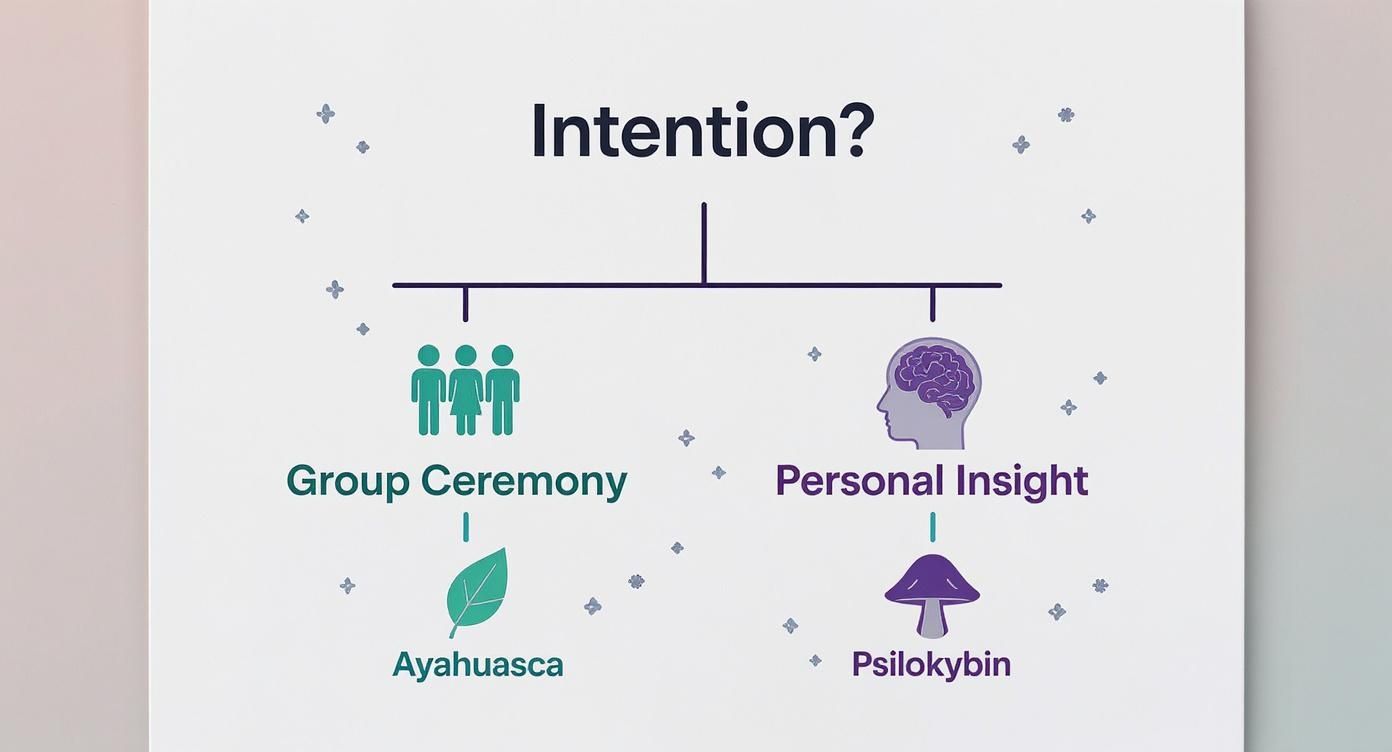
As you can see, it often comes down to a fundamental fork in the road: are you looking for a communal, ceremonial path or a more individualized, internal journey?
Considering Therapeutic Outcomes
If you have a specific therapeutic goal, looking at the research can give you some valuable context. The growing global interest in psychedelic therapy has led to a lot of clinical trials, especially for psilocybin, as a treatment for various mental health conditions.
The results have been pretty remarkable. Studies have shown that psilocybin-assisted therapy can lead to depression remission rates of 68%, a big jump compared to 45% in control groups. In studies with cancer patients dealing with anxiety, over half of the participants described their psilocybin experience as one of the most meaningful of their entire lives. Smoking cessation trials have also shown impressive outcomes, with 80% of participants staying smoke-free six months after treatment—a success rate that blows most conventional methods out of the water. You can dive deeper into these powerful findings on psychedelic therapy from Nature.
Ultimately, the choice is not about which substance is "better," but which one resonates most deeply with your personal quest for healing, understanding, or growth. Reflecting on your intentions—whether they are spiritual, therapeutic, or creative—is the most important step in choosing your path.
Got Questions? We’ve Got Answers
When you start comparing ayahuasca and psilocybin, a lot of practical questions pop up. Let's get straight to the point and tackle some of the most common ones to help you understand the real-world differences.
Is One Experience Considered More Spiritual Than the Other?
This is a tough one because spirituality is so personal. Ayahuasca is almost always taken in a structured, shamanic ceremony. It's often called a "teacher" plant, and many people describe the experience as a direct encounter with a wise, external intelligence. That ceremonial container itself creates a deeply spiritual context.
Psilocybin can absolutely take you to the same profound, mystical places, but the setting is often more personal or even clinical. The spiritual depth of either journey really comes down to your own intentions, your mindset going in, and the environment you create for yourself.
What Is the Importance of Integration After the Experience?
Integration is everything. It's the essential—and often overlooked—work of taking the wild, abstract insights you get during a journey and weaving them into real, positive changes in your daily life. It's the bridge between a mind-blowing experience and meaningful personal growth.
The psychedelic experience opens a door; integration is the work of walking through it and bringing its lessons into your everyday reality.
So, how do people actually do it? Common practices include:
- Journaling: Getting the insights, feelings, and memories down on paper to make sense of it all.
- Therapy: Talking with a professional to unpack the lessons and figure out how to apply them.
- Meditation: Using mindfulness to stay connected to the new perspectives you’ve gained.
- Community Discussions: Sharing with a guide or a trusted group helps put the journey into words and gain clarity.
Does the Mushroom Species Change the Psilocybin Experience?
While psilocybin is the main active compound, different mushroom species have their own unique blend of alkaloids, like psilocin. Because of this, many experienced users will tell you there are subtle differences in the "character" or feel of a journey depending on the species.
But let's be clear: the biggest factors by far are dose, your personal mindset, and the environment where you have the experience. The species is a much smaller variable in the grand scheme of things.
What Is the Role of a Guide or Facilitator?
A trained guide or facilitator is your safety net. Their job is to hold a safe space and help you navigate the sometimes-choppy waters of the experience. In ayahuasca ceremonies, this role is traditionally filled by a shaman who guides the energy of the entire group.
For psilocybin, especially in therapeutic settings, a therapist provides that support. Their main goal is to create a secure container, offer a reassuring presence during difficult moments, and help you with integration afterward. Having that support dramatically increases the chances of a positive, lasting outcome.
At The Magic Mushroom Delivery, we provide access to high-quality, organic psilocybin products for adults 21+ across the U.S. Explore our curated selection of mushrooms, edibles, and capsules, all delivered discreetly to your door. Begin your journey with a trusted source at https://themagicmushroomdelivery.com.