
Which mushroom is in your creamer, and how much of it reaches the cup? The front of the bottle answers with a friendly species name in large type. The panel further down answers with a number that often describes a whole blend rather than any single mushroom. That gap, between the promise and the thing you can confirm, is the whole decision.
Closing it takes about two minutes. A mushroom coffee creamer is a label you can audit: species, mushroom material, dose per serving, and the base that carries all three into your mug. The front of the jar holds claims. The small print holds facts you can weigh.
Mushroom Coffee Creamer vs Standard Creamer Side by Side
Strip away the marketing and a mushroom coffee creamer is a standard creamer base, dairy or plant-based fat and protein, with mushroom powder or extract stirred in, most often lion's mane, reishi or chaga. Both products are oil-in-water emulsions built to carry fat into hot, acidic coffee without splitting. That's why they pour, swirl and taste so similar. The part a buyer has to work for is the mushroom itself: which species, which part of it, and how much per serving.
The category carries real commercial weight. One market report put the global mushroom coffee creamer market at USD 698.7 million in 2025, projecting USD 1.4745 billion by 2034 at an 8.7% compound annual growth rate, with powdered creamers holding about 38.5% of the market, non-dairy and vegan creamers at roughly 27.5% as the fastest-growing format, and liquid creamers near 24.0% (Growth Market Reports). Treat those numbers as an industry forecast built on proprietary definitions, not a government count.
| Feature | Mushroom coffee creamer | Standard creamer |
|---|---|---|
| Core ingredient | Fat and protein base plus mushroom powder or extract | Fat and protein base with no added fungi |
| Functional claim | Mushroom benefits, with evidence still limited | None |
| Label to check | Mushroom species, material and dose per serving | Sugar, fat and additive content |
| Emulsifiers | Often used to keep mushroom solids dispersed | Often used for stability |
None of that tells you whether a particular jar is any good. A functional promise printed across the front is a positioning statement, not evidence. What separates a verifiable mushroom creamer from a flavored one is the species, the material (fruiting body or mycelium) and the dose per serving. A standard creamer faces a simpler test: sugar, fat and additives. Buying for the mushroom means running the label audit below. Buying for the coffee means the diet checks decide it.
What Is Actually Inside a Mushroom Coffee Creamer
A mushroom name without its extract type is like a coffee's origin without its roast or grind. Ethiopia tells you something. It doesn't tell you what's in the cup.
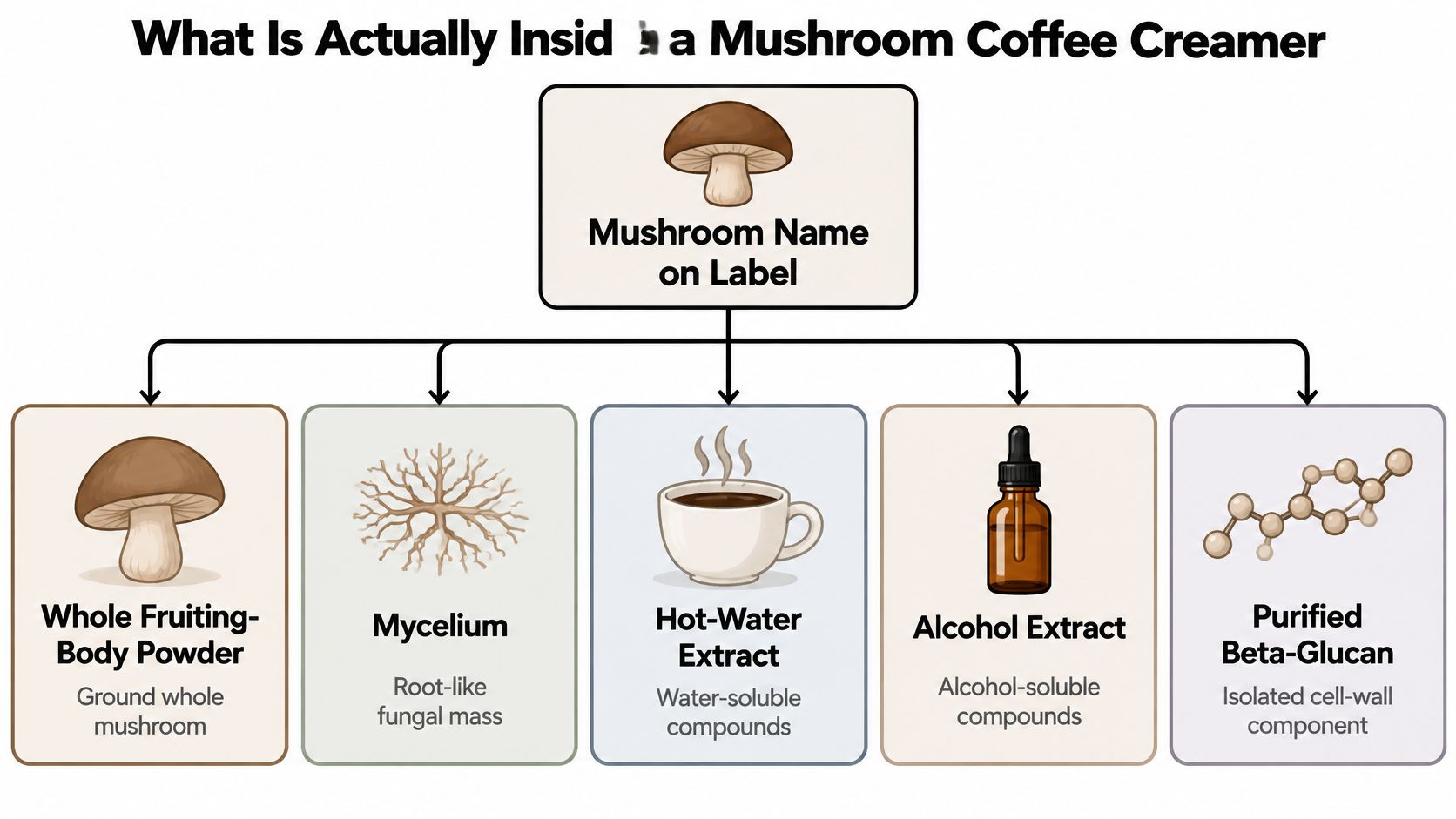
The same species can arrive in your jar as any of five quite different materials, and they aren't interchangeable:
- Whole fruiting-body powder. The mushroom dried and ground, carrying the full matrix of the organism.
- Mycelium. The root-like fungal mass, often grown on grain, which is why some mycelium products carry a large share of grain starch.
- Hot-water extract. Water-soluble compounds pulled out with heat and concentrated, normally sold at a stated ratio.
- Alcohol extract. A different solvent lifts a different set of compounds, and it doesn't stand in for the water extract.
- Purified beta-glucan. An isolated cell-wall component, standardized to a number rather than to a mushroom.
Mushroom cell walls carry beta-glucans built on a beta-(1→3) backbone with beta-(1→6) branches, and species, molecular weight, branching pattern, extraction solvent, temperature and purification method all change how soluble, how viscous and how biologically active that material turns out to be. A jar that says only "mushroom blend" establishes neither the beta-glucan amount nor the extract ratio. Absorption is modest as well: one review reports roughly 0.5% to 4.9% absorption for three soluble beta-glucans, varying with molecular structure (review of beta-glucan bioavailability). Claims should stay proportionate to that.
What the evidence supports, and what it doesn't
CNN's 2024 review of mushroom coffee found no definitive research specifically testing these products, noted they aren't FDA-approved or regulated as therapeutic products, and recorded an FDA memorandum from September 2024 that found insufficient evidence to recognize Amanita muscaria, its extracts, muscimol, ibotenic acid or muscarine as generally recognized as safe in conventional food (CNN's 2024 mushroom coffee review). That memorandum is about a psychoactive genus, not about lion's mane, reishi or chaga, and the distinction matters. Culinary and functional mushrooms belong in a different category from species with known toxicity.
A creamer worth buying names its species and says plainly whether you're getting a fruiting body, mycelium or an extract. For a fuller breakdown of the raw materials that go into these products, see this guide to mushroom coffee ingredients.
How to Read a Label and Verify the Mushroom Dose
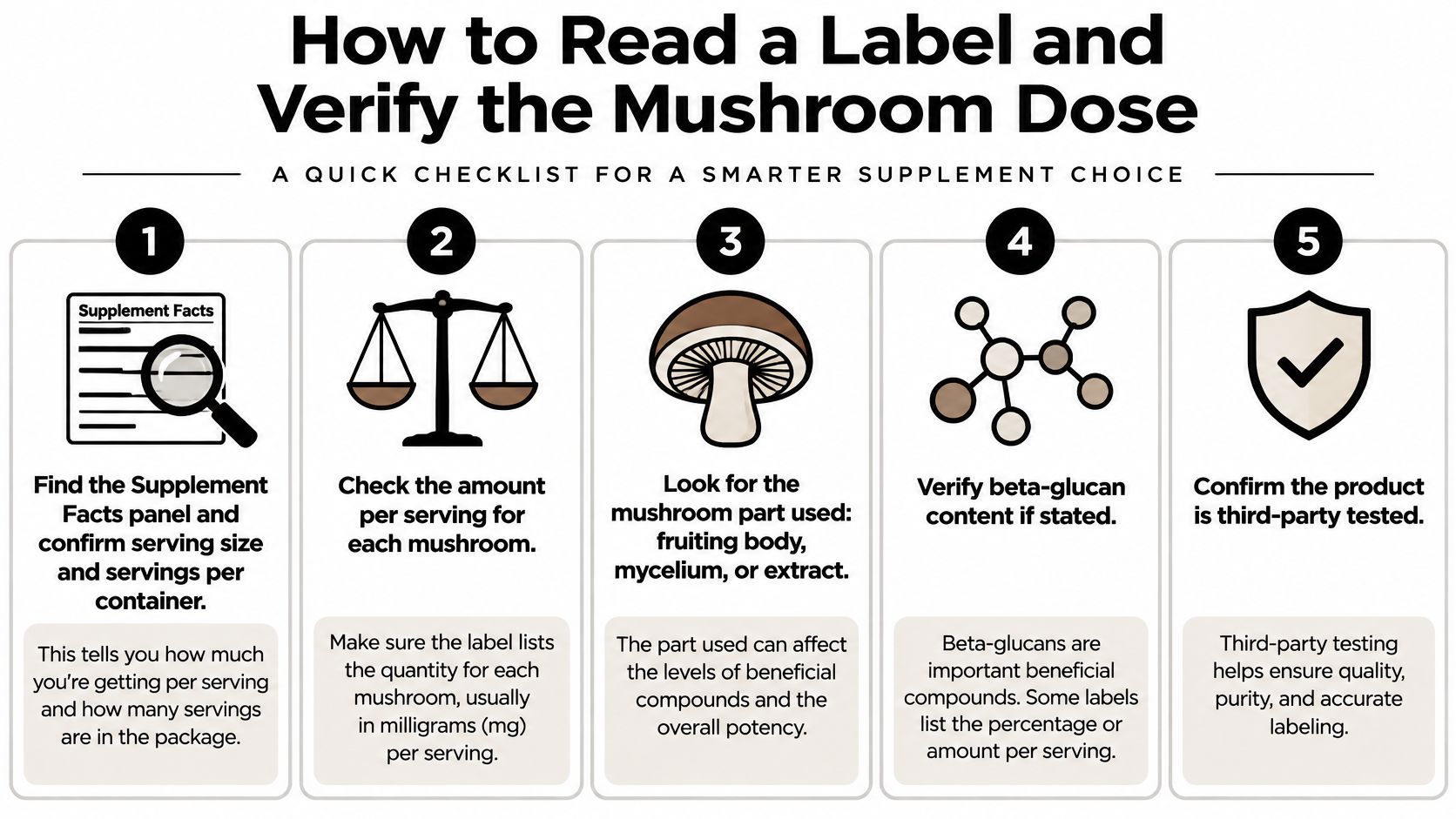
A label is useful only if it lets you trace what is in the jar: the mushroom species, the material used, and the amount per serving. Read it in this order, and treat vague wording as a reason to ask questions.
- Confirm the product type and serving size. Dietary supplements have labeling requirements that include product identity, net quantity, a Supplement Facts panel, an ingredient list, and the manufacturer's or distributor's name and place of business (FDA questions and answers on dietary supplements). Serving size and servings per container also help you compare the cost per serving.
- Check the amount listed for each mushroom. Look for a quantity per serving beside each named ingredient. A figure for lion's mane, for example, is more informative than “mushroom complex.” If the mushrooms are grouped in a proprietary blend, their individual amounts may not be clear.
- Look for both common and Latin names. Minnesota Department of Agriculture retailer guidance says mushroom supplements should identify mushrooms by both names and specify the material used, such as fruiting body or mycelium (Minnesota Department of Agriculture guidance). These details tell you what the ingredient is.
- Treat “proprietary mushroom blend” as incomplete information. Generic wording can leave both the species and the amount of each mushroom unclear. Ask for those details before comparing the product with one that lists them.
- Read the Other Ingredients list. It shows ingredients outside the Supplement Facts panel, including the creamer base, sweeteners, oils, and emulsifiers. This list helps you understand what makes up the rest of each serving.
- Ask whether independent testing checks for contaminants. Mushrooms can accumulate lead, arsenic, mercury, and cadmium, making contaminant testing relevant (Mayo Clinic Press on mushroom supplements). Ask what the test covers and whether you can see the results.
- Check what the certificate of analysis covers. A report for a raw ingredient does not establish what is in the finished jar. A finished-product report is more directly relevant, but it still cannot fill in a missing dose on the label.
- Keep “organic” and “natural” separate from potency. Those terms do not tell you the species, amount per serving, or contaminant status. Check each of those details independently.
When a label fails a step
A readable label names the mushroom, identifies the material used, lists an amount per serving, and gives the full ingredient list. A test report you can request adds information about what was tested. The FDA does not preapprove supplements for safety before they reach the market, so a label alone is not a regulator's review of the product.
Practical rule: If you cannot find the species and dose in two minutes, ask the seller for those details before buying. A guide to third-party lab testing explains what to look for in a certificate of analysis.
Dairy, Allergen and Sweetener Checks for Your Diet
The base answers most of the diet questions before the mushrooms get a say. A dairy creamer carries milk protein and lactose, which rules it out for anyone avoiding either. Oat, almond, coconut and soy bases each raise their own allergen question, with soy and tree nuts topping the list for many readers. Coconut-based creamers run high in fat, largely saturated, so compare the grams per serving against what you're already eating in a day.
Practical rule: scan the base first, the sweetener second, the emulsifiers third. That's the order your diet is affected.
What the sweetener line is telling you
Compare sugar per serving against an unsweetened creamer, and count it if you drink two cups. Sugar alcohols such as maltitol and erythritol, plus added syrups, matter for anyone managing blood sugar or watching total intake, and they have a digestive reputation worth knowing before you commit to a daily serving. A creamer that tastes sweet with no sugar listed is usually leaning on a sugar alcohol or a high-intensity sweetener.
Emulsifiers keep the fat and water from separating. Lecithin, mono- and diglycerides, polysorbates, phosphate salts and plant proteins all do work in that system, jointly controlling how a powder disperses and how the drink feels in your mouth (review of plant-protein non-dairy creamers). If you react to soy, check whether the lecithin is soy-derived or sunflower-derived, because the label normally names the source.
The caffeine question
The creamer contributes none. The coffee underneath sets the total, so a mushroom blend doesn't automatically make a cup decaf, and a product sold on calm energy still deserves a look at its caffeine figure if you're limiting intake. Read the brewing instructions, not the mood words on the front.
Ask a clinician before adding a functional mushroom product if you're pregnant or breastfeeding, taking immune-suppressing medication or blood thinners, or facing surgery in the next few weeks.
Buying a Ready-Made Creamer or Making Your Own
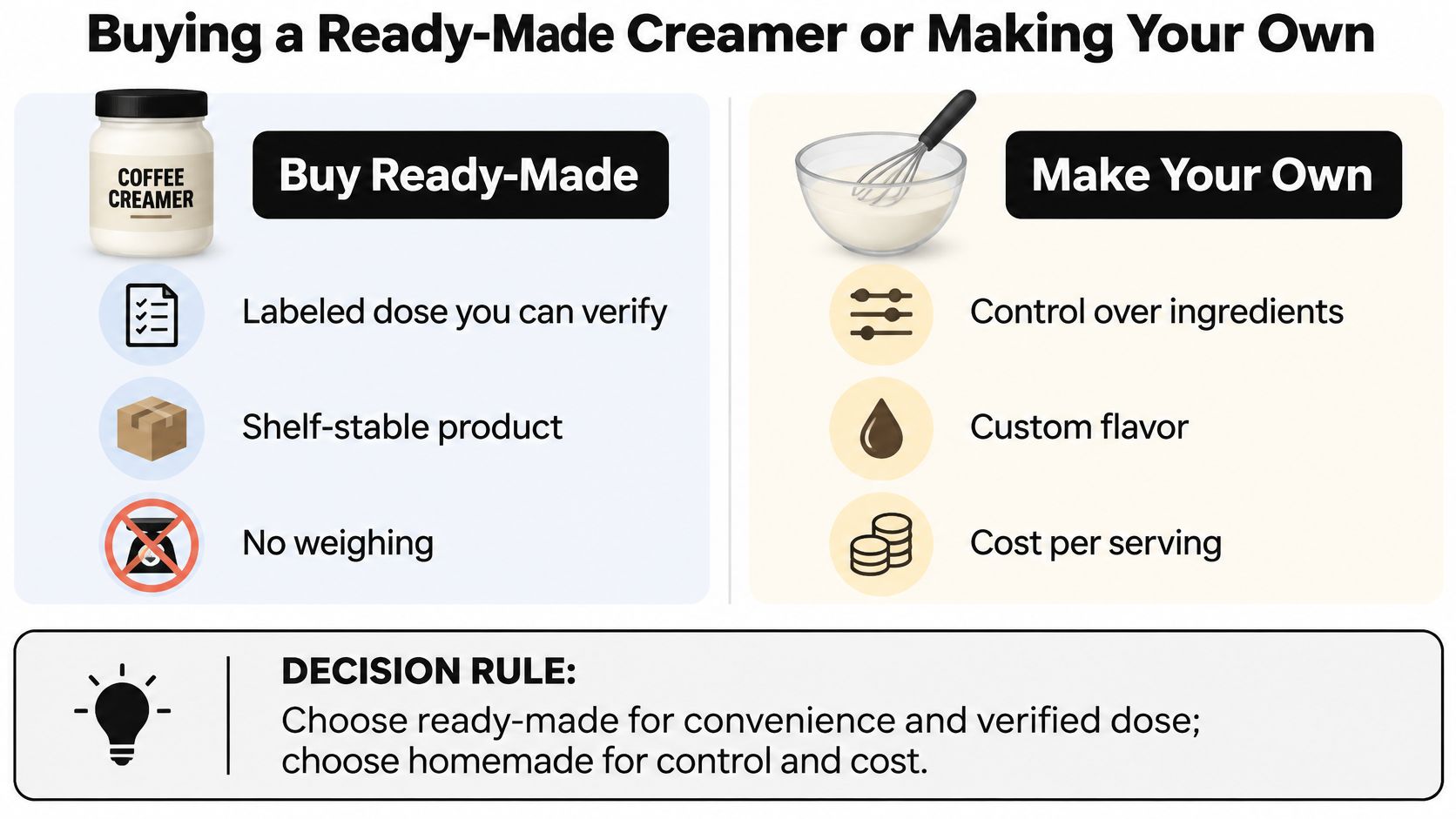
Two routes, and they ask different things of you. The table sets out the trade.
| Factor | Buy ready-made | Make at home |
|---|---|---|
| Dose certainty | Verifiable when the label and test report match | Set by your weighed recipe |
| Stability | Formulated with emulsifiers and stabilizers | Separates sooner; keep batches small |
| Shelf life | Set by the producer's process and packaging | Short; refrigerate and use within days |
| Effort | Lowest; ready to use | Sourcing, weighing and blending |
| Ingredient control | Limited to listed options | Full control over base, sweetener and dose |
Why homemade separates
A creamer is an oil-in-water emulsion, meaning fats have to stay dispersed in a water-based, hot, acidic coffee system. Emulsifiers such as lecithin, mono- and diglycerides and polysorbates lower interfacial tension and hold off oil separation, crystallization and poor dispersion (FDA overview of food ingredient types). Commercial producers run stability checks under heating, freeze-thaw cycling and pH shifts, and they watch for rapid wetting, low clumping, complete dispersion and minimal floating oil in the cup.
Packaging does the rest. UHT treatment plus aseptic packaging can give a shelf-stable liquid, while the same UHT product in a nonsterile container needs refrigeration and has a much shorter usable life. Mushroom solids make all of this harder, because badly dispersed particles sediment, deliver an uneven dose and turn the mouthfeel gritty.
A home version you can dose
- Choose a named extract. Species, extract form and ratio on the package, or don't buy it.
- Weigh the dose per serving. A kitchen scale beats a teaspoon, because scoops vary wildly between powders.
- Blend it into oat or coconut milk with a stick blender until no specks remain.
- Add a small amount of food-grade emulsifier such as lecithin if the mix separates on standing.
- Store it refrigerated in a labeled jar and use it within a few days.
Homemade gives you full control and no supplement panel, so the dose checking becomes yours. Buying wins when a label and test report can be verified. Our walkthrough on how to make mushroom coffee covers the brewing side.
Before you commit, do the arithmetic. Divide the price of a ready-made creamer by its servings per container for cost per serving, then price a standard creamer the same way. For homemade, add the base, the weighed extract and the sweetener per batch, divide by servings, and compare the two figures side by side.
Flavor Pairings and Everyday Ways to Use It
Mixing decides whether you taste coffee or sediment. The method matters more than the flavor name on the jar.
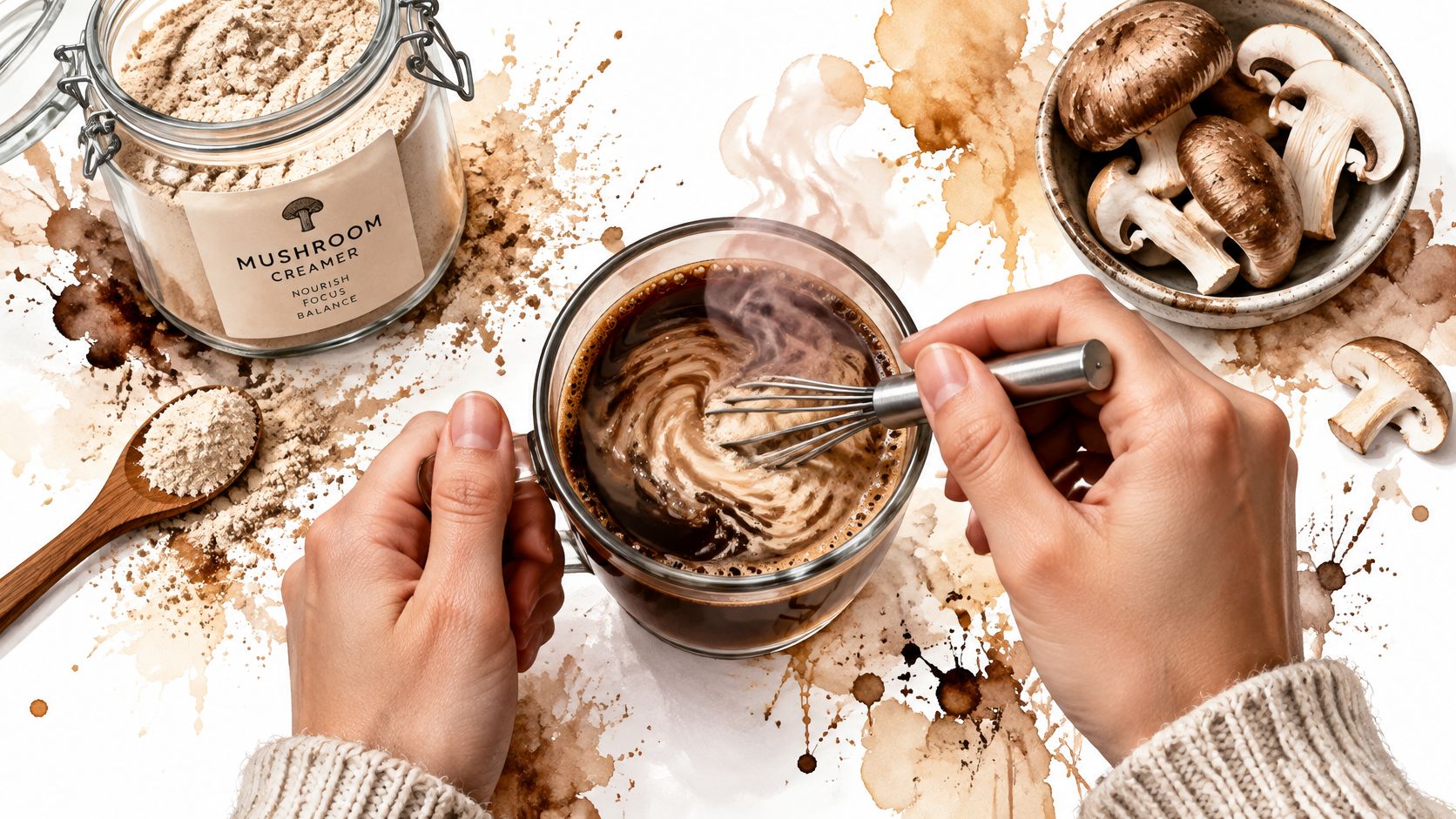
Spoon the powder into a small splash of hot coffee first, whisk it to a smooth paste, then add the rest of the cup. Powder dropped straight into cold liquid clumps and stays clumped. Watch the surface for floating oil or grit, which signal poor dispersion and the gritty texture that badly dispersed mushroom solids leave behind.
Pairings that hold up
- Vanilla or cinnamon creamer with a medium roast. The sweetness sits alongside nutty notes instead of burying them.
- Cacao or mocha notes with a dark roast. Bitter edges meet bitter edges, and the cup tastes rounder.
- A light oat creamer with a light roast or pour-over. Keeps the fruit notes readable instead of coating them.
- Liquid creamer for cold brew. Or whisk the powder into a spoonful of warm water before it goes anywhere near the ice.
The mixture is one food matrix
Creamer doesn't behave like a neutral flavoring step. Research on instant coffee with creamer found the creamer significantly affected the bioaccessibility of chlorogenic acids and antioxidant activity, with the effect potentially tied to interactions between milk proteins and coffee phenolic compounds (study of instant coffee with creamer). The study treated creamer as a processed oil-in-water emulsion. Read that as a reason to judge the whole cup, not the mushroom powder in isolation.
Three habits make a trial worth running. Start with a small dose and build only if the taste and your routine both hold. Keep one cup style for a week before you judge anything, because a single mug on a busy morning tells you nothing. Note the brand, the batch and the serving, so that when something works you know what to reorder.
Choose a Mushroom Creamer You Can Verify
Run these in order and the choice usually makes itself.
- Species, material and dose per serving. Confirm all three on the panel, not on the front label.
- Third-party testing and a finished-product certificate. Lead, arsenic, mercury and cadmium are the four to ask about.
- Diet fit. Base, sugar and emulsifiers, checked against how you eat.
- Format. Powder for shelf stability without refrigeration, liquid for a richer texture, non-dairy if you avoid dairy.
A creamer that clears the first three checks but publishes no dose or test data should lose to one that does, even at a higher price. For online buyers, add a retailer check: the listing should show the full Supplement Facts panel, the species and material for each mushroom, and a test report, and the seller should answer written questions about dosing before you order. Treat any retailer claim, organic sourcing included, as something to verify rather than proof. For our part, we use only organic mushrooms, cultivated with organic farming practices free from synthetic pesticides, herbicides and fertilizers, and our Magic Mushroom Instant Coffee comes in a 22-gram Vanilla Latte size.
Start with a small amount, keep the label and the batch number, and reassess after a week. Verification is the reason to pick one jar over another, and it's the only part of the decision that survives the marketing.
Choosing a creamer gets easier once you know which questions to ask, and we'd rather answer them before you order than after. The Magic Mushroom Delivery stocks mushroom coffee alongside functional mushroom capsules and chocolates, and customers can call us at (510) 738-1007 with questions about species, serving size or sourcing. Visit The Magic Mushroom Delivery to see the current coffee range and the rest of the catalog.