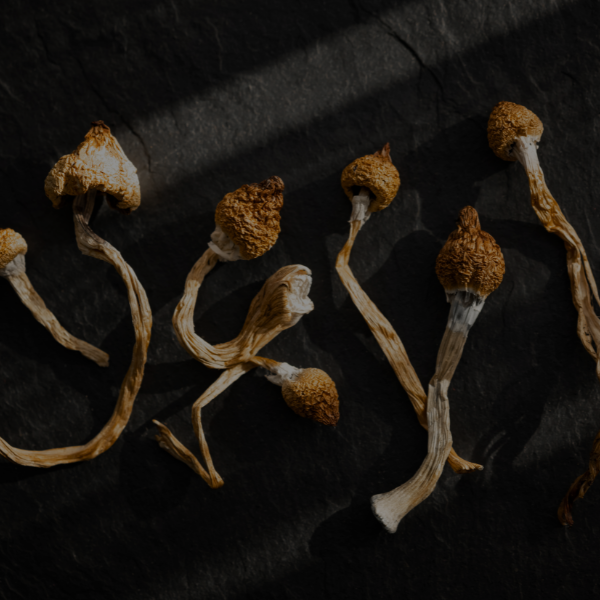

When you picture a magic mushroom, what comes to mind? For most people, it’s probably one of nature’s quirky little umbrellas—a small, brownish fungus with a slender, whitish stem and a classic cap that can be anything from conical to bell-shaped. But the real tell-tale sign, the one seasoned foragers always look for, is the bluish bruising that appears wherever it's been handled.

Your First Look at Magic Mushrooms
Let’s dig a bit deeper into that classic image. While the term "magic mushroom" actually covers hundreds of different species, there are a few common visual threads that tie many of them together. Learning these basics gives you a solid foundation before we get into the nitty-gritty of specific types. Think of it like learning the general shape of a car before you start spotting the differences between a Ford and a Honda.
These fungi are often delicate and surprisingly unassuming, easily blending into their natural surroundings. Their appearance can also change dramatically depending on their age and recent weather, which is why identification is a skill that demands a sharp, observant eye. A fresh, young mushroom after a good rain might look vibrant and deeply colored, but an older one could appear faded, dry, and almost entirely different.
Core Visual Characteristics
To get a clearer picture, let's break down the essential features you'll need to recognize. These four components are the building blocks of mushroom identification, and you’ll want to get familiar with them.
- Cap (Pileus): This is the top of the mushroom. It’s often a shade of brown or golden tan, and its shape can change as it matures—starting out sharply pointed and eventually flattening out into a broad, convex disc.
- Gills (Lamellae): Tucked underneath the cap, these are the thin, blade-like structures that produce spores. Their color is a critical identifier and almost always darkens as the mushroom gets older.
- Stem (Stipe): This is simply the stalk holding up the cap. It’s usually long and slender, with colors ranging from bright white to yellowish. Keep an eye out for a distinct ring around the stem, as some species have one.
- Bruising Reaction: This is one of the most famous tell-tale signs. A bluish stain often appears on the cap or stem wherever the mushroom is damaged or handled. This reaction is a huge piece of the identification puzzle.
To help you remember these key traits, here’s a quick summary table.
Quick Guide to Magic Mushroom Features
| Feature | Common Appearance | Key Details to Notice |
|---|---|---|
| Cap (Pileus) | Typically brownish to golden-tan; conical, bell-shaped, or flat | Shape changes with age, color can vary with moisture |
| Gills (Lamellae) | Attached to the stem, often starting light and darkening | Color change is crucial (e.g., from pale to dark purplish-brown) |
| Stem (Stipe) | Long, slender, and whitish or yellowish | Look for a ring (annulus) and note its fragility |
| Bruising | Distinctive blue or blue-green staining on damaged flesh | The speed and intensity of the bruising can be an identifier |
This unique combination of traits hasn’t just fascinated people for centuries; it’s also fueling a massive surge in market interest. The distinctive look of these mushrooms is now at the heart of a burgeoning wellness movement. This growing fascination is easy to see in the market trends.
For instance, the US psychedelic mushroom products market is projected to grow by an incredible USD 328.2 million between 2025 and 2029. To give you some perspective, the Psilocybe segment alone—known for its classic appearance—was already valued at USD 380.80 million back in 2019, showing a strong and steady climb. You can learn more about these market trends and their driving factors to see just how quickly this space is evolving.
Decoding the Anatomy of a Magic Mushroom
To really get a feel for what magic mushrooms look like, you have to go deeper than a quick glance. It’s a bit like learning to identify a classic car—you don't just see a "red car," you notice the specific curve of the fender, the shape of the grille, and the style of the headlights. Every part of a mushroom tells a story, and those details are the critical clues you need for proper identification.

By breaking the mushroom down piece by piece—from the very top of the cap down to the base of the stem—we can build a reliable mental checklist. This methodical approach is the key to telling the difference between a psilocybin-containing mushroom and its many look-alikes.
The Cap: The Mushroom's Umbrella
The cap, or pileus, is what everyone notices first. It's the mushroom's most prominent feature, and while its appearance can vary wildly, there are a few common shapes to keep an eye out for.
Young magic mushrooms often start with conical or bell-shaped caps. As they grow up, they tend to spread out and flatten, becoming more convex. Some even develop a little nipple-like bump in the center, which mycologists call an umbo.
One of the coolest features you'll see in many active species is a hygrophanous cap. This is just a fancy way of saying its color changes based on how wet it is.
Think about a dark t-shirt after you spill some water on it. The wet spot looks dark and saturated, right? But as it dries, it lightens up. A hygrophanous cap does the exact same thing, often shifting from a rich caramel-brown when damp to a pale tan or straw-yellow as it dries out.
This is a huge clue for identification because it's a dynamic trait. If you only see the mushroom when it's bone-dry, you're missing half the story.
The Gills: Under the Hood
Flip the cap over, and you'll find the gills, also known as lamellae. These delicate, papery fins are the mushroom's spore factories. When it comes to identification, two things about the gills matter most.
First is how they attach to the stem. In many common psilocybin species, the gills are adnate or adnexed, which means they're attached either broadly or just narrowly to the stem.
Second, and maybe even more important, is their color. The gills on a young mushroom are often a pale, grayish color. But as the mushroom matures and starts dropping spores, the gills darken dramatically, turning a deep purplish-brown or almost black. This color change is a dead giveaway, as it’s literally the color of the spores coating the gills.
The Stem: The Supporting Stalk
The stem, or stipe, is the stalk that holds the cap up high enough to release its spores. In many psilocybin species, the stem is pretty long and slender, usually whitish or yellowish in color with a texture that can be either smooth or a little fibrous.
A key feature to look for on the stem is a ring, or annulus. This is what's left of the partial veil, a thin little membrane that covered the gills while the mushroom was still a "button."
- Got a Ring? Some species, like the famous Psilocybe cubensis, almost always have a noticeable, skirt-like ring on the upper part of the stem.
- No Ring? Other species have no ring at all, or just a faint, dark line called an "annular zone" where the veil used to be.
Whether that ring is present, absent, or just a faint trace is another vital piece of the identification puzzle.
The Blue Bruising: A Chemical Clue
And now for the main event: the famous blue bruising. This is one of the most talked-about traits of magic mushrooms. When the mushroom's flesh is damaged—from being handled, nibbled by a bug, or even just getting old—it often turns a distinct shade of blue or blue-green.
This isn't a pigment; it's a live chemical reaction. When the mushroom's cell walls are broken, compounds inside are exposed to oxygen, kicking off an enzymatic process that creates the blue color. The intensity can vary from a faint, slow-to-appear bluish tint to a deep, inky-blue blush that appears almost instantly. For foragers, this reaction is one of the most trusted visual indicators out there.
Alright, you've learned the basic anatomy of a mushroom—the cap, gills, stem, and all that. Now it’s time to put that knowledge to work and see how those parts come together in the wild. Think of it like learning the alphabet versus reading your first book. We're about to meet some of the most well-known species out there, the real "celebrities" of the fungi kingdom.
Each one has its own signature look, its favorite place to grow, and even its own personality. Getting to know a few of the most common types is the best way to start training your eye. This is where the theory becomes a real, practical skill.
The Famous Psilocybe Cubensis
If you were to ask someone to picture a magic mushroom, chances are they're thinking of Psilocybe cubensis. Known affectionately as "cubes" or "gold caps," this is hands-down the most widespread and cultivated psilocybin mushroom on the planet. Its popularity makes it the perfect starting point for any budding mycologist.
P. cubensis is a robust and hearty mushroom; it’s not some delicate, fragile thing. Here’s what gives it away:
- Cap: This is one of its most defining features. It starts out conical or bell-shaped when young but flattens out as it gets older, often keeping a little bump in the center. The color is usually a beautiful golden-brown or caramel that fades to a paler straw color when it dries.
- Stem: The stem is thick, sturdy, and typically white or yellowish. A key identifier is the persistent ring, or annulus, you'll find on the upper part of the stem—it's a little skirt left over from its partial veil.
- Gills: The gills begin as a pale gray but darken to a deep purplish-brown as the mushroom matures and drops its dark spores.
- Bruising: P. cubensis is famous for its dramatic blue bruising. Any little bit of damage to the cap or stem will quickly cause a vivid blue or blue-green stain to appear.
This mushroom is a world traveler, found in subtropical and tropical climates across the globe. It's most at home growing on the dung of large herbivores like cattle, which is why you'll often find it in pastures and rich, manured soils.
The Dainty Psilocybe Semilanceata
Next up, let's meet a completely different character: Psilocybe semilanceata, better known as the "Liberty Cap." This species is petite and elegant, with a look that’s entirely its own. While P. cubensis is built like a tank, the Liberty Cap is delicate and almost whimsical.
It's also one of the most potent and sought-after wild psilocybin mushrooms, especially in cooler, temperate parts of the world.
If P. cubensis is a sturdy oak tree, then P. semilanceata is a graceful willow. Its slender form and distinctive pointed cap make it stand out, but its small size means it often hides in plain sight among tall blades of grass.
Here are the key features to keep an eye out for with a Liberty Cap:
- Cap: This is the dead giveaway. The cap is sharply conical or bell-shaped and almost never flattens out. It has a very prominent nipple-like bump (called an umbo) right on top, giving it that classic "liberty cap" shape. The color is typically a pale yellowish-brown and can become almost translucent when wet, letting you see the gills as faint lines through the cap.
- Stem: The stem is long, thin, and often wavy, appearing much more flexible and sinuous than the straight, rigid stem of a cube. Crucially, it doesn't have a ring.
- Gills: The gills start out a pale, creamy color before darkening to a purplish-black as the mushroom gets older.
- Bruising: You might see some blue bruising, but it’s often much fainter and slower to show up than in P. cubensis. You'll usually only spot it at the very base of the stem.
Unlike cubes, Liberty Caps prefer grassy spots like meadows, pastures, and lawns. They thrive in areas fertilized by sheep or cattle but don't typically grow directly on dung. For many foragers, spotting them is a classic sign of autumn.
The signature look of these mushrooms—with their thin stems and hygrophanous caps that change color when wet—has made them a subject of intense interest. In the US, the Psilocybe genus dominates the market because of its naturally high psilocybin levels, which can hit 1.8% of its dry weight. This makes it far more popular than other genera like Gymnopilus or Panaeolus for both wellness and recreational use. For more details on these market dynamics, you can discover more insights about Psilocybe market trends.
If you're interested in learning about even more species, you can continue your journey by checking out our article on the different types of psilocybe mushrooms.
Identifying Common Lookalikes and Key Differences
Navigating the world of mycology is about more than just knowing what you’re looking for; it's about being absolutely certain of what you need to avoid. For every psilocybin mushroom out there, nature has cooked up dozens of lookalikes. Some are harmless, but others can be downright deadly. This is where your identification skills become non-negotiable, because a simple mistake can have serious consequences.
The stakes are incredibly high. Some of the most toxic mushrooms in the world can easily pass for their psychedelic cousins to the untrained eye. A classic—and critical—example is telling a common magic mushroom apart from the notoriously poisonous Galerina marginata, often called the "Deadly Galerina." A quick glance isn't enough; you need a detailed, feature-by-feature comparison to be safe.
The Galerina Imposter
Galerina marginata is the perfect example of a dangerous doppelgänger. It loves to grow in the same places as some psilocybin species, especially on decaying wood. But even with their superficial similarities, there are distinct, non-negotiable differences that will help you tell them apart with complete certainty.
Without a doubt, the single most definitive way to differentiate them is by taking a spore print. This is a simple but essential mycological technique where you place the mushroom cap, gills-down, on a piece of paper for a few hours. The color of the spores left behind is a critical genetic fingerprint.
A spore print acts like a mushroom's unique signature. While two mushrooms might wear similar-looking "outfits" (caps and stems), their spore color reveals their true identity—a trait that simply cannot be faked.
This simple, patient step might be the most important one you take. It removes all the guesswork and relies on a consistent biological marker.
The iconic look of magic mushrooms—those slender, wavy stems topped with convex caps, often 1-5 cm wide and ranging from gold to mahogany—has deep roots in history and is now a staple of the modern market. This classic appearance is central to a rapidly expanding industry. The US market, for instance, is estimated to hit USD 2.50 billion in 2025 and is projected to climb to USD 4.32 billion by 2030. Processed products like edibles are growing even faster, thanks to their discretion and consistent dosing. Discover more insights about the growing psychedelic mushroom market on grandviewresearch.com.
A simple decision tree like the one below helps visualize how to start sorting fungi based on their most basic visual traits.

This flowchart shows how just one feature, like the shape and sturdiness of the cap, can immediately send you down two completely different identification paths. It really hammers home how crucial it is to observe every key detail.
A Head to Head Comparison
Let's put a common psilocybin mushroom, Psilocybe cubensis, right next to its deadly lookalike, Galerina marginata. When you know exactly what to look for, the differences become crystal clear.
This table breaks down the crucial distinctions that separate these two species. Pay close attention to the spore color and bruising reaction, as these are your most reliable indicators.
Psilocybe Cubensis vs Toxic Galerina Marginata
| Feature | Psilocybe cubensis (Magic Mushroom) | Galerina marginata (Deadly Lookalike) |
|---|---|---|
| Cap Color | Golden-brown to pale tan, often fading with age. | Yellowish-brown to dark brown, often sticky when wet. |
| Spore Color | Purplish-brown to almost black. | Rusty brown or cinnamon-brown. |
| Bruising | Stains blue or blue-green when damaged. | Does not bruise blue. May show brownish stains. |
| Habitat | Primarily grows on the dung of herbivores in pastures. | Primarily grows directly on decaying wood (logs, stumps). |
| Stem Ring | Usually has a distinct, skirt-like ring (annulus). | May have a fragile ring that often disappears with age. |
By committing these key differences to memory, you build a strong foundation for safe and responsible mushroom identification. Knowing what something isn't is just as important as knowing what it is. This careful, methodical approach is the hallmark of a skilled and cautious forager.
Where Magic Mushrooms Grow: A Clue to Their Identity
Figuring out what magic mushrooms look like goes way beyond just memorizing cap shapes and gill colors. The environment where a mushroom pops up offers a huge set of clues that can either confirm your ID or tell you you're on the wrong track. Think of yourself as a detective: the physical evidence is vital, but the scene of the crime tells half the story.
A mushroom’s habitat is its home address, and different species are surprisingly picky about where they live. This preference for a specific environment, or substrate, is an incredibly powerful tool for any forager. When you know where a certain mushroom likes to grow, you can narrow down the possibilities long before you even get a close look.
This connection between a mushroom's appearance and its home turf adds a crucial layer of context to your search.
Following Nature’s Real Estate Signs
Some species have developed incredibly specific relationships with their surroundings. For instance, many of the most well-known psilocybin mushrooms have a distinct taste for nutrient-rich environments, which drastically narrows down where you’ll find them.
A classic example is Psilocybe cubensis, which absolutely thrives on the dung of large herbivores like cows. Its identity is directly tied to this habitat; you simply won't find it growing on the side of a pine tree. Knowing that one simple fact immediately eliminates countless lookalikes that prefer other snacks.
In contrast, other species have entirely different tastes.
- Psilocybe cyanescens: Often called "Wavy Caps," this species is a true wood-lover. You'll find it almost exclusively on decomposing wood chips, making it a common sight in landscaped garden beds, parks, and along trails where mulch has been laid down.
- Psilocybe semilanceata: The famous "Liberty Cap" is a fan of grassy fields and meadows. It grows right out of the soil among grasses, often in areas enriched by sheep or cattle droppings but not directly on the dung itself.
This ecological specificity is a key reason why knowing where a mushroom grows is just as important as knowing what it looks like.
Timing Is Everything: Season and Weather
Beyond the physical location, the when is just as critical as the where. Mushrooms are fleeting; they show up and disappear with the changing seasons and weather. Most psilocybin-containing species fruit—that is, produce mushrooms—during specific times of the year, usually triggered by shifts in temperature and moisture.
A mushroom is just the fruiting body of a much larger underground network called mycelium. Think of the mycelium as an apple tree and the mushroom as the apple. The tree is there all year, but the apples only appear when the seasonal conditions are just right.
For many species in temperate climates, the prime season is autumn. The combination of cooling temperatures and increased rain after a hot summer signals the mycelium that it's time to fruit. Finding a mushroom that looks right but is growing in the dead of summer should be a major red flag.
Learning how to find magic mushrooms in the wild involves understanding these natural rhythms. This holistic approach, combining visual traits with environmental context, transforms identification from a simple checklist into a thoughtful, observational skill.
Your Next Steps in Mushroom Identification
Think of this guide as your launchpad into the world of magic mushrooms. It's a solid start for understanding what these fungi look like, but trust me, it’s just the beginning. The world of mycology is massive and endlessly fascinating, and moving forward means committing to learning more, step by careful step.
The knowledge you have now is your foundation. The best way to build on it is to get your hands on some trusted field guides and jump into online mycology communities. These places are where the real learning happens, giving you the depth and real-world context you need to sharpen your identification skills without taking unnecessary risks. Nothing beats learning from folks who have been doing this for years.
A Path of Certainty and Convenience
For those who aren’t keen on the risks that come with foraging—and let's be honest, misidentification is a serious gamble—there’s a much simpler way to go about it. Sourcing from a trusted supplier like The Magic Mushroom Delivery completely removes the guesswork. You get exactly what you’re looking for, no danger, no stress. It's all about peace of mind.
Going with a reliable provider has some major perks that you just can't get from hunting in the wild:
- Guaranteed Species Accuracy: You know for a fact you're getting the exact species you want, all professionally identified and verified.
- Consistent and Precise Dosing: Products like edibles and capsules are made with exact measurements, so you get a predictable and controlled experience every time.
- Professional and Discreet Service: Your orders are handled with care, packaged discreetly, and shipped reliably right to your door.
At the end of the day, opting for a trusted supplier is simply the smart, safe alternative. It takes the focus off the uncertainties of foraging and puts it on the assurance of quality, consistency, and professional service.
This responsible path lets you explore the benefits of these fungi without any of the risks of harvesting them yourself. It’s a nod to the complexity of mushroom identification, leaving it to the experts. If you want to keep building your knowledge, you can learn more by exploring our complete psychoactive mushroom guide.
Your Questions Answered: Appearance & Identification
Let's dig into a few of the most common questions that come up when you're trying to figure out what you're looking at. Think of this as a quick-reference to lock in the key lessons from the guide.
Does Blue Bruising Always Mean It’s a Magic Mushroom?
This is a big one. While that tell-tale blue bruising is one of the most reliable signs you’re looking at a psilocybin-containing mushroom, it's not a 100% guarantee. A few other non-active species out there will also turn blue when you handle them.
What's more telling, though, is the reverse. If you find a mushroom you suspect is active, but it shows zero blue bruising at all, that’s a major red flag. For many of the most sought-after species, a complete lack of blueing is a strong indicator that you've got a look-alike.
Think of it like this: not every car with a racing stripe is a high-performance sports car, but you’d definitely expect a sports car to have them. Blue bruising is a key feature, but it’s just one piece of the puzzle. You need to look at everything else—cap shape, gill attachment, habitat, and especially the spore print.
Can Some Magic Mushrooms Look White or Yellow?
Yes, absolutely. A lot of people have the classic golden-brown Psilocybe cubensis stuck in their head, but magic mushrooms come in a huge range of colors. Some cultivated varieties are specifically bred to be pale or nearly white, often called "albino" or "leucistic."
Mother Nature plays a big role, too. Many psilocybin mushrooms are hygrophanous, which is just a fancy way of saying their caps change color as they dry out. What looks like a dark, saturated brown cap when it's wet can fade to a pale tan or straw-yellow as it loses moisture. This is why you can never rely on color alone to make an ID.
What Is a Spore Print and Why Is It So Important?
A spore print is probably the single most critical tool in a forager's identification kit. You make one by simply placing a mushroom cap, gills-down, on a piece of paper or foil and letting it sit for a few hours. The cap drops its spores, leaving behind a clear, concentrated print that shows their true color.
Why does this matter so much? Because spore color is a stable, genetic trait that helps mushroom hunters separate entire families of fungi. Most of the common psilocybin species in the Psilocybe genus, for example, will leave a signature purplish-brown to nearly black spore print.
This simple test can be a literal lifesaver. Many dangerous mimics, like the deadly Galerina species, drop a rusty brown spore print. Seeing that color difference is often the final piece of evidence that confirms an ID or, more importantly, prevents a tragic mistake. For any serious forager, taking a spore print isn't optional—it's essential.
If you'd rather have total certainty without the stress of foraging, The Magic Mushroom Delivery offers a safe, convenient, and reliable path. We provide expertly identified, high-quality psilocybin products, from microdoses to delicious edibles, all delivered right to your door. Skip the guesswork and explore our curated selection at The Magic Mushroom Delivery.