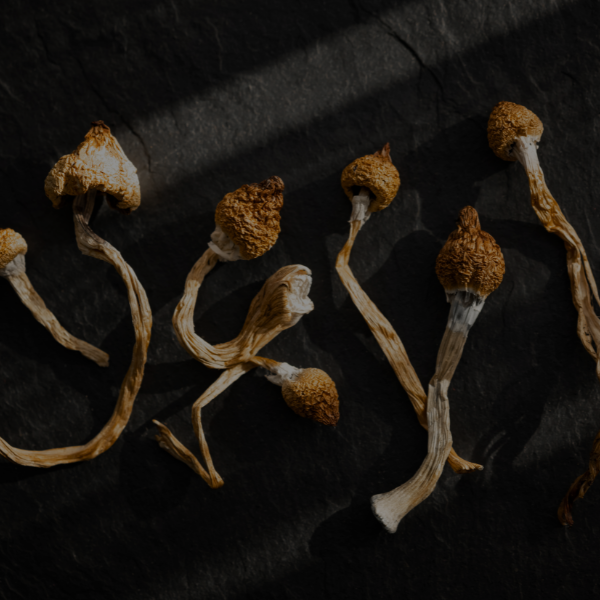

When you start exploring the world of magic mushrooms, you'll quickly come across two names: psilocybin and psilocin. While they sound similar, they play very different roles in the psychedelic experience. Think of it this way: psilocybin is the stable ingredient safely stored inside the mushroom, while psilocin is the active compound that actually produces the trip.
Your body is the bridge between the two. After you consume a mushroom, your digestive system gets to work and naturally converts psilocybin into psilocin, unlocking its mind-altering effects.
The Two Key Players in Your Psychedelic Experience
To really wrap your head around the magic mushroom journey, you have to meet its two main characters. These molecules work in a fascinating partnership where one is essentially a delivery vehicle for the other. Getting this dynamic is the first step to understanding how these fungi actually work inside our bodies.
Imagine psilocybin is a sealed envelope containing a secret message. You can hold the envelope, see it, and carry it around, but the message inside is completely hidden. It’s only when your body "opens" that envelope that it can finally read what's inside. In this case, that powerful, mind-expanding message is psilocin.
The Prodrug Concept Explained
In scientific terms, psilocybin is what's known as a prodrug. It's just a fancy way of saying it’s an inactive substance that your body metabolizes, or converts, into an active one. The mushroom produces psilocybin for a very practical reason: it’s incredibly stable. A protective phosphate group in its chemical structure allows it to survive drying, storage, and even the harsh environment of your stomach without breaking down.
Psilocin, on the other hand, is much more fragile. It degrades quickly when it’s exposed to heat or oxygen. This is why fresh mushrooms often turn a distinct blue color when they're bruised or handled—that blueing is the psilocin oxidizing right before your eyes. This instability makes pure psilocin difficult to work with, which is exactly why nature perfected this clever delivery system.
The core relationship is simple: Mushrooms contain the stable psilocybin, but it's the active psilocin that directly interacts with your brain to produce the profound shifts in perception, thought, and emotion.
Why This Relationship Matters
This conversion from psilocybin to psilocin isn’t just a minor chemical detail; it's the main event that kicks off the entire psychedelic experience. Without this transformation happening inside your body, the journey would never even begin. Your body holds the key that unlocks psilocin’s true potential.
Understanding this foundational concept helps explain several practical things about using mushrooms:
- Consistency: The prodrug mechanism ensures a reliable and predictable conversion process inside the body.
- Potency: The amount of psilocybin in a mushroom directly determines how much active psilocin will become available to your brain.
- Onset Time: The time it takes for your body to perform this conversion is a major factor in how quickly you start to feel the effects.
By understanding that psilocybin is the stable carrier and psilocin is the active agent, you gain a much clearer picture of the science behind the magic. You can learn more about the diverse fungi that contain these compounds by exploring different types of psilocybe mushrooms and their unique characteristics.
How Your Body Transforms Psilocybin into Psilocin
Once you’ve consumed magic mushrooms, psilocybin begins a remarkable journey through your body. The entire experience hinges on a critical biochemical transformation, a moment when the stable, dormant molecule awakens into its active form. This process is called dephosphorylation, and it's the metabolic event that unlocks everything.
Think of psilocybin as a key blank—it has the right general shape but lacks the specific grooves needed to fit the locks in your brain. Your body is the master key maker, using potent acids and enzymes as its tools to expertly cut that key. This biological key-cutting is what turns psilocybin into psilocin, the compound that actually produces the psychedelic effects.
The Chemical Conversion Process
This journey kicks off the second psilocybin hits your stomach. The highly acidic environment immediately gets to work on its molecular structure, starting the first step of the conversion. From there, specialized enzymes in your liver and intestinal tract take over.
These enzymes, especially alkaline phosphatases, are designed to do one thing: snip off psilocybin's protective phosphate group. This single chemical tweak is profound. It completely changes the molecule's properties, allowing it to slip across the blood-brain barrier—a highly selective filter that protects your brain. Psilocybin itself struggles to get past this barrier, but psilocin glides through with ease.
The diagram below maps out this fascinating journey from an inactive compound to the active psychoactive molecule.
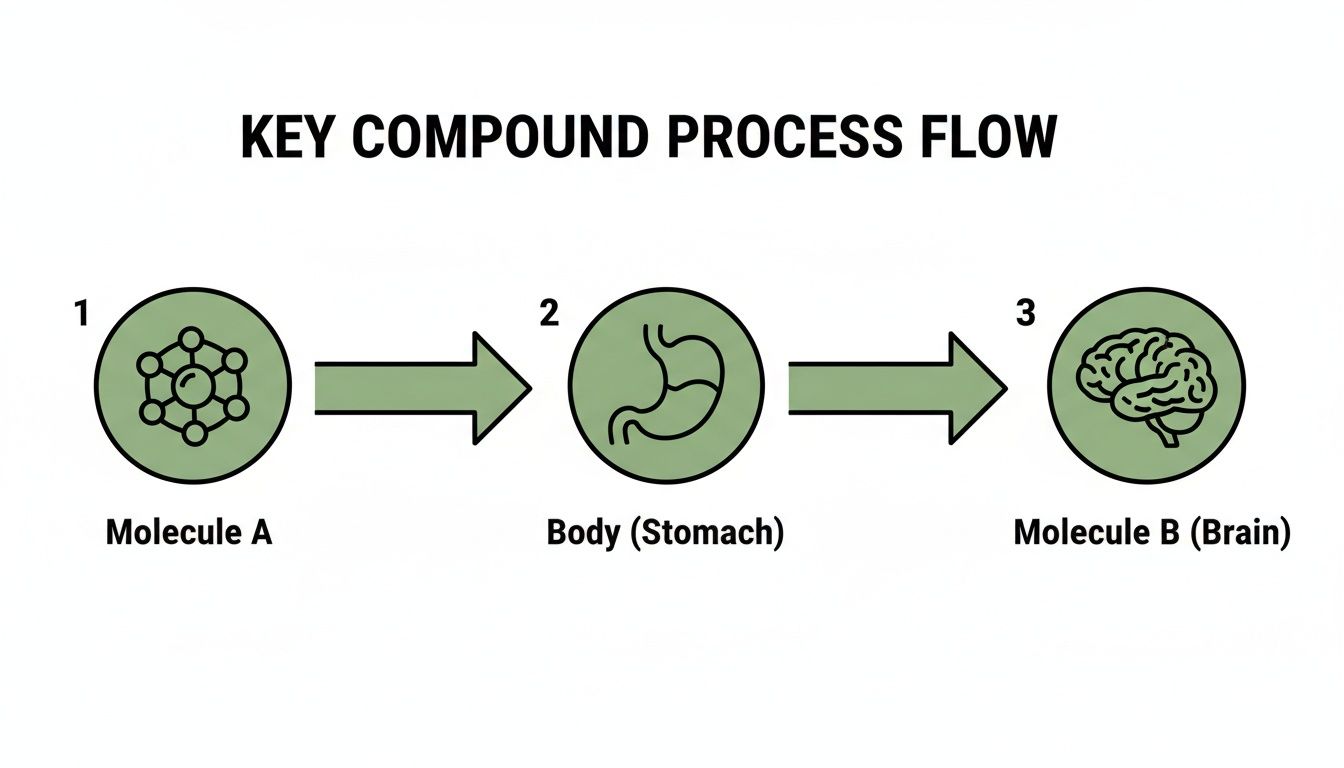
This visual really shows how your body acts as a natural laboratory, performing a precise chemical reaction to get psilocin ready for its ultimate destination.
Factors That Influence Conversion Speed
Not every conversion happens at the same pace. How fast your body transforms psilocybin and psilocin can be influenced by a few things, which in turn affects how quickly you feel the effects. Knowing these can help you better prepare.
- Consumption Method: How you take your mushrooms matters. Making a tea or using the "lemon tek" method can actually start the dephosphorylation process before ingestion, leading to a much faster onset.
- Metabolism: Your personal metabolic rate is a huge factor. A faster metabolism generally means a quicker conversion and a faster launch into the experience.
- Stomach Contents: Taking mushrooms on an empty stomach allows for more rapid absorption and conversion. A full stomach, on the other hand, can slow the whole process down considerably.
The Key Takeaway: The transformation of psilocybin into psilocin isn't just a side note—it is the central mechanism that makes the whole experience possible. Your body is an active participant, performing the essential chemistry to bring the mushroom's compounds to life.
This incredible natural process has been a part of human culture for centuries, though our scientific understanding is much more recent. Research was moving along steadily after Albert Hofmann first isolated psilocybin in 1957. For decades, scientists and clinicians have explored its potential. You can learn more about this complex history and research over at Beckley Retreats.
Psilocin and Its Dance with Your Brain Receptors
Once your body has done its job converting psilocybin into psilocin, the real show can finally begin. This is the moment the active compound reaches the brain and starts working its magic, producing those profound shifts in consciousness that define the whole experience. It all boils down to a clever bit of molecular mimicry—a case of mistaken identity so convincing that psilocin can waltz right into your brain's most important communication networks.
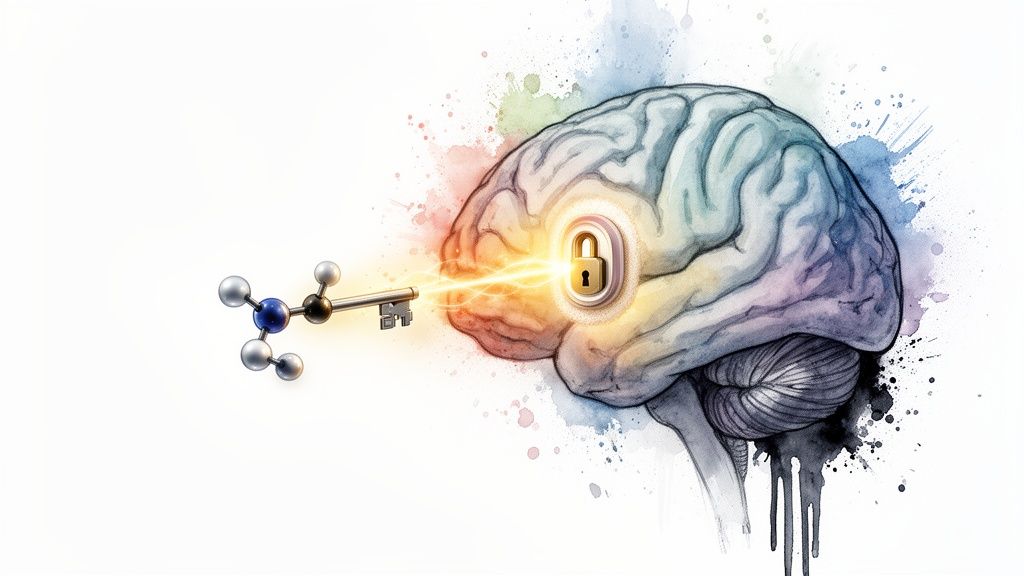
The secret is in its shape. The psilocin molecule looks uncannily similar to serotonin, a powerhouse neurotransmitter that’s basically in charge of your mood, happiness, and sense of well-being. Because of this resemblance, psilocin acts like a master key, slipping perfectly into specific serotonin receptors, most notably the 5-HT2A receptor.
When psilocin latches onto these receptors, it doesn't just copy serotonin; it activates them in a completely unique way, setting off a chain reaction of changes across your entire brain.
Unlocking New Brain Highways
The biggest change that happens when psilocin binds to these 5-HT2A receptors is a temporary rewiring of your brain’s communication grid. Think of your brain as a bustling city with well-worn traffic routes that keep everything running efficiently. Psilocin’s arrival temporarily quiets a major traffic hub called the Default Mode Network (DMN).
The DMN is the part of your brain tied to your sense of self, daydreaming, and all those well-worn, habitual thought patterns. When its activity dials down, the brain’s rigid structure loosens up. This allows parts of the brain that don't normally communicate to suddenly start chatting with each other.
Imagine a company where the creative team and the accounting department never speak. Then a new manager (psilocin) comes in and sets up direct lines between them, sparking totally unexpected collaborations and brilliant new ideas. That’s pretty much what happens in your brain, paving the way for fresh perspectives, sudden insights, and that classic feeling of interconnectedness.
This temporary shake-up in brain connectivity is the very engine behind the profound shifts in perception, thought, and emotion that people experience. It's not just a fleeting chemical high; it's a fundamental change in how your brain processes reality.
This mechanism is the core reason so many people report life-changing personal insights and breakthroughs in creative problem-solving.
The Link to Neuroplasticity and Wellness
The relationship between psilocybin and psilocin and your brain receptors isn't just about the trip itself; it may also have lasting benefits linked to neuroplasticity. Neuroplasticity is simply your brain's amazing ability to reorganize itself by forming new connections throughout your life.
It’s believed that psilocin’s activity at the 5-HT2A receptors actively promotes this process, encouraging the growth of new links between brain cells. This is a huge deal for overall wellness, since a more flexible, plastic brain is linked to better learning, sharper memory, and healthier emotional regulation. If you want to go deeper on this, you can learn more about psilocybin's effects on the brain and what these changes look like in practice.
Researchers are exploring several ways this interaction may support mental and emotional health:
- Reprocessing Emotions: By letting different brain regions talk, psilocin can help people revisit old emotional memories from a new, more detached point of view.
- Boosting Creativity: This increased cross-talk between brain networks is a breeding ground for divergent thinking, a cornerstone of creative and innovative thought.
- Breaking Old Habits: By quieting the DMN, psilocin can disrupt the rigid, looping thoughts common in conditions like depression and anxiety, opening the door for healthier mental patterns.
At the end of the day, psilocin’s incredible ability to act as a key to the brain's serotonin system is what makes the magic mushroom experience so powerful. It temporarily redraws the map of your brain's communication, fostering new connections and insights that can stick with you long after the journey is over.
Navigating the Timeline: Onset, Peak, and Duration
Understanding the rhythm of a psilocybin journey is one of the best ways to prepare for a comfortable and meaningful experience. Think of it like a story with a beginning, a middle, and an end. Every session follows this predictable arc—an ascent, a peak, and a gradual return. Knowing this timeline helps you relax and anticipate the flow, from the first subtle shifts in perception to the deeper insights that come later.
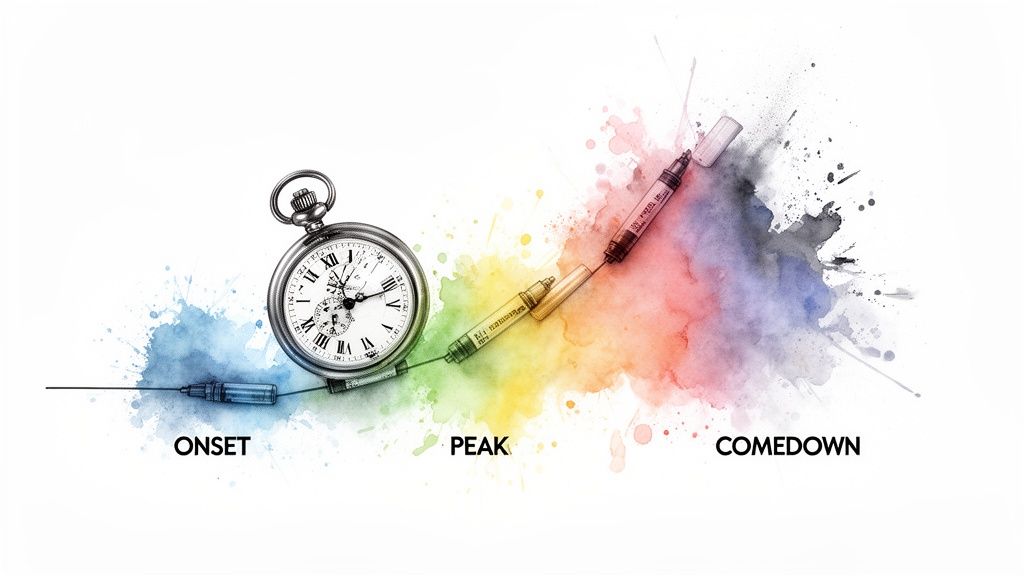
The whole experience with psilocybin and psilocin generally unfolds over four to six hours, but this can definitely vary. The first effects, or the "onset," usually appear within 20 to 60 minutes of consumption. This is when your body gets to work converting psilocybin into the active psilocin. You might notice colors seem a little brighter, or a light, pleasant sensation spreads through your body.
Mapping the Stages of a Journey
After the onset, the experience steadily builds toward its peak. This is the most intense phase of the journey, typically arriving around 2 to 3 hours after you've taken the mushrooms. It’s during this time that people often report deep personal insights, vivid visuals, and a powerful sense of emotional connection.
Once the peak passes, the effects start to soften into a gentle "comedown." This final stage can last for another two or three hours and is marked by a gradual return to your everyday awareness, often leaving you with a feeling of calm and reflection. All in all, the entire experience usually wraps up in about 4 to 6 hours.
Understanding this progression—onset, peak, and comedown—provides a reliable map for your experience. It helps you relax into the process, knowing that the intensity will naturally rise and fall over a manageable period.
Of course, this timeline isn't set in stone. A few key factors can shift these timings, making your personal journey unique.
How Personal Factors Shape Your Timeline
Your own body chemistry plays a huge part in how quickly psilocybin is converted to psilocin and absorbed. Everyone's metabolism is different; if yours is faster, you might feel the effects sooner and find the trip is a bit shorter.
What you've eaten recently also makes a big difference. Taking mushrooms on an empty stomach often leads to a much faster onset because there's nothing slowing down digestion. On the flip side, having them after a big meal can delay the start of your journey by an hour or more.
A Comparison of Psilocybin Product Timelines
The way you consume psilocybin can dramatically change the experience's timeline. It really comes down to how quickly your body can absorb the active compounds. Products that deliver psilocin more directly will naturally have a quicker onset.
To help you choose the best option for your intended experience, the table below breaks down the typical timelines you can expect from common product formats.
| Product Format | Typical Onset Time | Typical Peak Time | Total Duration |
|---|---|---|---|
| Raw or Dried Mushrooms | 30-60 minutes | 2-3 hours | 4-6 hours |
| Mushroom Chocolates | 30-60 minutes | 2-3 hours | 4-6 hours |
| Mushroom Capsules | 45-75 minutes | 2.5-3.5 hours | 4-7 hours |
| Mushroom Teas | 15-30 minutes | 1.5-2.5 hours | 3-5 hours |
As you can see, mushroom tea is often the fastest way to feel the effects, leading to a quicker onset and a slightly shorter trip. This happens because the hot water extracts the psilocybin and psilocin, making them immediately available for absorption. Capsules, however, need to be digested first, which explains the slight delay.
By keeping these variables in mind—your body, your last meal, and your chosen product—you can better predict and prepare for the unique rhythm of your experience.
Dosing, Potency, and Responsible Use
Having a good experience really boils down to being informed. When you step into the world of psilocybin, the two most important concepts to get your head around are potency and dosing. Getting these right is the key to tailoring your journey, whether you're after a subtle creative boost or a much deeper, more profound exploration.
One thing to know right away is that the concentration of psilocybin and psilocin isn't the same everywhere. It can swing wildly between different mushroom species, and even change from the cap to the stem of the exact same mushroom. This natural variation means that dosing with raw or dried mushrooms is often more of an art than a science.
This is exactly why standardized products, like precisely dosed chocolates or capsules, have become so popular. They take the guesswork out of the equation, giving you a predictable and consistent experience every single time. You know exactly what you're getting.
Understanding Dose Levels
The kind of experience you'll have with psilocybin is tied directly to the dose. Even a small adjustment can completely change the nature of the journey, which makes it crucial to understand the different dose categories. This knowledge lets you match your dose to your intention.
- Microdose: Think of this as a sub-perceptual dose, usually just a tiny fraction of a gram. It's designed to work quietly in the background, helping to enhance focus, spark creativity, and improve emotional balance without any noticeable psychedelic effects.
- Macrodose: This is what most people think of—a larger dose meant to bring on a full psychedelic experience. A macrodose can trigger profound shifts in how you see the world, lead to deep personal insights, and create a powerful sense of connection.
The real goal is to match the dose to the outcome you’re looking for. Whether you want a gentle nudge for your brain or a deep dive into your own consciousness, picking the right amount is the first and most important step.
For anyone looking to dial in their approach, our guide is packed with detailed info to help you find the perfect starting point. Check out our comprehensive psilocybin dosage guide for more specific advice.
The Importance of Set and Setting
Beyond the substance itself, two other factors have a massive impact on your experience: set and setting. This concept is probably the single most important principle for responsible psychedelic use.
Set is all about your internal world—your mindset, your mood, what you expect to happen, and your intentions for the journey. Going into an experience with a mind that's calm, open, and curious can make all the difference.
Setting is your external physical environment. You want a space that feels safe, comfortable, and familiar, where you won't be interrupted. The people you choose to be with are also a huge part of your setting.
These two elements work hand-in-hand to create the "container" for your journey. A positive mindset in a supportive environment lays the groundwork for a constructive and meaningful experience.
A Focus on Safety and Responsibility
When used mindfully, psilocybin has a remarkably good safety profile. Study after study has shown it has a low potential for creating dependence and poses minimal long-term health risks, which sets it apart from many other substances.
When it comes to safety, psilocybin and psilocin stand out with impressively low risks, making them a go-to for first-timers and seasoned explorers alike. A Dutch review covering decades of data found that its dependence potential was low, acute toxicity was moderate (with mostly mild reactions), chronic toxicity was negligible, and the risk to public health was basically zero.
In fact, over 41 years, only 4 deaths worldwide were directly linked to psilocybin, despite millions of uses. You can learn more about these public health findings at PMC.
Ultimately, a responsible approach—one rooted in education, preparation, and respect for these compounds—is the best way to ensure your exploration is both safe and beneficial.
Got Questions About Psilocybin and Psilocin?
Diving into the world of psilocybin and psilocin is bound to spark some curiosity. It's totally natural. Here, we'll tackle some of the most common questions that pop up, giving you clear, straightforward answers to build your confidence and understanding.
Think of this as a way to clear up any confusion and arm you with practical knowledge for your wellness journey. Let's get into it.
Why Is Psilocybin More Stable Than Psilocin?
It all boils down to a neat little piece of molecular architecture. Psilocybin has a special phosphate group attached to it, which acts like a protective bodyguard, shielding the molecule from breaking down when exposed to things like heat, light, and air.
This is exactly why dried mushrooms can stay potent for so long—their active ingredient is locked in a stable form. Psilocin, on the other hand, doesn't have this protective shield. It's much more fragile and degrades quickly.
Ever wonder about that blue bruising you see on fresh mushrooms when they get handled or damaged? That's psilocin's instability in action. The blue color is the visual evidence of psilocin oxidizing the second it hits the air.
This brilliant bit of natural chemistry keeps the mushroom’s potential perfectly preserved right up until you’re ready.
Can You Consume Psilocin Directly?
Theoretically, maybe in a highly controlled lab somewhere, but in the real world? Not really. Pure psilocin is so incredibly unstable that extracting it, stabilizing it, and storing it is practically impossible.
Honestly, the most efficient and natural way to experience psilocin is simply by consuming psilocybin-containing mushrooms. Your body is the perfect lab for the job.
It handles the chemical conversion from stable psilocybin to active psilocin flawlessly, right when it's needed, making sure the compound gets to your brain in its most effective form.
How Does Lemon Tekking Relate to Psilocin?
Lemon tekking is a popular prep method that’s a fantastic example of kitchen chemistry playing with the psilocybin and psilocin relationship. The whole idea is that the citric acid in lemon juice mimics the acidic environment of your stomach.
When you soak ground mushrooms in lemon juice, you're essentially kickstarting the conversion of psilocybin into psilocin before it even enters your body. This "pre-digestion" means the active psilocin can be absorbed much faster once you drink it.
People who use this method often report a much quicker onset and a more intense—though sometimes shorter—experience. It’s a great illustration of how understanding the science can help you tailor your own journey.
Do Psilocybin and Psilocin Show Up on a Standard Drug Test?
This is a big one for a lot of people. The short answer is usually no. Standard drug screenings, like the 5-panel tests most employers use, are looking for things like cannabis, cocaine, opiates, and amphetamines.
Psilocybin and psilocin aren't on that list. You'd need a specialized test to specifically look for psilocin or its metabolites. Even then, your body processes and eliminates psilocin pretty quickly—typically within 24 to 48 hours—so the detection window is very short.
A few things can affect that timeline:
- Dosage: A larger dose might take a bit longer for your body to fully process.
- Metabolism: Everyone's metabolic rate is different, which changes how fast compounds are cleared out.
- Frequency of Use: Regular use could potentially extend the detection window slightly.
So, while it's not a worry for most standard tests, it's still good to know how these compounds move through your system.
How Does a Microdose Differ from a Full Dose?
The difference here comes down to scale, intention, and the final effect. A microdose is a sub-perceptual amount—it's so small that you won't experience any classic psychedelic effects like visuals or a major shift in consciousness.
Instead, people microdosing often report subtle, positive changes in their day-to-day life, like:
- Sharper focus and more creativity
- A better mood and more emotional balance
- A gentle boost in energy and productivity
It works by giving your brain's serotonin system a little nudge, not a big push. A macrodose, or a full dose, is the opposite. The goal is to induce a powerful psychedelic experience, leading to significant changes in perception, thought, and emotion. The real difference is simply how much psilocin becomes available to your brain's receptors and how intense that interaction is.
Ready to continue your wellness journey with trusted, high-quality products? The Magic Mushroom Delivery offers a curated selection of premium mushroom products, from precisely dosed chocolates to classic dried mushrooms, all delivered discreetly to your door. Explore our collection and find the perfect fit for your needs at https://themagicmushroomdelivery.com.