


So, what exactly is a "bad trip?" You've probably heard the term thrown around, often with a sense of dread. It’s not a clinical diagnosis, but a common way to describe a psychedelic journey that takes a sharp turn from insightful or euphoric into something intensely frightening and chaotic.
Think of it as a temporary but powerful psychological storm. These experiences are almost always shaped by your internal state (set) and your external environment (setting), which is good news—it means they aren't totally random.
What a Challenging Psychedelic Trip Actually Feels Like

When someone says they had a "bad trip," they’re talking about a period of profound psychological turbulence. It’s less of a single event and more of an internal storm that feels incredibly real and all-consuming while it's happening.
Here’s a helpful way to picture it: Imagine your mind is a river. A positive psychedelic experience can feel like floating downstream, seeing the familiar landscape of your consciousness from new, beautiful angles. A challenging trip, on the other hand, is like being sucked into a violent whirlpool. You're completely disoriented, fighting a current you can't see, with no sense of which way is up.
The Core Components of a Difficult Journey
A difficult trip can show up in a few different ways, and these feelings often bleed into one another, creating a deeply unsettling state of mind. Getting familiar with these components helps pull back the curtain on the experience, moving the focus from raw fear to gentle awareness.
Most challenging trips involve a mix of these elements:
- Intense Psychological Distress: This is the heart of a bad trip. We're talking about overwhelming anxiety, gut-wrenching fear, or sudden, gripping paranoia. You might feel a crushing sense of dread, like something awful is just about to happen, or become convinced you’re in serious danger.
- Frightening Perceptions and Hallucinations: Visuals are a classic part of the psychedelic experience, but during a difficult journey, they can turn menacing. Patterns might feel hostile, colors can seem aggressive, and sounds may become distorted and threatening.
- Distorted Sense of Self and Reality: A hallmark of a tough trip is the loss of your stable sense of "you," a state sometimes called ego-dissolution. When this happens in a negative context, it can feel like you're dying, going insane, or simply ceasing to exist. Time itself can warp, making a few moments of fear feel like an eternity.
A challenging psychedelic experience often becomes a feedback loop: a scary thought triggers anxiety, and that anxiety makes the original thought even scarier. The secret is realizing you're not losing your mind—you're just caught in a temporary, super-charged emotional state.
This cycle is exactly what makes a bad trip feel so inescapable. Trying to fight for control usually just makes things worse. Learning how to ride out the storm, rather than battle it, is a much better path forward.
To make this clearer, let's look at how a positive journey and a challenging one stack up side-by-side.
Positive Trip vs Challenging Trip At a Glance
Here’s a quick comparison of the emotional, cognitive, and sensory experiences that typically define a positive psychedelic journey versus a challenging or 'bad' trip. This can help you recognize the signs in yourself or others.
| Characteristic | Positive Experience (Ego Dissolution) | Challenging Experience (Bad Trip) |
|---|---|---|
| Emotional State | Feelings of unity, love, euphoria, and profound connection to the world and others. | Intense fear, paranoia, anxiety, panic, and a sense of impending doom. |
| Cognitive State | Creative insights, spiritual awakenings, clarity, and a new perspective on life. | Confusing thought loops, inability to distinguish reality, and a conviction it will never end. |
| Sensory Perception | Beautiful visuals, enhanced appreciation for music and art, pleasant body sensations. | Frightening or menacing visuals, distorted sounds, and uncomfortable physical feelings. |
| Sense of Self | A liberating feeling of transcending the ego, leading to a sense of interconnectedness. | A terrifying feeling of losing control, going insane, or ceasing to exist. |
Ultimately, the goal isn't to avoid all challenges—sometimes the most difficult parts of a trip offer the most profound lessons. The goal is to be prepared, so you can navigate those moments with awareness instead of fear.
The Real Causes Behind a Difficult Trip

A difficult psychedelic experience rarely just materializes out of thin air. It’s almost never a random event. The single most powerful thing you can do to avoid one is to understand what actually causes them, turning raw fear into mindful preparation.
The entire architecture of a psychedelic journey really comes down to two foundational pillars, famously summed up by the phrase “set and setting.” Think of them as the core ingredients that determine the entire flavor of your trip.
Your Internal World: Set
"Set" is just a shorthand for your mindset—it’s a snapshot of your complete internal world the moment you begin. We’re talking about your mood, your thoughts, your expectations, and even your deeper personal history and anxieties.
Imagine your consciousness is a house. If you start a journey when that house is tidy, calm, and filled with sunlight, the experience will likely feel expansive and peaceful. But if you begin when that same house is cluttered with stress, unresolved emotions, or anxiety, things can quickly get chaotic.
This internal state is, without a doubt, the most critical factor. Going into a trip feeling angry, sad, or anxious can amplify those feelings to an overwhelming degree, paving the way for a difficult time.
Your External Environment: Setting
"Setting" is all about your external environment—the physical space you're in and the people you're with. It’s the literal stage where the internal drama of your trip plays out. A comfortable, supportive setting acts as a safe container, giving you the security you need to explore your own mind without fear.
Just think about the night-and-day difference between these two scenarios:
- Scenario A: You’re in a quiet, familiar room with soft lighting, listening to calming music, and have a trusted friend nearby.
- Scenario B: You’re at a loud, crowded party with flashing lights, surrounded by strangers you don’t really know.
Even if your mindset is identical, the trip in Scenario B is far more likely to become overwhelming, triggering paranoia or panic. Your environment has a direct line to your emotional state.
A landmark study from Johns Hopkins University drove this point home. Researchers surveyed nearly 2,000 people about their most challenging psilocybin experience and found that a startling 10.7% felt their trip put themselves or others at risk of physical harm. The study pinpointed higher doses and the absence of supportive company as key factors in these dangerous situations, highlighting just how crucial a calm, safe setting really is.
For us at The Magic Mushroom Delivery, this kind of data is exactly why we put such a heavy emphasis on education. We serve adults aged 21 and over, and we firmly believe that a solid understanding of set and setting is the bedrock of responsible use.
The Critical Role of Dosage
Beyond set and setting, the single most powerful physiological factor is dosage. Taking too much, especially for a first-timer, is one of the fastest tickets to a difficult and intensely overwhelming experience.
Psychedelics are amplifiers. A low dose might feel like turning up the volume on your thoughts and senses, making everything more vibrant and clear. A high dose, on the other hand, can feel like blasting that volume until the speakers blow out, leading to total disorientation, confusion, and fear.
This is exactly why the principle of "start low, go slow" is a universal harm-reduction mantra in the community. You can always take more on another day, but you can never take less once it's in your system. Respecting the substance by starting with a conservative dose isn't a sign of weakness—it's a sign of wisdom. Our detailed guide on dosing can help you make a smart, informed decision for your own journey.
By carefully managing your mindset, choosing a safe environment, and being mindful of your dose, you reclaim a huge amount of control. You can't steer every twist and turn of the psychedelic river, but you can absolutely choose where you put your boat in the water and how you prepare for the current.
Recognizing the Early Warning Signs of a Bad Trip
Knowing how to spot the early signs of a difficult trip is the first step in steering it toward a more positive outcome. Think of these signs not as blaring alarms, but as gentle nudges from your subconscious, signaling that it’s time to pay closer attention.
When you learn to catch these subtle shifts, you or a trip sitter can step in with support. This can transform a potential negative spiral into a manageable, and sometimes even insightful, challenge.
These warning signs can be sneaky at first, often starting as a quiet sense of unease before blooming into something more intense. They typically show up in three main areas: your emotions, your thoughts, and your body. Learning to recognize them is a critical skill for anyone exploring psychedelics.
Early Warning Signs of a Challenging Trip
Spotting a difficult trip early on is all about awareness. The experience can shift quickly, so knowing what to look for—in yourself or in a friend—can make all the difference. The table below breaks down the common emotional, cognitive, and physical signals that indicate a journey is becoming turbulent. Think of this as a quick-reference checklist to help you identify when it might be time to offer support, change the setting, or simply take a few deep breaths.
| Category | Warning Signs to Watch For |
|---|---|
| Emotional | – Sudden, intense spikes in anxiety or dread – Feelings of paranoia (being watched, judged, or conspired against) – Primal, unexplained fear that feels life-threatening – Waves of overwhelming sadness, grief, or hopelessness |
| Cognitive | – Getting stuck in a repetitive, negative thought loop – Deep confusion about where you are or what is happening – Losing the ability to tell the difference between internal thoughts and external reality – Fixating on a single, disturbing idea or memory |
| Physical | – Racing or pounding heart (tachycardia) – Nausea, stomach cramps, or a "gut-wrenching" feeling – Uncontrollable shaking, trembling, or chills – Dizziness and a physical sense of disorientation or being unsteady |
Recognizing these signs isn't about avoiding difficulty altogether; some of the most profound psychedelic experiences have challenging moments. It's about being prepared to navigate those moments with compassion and skill, turning a crisis into an opportunity for growth.
Emotional Signals: The First Ripples
The very first clues that a journey is getting turbulent are almost always emotional. A psychedelic experience turns the volume way up on whatever you're feeling, and when negative emotions surface, they can quickly become overwhelming if you ignore them.
What you're looking for is an abrupt and negative shift in the emotional tone. An experience that started with joy and wonder might suddenly curdle into something much darker.
Keep an eye out for these emotional red flags:
- Sudden Spikes in Anxiety: This is more than a fleeting worry. It's a creeping sense of dread that feels impossible to shake, as if something is about to go terribly wrong.
- Creeping Paranoia: A vague suspicion can balloon into a full-blown conviction. You might start to feel that you're being watched, that the people around you have hidden motives, or that you're in some kind of trap.
- Primal, Unexplained Fear: This is a raw, gut-level fear that isn’t tied to anything specific in your environment. It's a deep-seated feeling that you are in grave danger, even when you logically know you’re safe.
- Overwhelming Sadness or Despair: A sudden tidal wave of grief or hopelessness can crash over you, making the world feel bleak, empty, and oppressive.
Noticing these feelings early is your cue to make a change. It's a signal to switch the music, move to a different room, or simply acknowledge the feeling without letting it become the whole story.
Cognitive Traps: When Your Mind Turns Against You
As your emotions shift, your thought patterns often follow. Your mind can get stuck in repetitive, looping cycles that act like fuel for the growing anxiety. These cognitive traps are a hallmark of a challenging trip.
One of the most common is the thought loop. This is when you're stuck on a single, often negative, question or idea that plays over and over like a scratched record. You might find yourself repeatedly thinking, "Am I going crazy?" or "Will this ever end?" without ever finding an answer. This mental hamster wheel only deepens the sense of being trapped.
Other cognitive warning signs include:
- Profound Confusion: You might completely lose your bearings—forgetting where you are, who you're with, or what you were just doing. The narrative of your experience starts to fracture, leaving you feeling lost.
- Blurring Reality: The line between your inner world and outer reality starts to dissolve in a scary way. You might begin to believe your paranoid thoughts are 100% true or that your internal fears are manifesting externally.
Body Alarms: Physical Reactions to Inner Turmoil
Finally, your body often sends the clearest signals that you're in distress. These physical symptoms are your nervous system screaming for help in response to the intense psychological storm you're weathering.
A challenging trip is a full-body experience. Your mind and body are locked in a feedback loop, and listening to your body’s distress signals is often the fastest way to realize your internal state needs support.
Look for these common physical red flags:
- Racing Heart: A pounding heart that feels like it’s going to beat out of your chest is a classic sign of a panic response.
- Nausea or Stomach Discomfort: Your gut is incredibly sensitive to your emotional state. Anxiety and fear often show up as a knot in your stomach or outright nausea.
- Shaking or Chills: Uncontrollable trembling or feeling intensely cold, even in a warm room, can accompany a surge of fear.
- Dizziness or Disorientation: A physical sensation of being unsteady, lightheaded, or disconnected from your body.
Again, the goal isn't to prevent every difficult moment. It's about empowering yourself to respond with skill and compassion, turning a moment of crisis into a chance to practice surrender and self-care.
How to Navigate a Difficult Psychedelic Experience
When a psychedelic journey starts to feel more like a storm than a gentle cruise, the experience can be intense, overwhelming, and feel like it'll never end. But it will. And more importantly, there are practical, in-the-moment things you can do to steer your ship back toward calmer waters.
The goal isn't to fight the storm—it's to learn how to ride the waves with a little more grace and a lot less fear.
The most powerful tool you have in these moments is surrender. Honestly, a challenging trip often spirals into a "bad trip" the moment we start fighting it. Resisting the weird thoughts, scary feelings, or intense body sensations just creates a feedback loop of fear and panic. Learning to accept and flow with whatever is coming up can turn a moment of crisis into one of real insight.
The Power of Changing Your Setting
One of the fastest and most effective ways to break a negative thought loop is to simply change your physical environment. Your setting has a direct, immediate impact on your internal world. If you feel anxiety creeping in, don't just sit there and let it build. Move.
Even small adjustments can make a world of difference:
- Move to a Different Room: If the living room suddenly feels claustrophobic, try moving to a quieter bedroom. A simple change of scenery can be enough to completely reset your mental state.
- Go Outside (If It's Safe): Stepping into a familiar, peaceful backyard to feel the breeze or look at the stars can be incredibly grounding. Just make sure the space is secure and you won't wander off.
- Adjust the Music: Music is a huge emotional driver. If the playlist suddenly feels jarring or chaotic, switch it to something gentle and instrumental, or just turn it off entirely. Silence can be golden.
- Change the Lighting: Dim any bright, harsh lights. Turn on a soft, warm lamp instead. Creating a cozier atmosphere helps you feel safer and more relaxed.
Grounding Techniques to Reconnect with the Present
When your mind feels like it's a million miles away, lost in a sea of confusing thoughts, grounding techniques are your anchor. These are simple sensory exercises designed to pull your awareness back to the here and now—back to the safety of your own body.
Here are a few classics that work:
- Focus on Your Breath: It sounds cliché, but it works. Take slow, deep breaths. Try inhaling for a count of four, holding for four, and exhaling for a count of six. Focusing on the physical feeling of air entering and leaving your lungs calms the nervous system right down.
- Engage Your Senses (The 5-4-3-2-1 Game): Look around and name five things you can see. Then, name four things you can feel (the soft texture of a blanket, the cool floor under your feet). Name three things you can hear, two you can smell, and one you can taste.
- Hold a Comforting Object: Grab a smooth stone, a favorite blanket, or anything with a pleasant, familiar texture. Just focus on how it feels in your hands.
This flow chart breaks down how a difficult trip often shows up—first emotionally, then mentally, and finally physically.
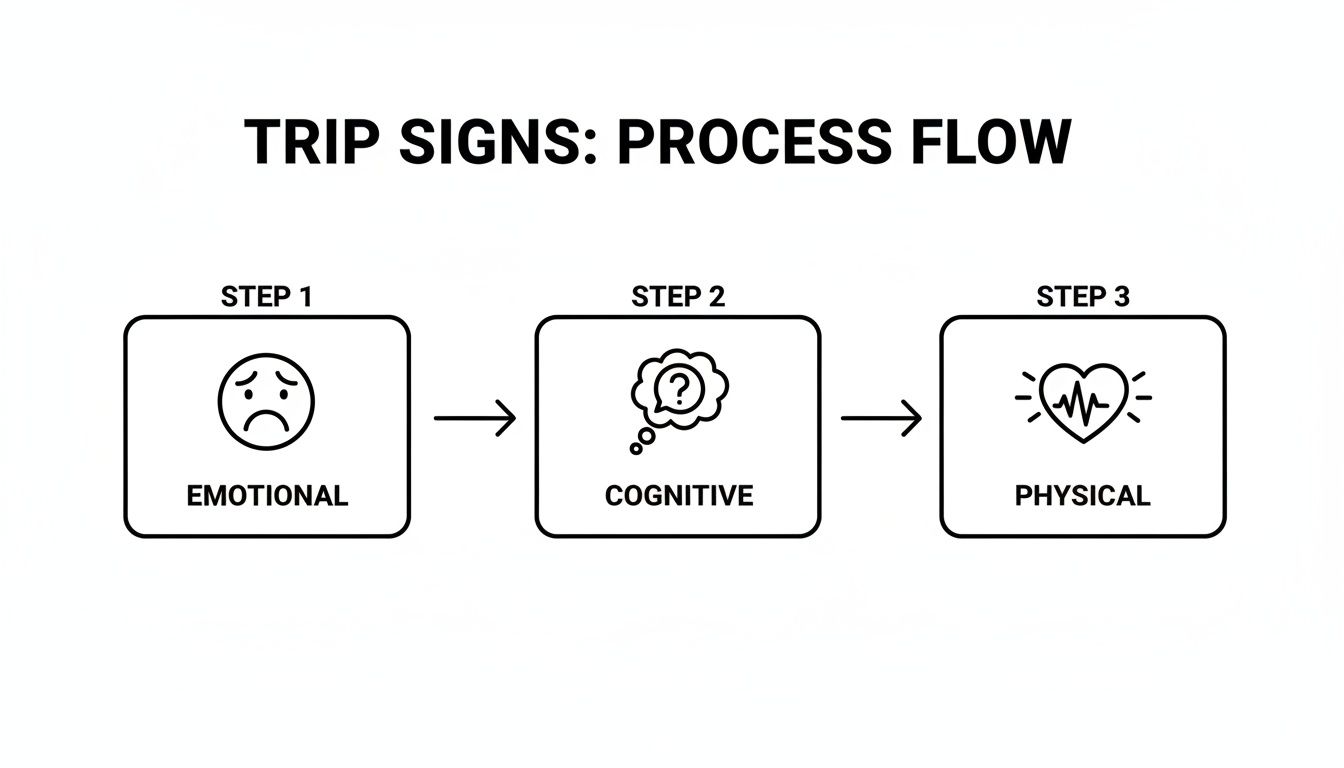
As you can see, the distress often starts with a shift in feelings, which can lead to confusing thought patterns, and then manifest as physical symptoms like a racing heart or tense muscles.
Tips for Effective Trip Sitting
If you're the one holding space for someone having a tough time, your calm, reassuring presence is the most important thing you can offer. A trip sitter's job isn't to "fix" anything; it's to be a stable anchor in their storm.
Here’s how you can provide support without being intrusive:
- Offer Simple Reassurance: Remind them that they are safe, that what they're feeling is temporary and caused by the substance, and that you're going to stay with them. Keep your words simple, calm, and kind.
- Avoid Probing Questions: Now is not the time to play therapist. Asking deep, analytical questions like, "What are you seeing?" or "Why do you think you feel that way?" can make them feel more confused and pressured. Stick to gentle, grounding statements.
- Encourage Hydration: Offer a glass of water. The simple act of holding a glass and sipping can be incredibly grounding. It gives them a small, manageable task to focus on.
- Suggest a Change of Scenery: Gently ask if they'd like to move to another room or if they'd prefer different music. Don't force it, just offer it as an option.
Key Takeaway: The core of getting through a tough trip is remembering three simple truths: "I am safe," "This is temporary," and "I took a substance." Repeating these like a mantra can be a lifeline when you feel lost in fear or confusion.
The sheer power of these experiences is backed by research. In one survey of psilocybin users, 39% rated their "worst bad trip" among the top five most challenging experiences of their entire lives. The study also found that the worst difficulties happened when people felt physically uncomfortable or lacked support, which really hammers home how crucial a safe setting is. You can learn more about these findings on challenging psychedelic experiences.
Navigating these moments is a skill. And like any skill, it gets easier with the right preparation and a bit of practice. If you find the experience is still too intense as it winds down, our guide on how to come down from shrooms has more tips for managing the final stages of the journey.
Turning a Bad Trip into Meaningful Growth

The journey doesn't just stop when the visuals fade. In fact, the hours, days, and weeks that follow a difficult psychedelic experience are where the real work—and the real growth—begins. This period is what we call integration.
A challenging trip can leave you feeling shaken, fragile, and emotionally raw. But buried within that turbulence is often a powerful opportunity for change. By approaching this aftermath with intention and a bit of self-compassion, you can start to transform what felt like a scary ordeal into a catalyst for profound personal insight.
The key is to try and reframe the "bad trip." Instead of seeing it as a personal failure or some random psychological glitch, consider it your mind bringing difficult, buried material to the surface. It’s an invitation to look closer, even if what you're seeing is uncomfortable at first.
The Gentle Art of Making Sense of It All
After a tough experience, your first instinct might be to slam the door on those memories and try to forget it ever happened. Resisting that urge is the first step. Giving yourself the time and space to process is how you start finding meaning in the chaos.
Rushing back into your normal routine without any reflection can leave those emotional wounds wide open.
So, give yourself permission to rest. Your mind and body have just been through the wringer, and they need gentle care. Think of it like recovering from a high-fever dream; you need quiet, comfort, and time to let your system recalibrate and find its footing again.
Practical Tools for Post-Trip Integration
Integration isn't some mystical, complicated process. It's really just about using simple, grounded practices to help you understand and absorb the lessons from your experience. These tools build a bridge between the wild insights from your journey and your day-to-day life.
Here are a few practices that can make a huge difference:
- Journaling: Get it all out on paper. Write down everything you can remember about the trip without judging or censoring yourself. Describe the feelings, the images, the thoughts—both the terrifying and the beautiful. The simple act of putting it into words helps you see it more clearly and might reveal patterns you missed in the moment.
- Talking It Out: Find a trusted, non-judgmental friend or partner and just share your experience. Simply saying what happened out loud can be incredibly healing and makes you feel less alone with the heavy memories.
- Connecting with Nature: Spending quiet time outdoors can be exceptionally grounding after a disorienting experience. Go for a slow walk in a park, sit by some water, or just pay attention to the clouds. Nature has a way of putting things back into perspective and calming a frayed nervous system.
The aftermath of a difficult trip is a sensitive period. A study of psychedelic users found that 67% dealt with emotional challenges like anxiety or paranoia afterward, with a third of those individuals feeling the effects for over a year. Many, however, eventually found ways to integrate the lessons for long-term personal growth. You can read the full analysis on psychedelic bad trips to learn more.
This data really highlights why post-trip care isn't just a nice-to-have; it's an essential part of the psychedelic process.
Finding the Lesson in the Challenge
Even the most frightening trips can contain hidden gifts. The things that came roaring to the surface—the fears, the anxieties, the difficult memories—are often the very things holding you back in your daily life. The experience may have simply held up a giant magnifying glass to them.
Try asking yourself some gentle, curious questions:
- What was the core fear that kept showing up?
- Did any of it remind me of past events or unresolved issues?
- If this whole ordeal had a message for me, what might it be?
You don't need to find some grand, life-altering answer right away. The goal is just to stay curious and open to the possibility that the challenge contained valuable information. Over time, what once felt like a terrifying storm can be seen as a cleansing rain, clearing the way for new growth to emerge. Exploring the wide variety of magic mushroom experiences can also provide a broader context for your own unique journey.
Answering Your Questions About Bad Trips
As we've walked through the landscape of challenging psychedelic experiences, it's totally normal for some specific questions to pop up. Getting a handle on what a "bad trip" really is means more than just knowing the signs; it's about clearing up common fears and myths. This last section is all about giving you direct, reassuring answers to the questions we hear most often, so you can go into any potential journey feeling knowledgeable and confident.
The goal here is to really lock in the key ideas from this guide—preparation, respect for the substance, and the power of integration—so you feel ready for whatever comes your way.
Can a Bad Trip Cause Permanent Psychological Damage?
This is usually the biggest fear people have. While a bad trip is an incredibly intense and distressing event, it is exceptionally rare for it to cause permanent damage in an otherwise healthy person. That said, the emotional aftershocks, like lingering anxiety or paranoia, can sometimes hang around for a bit, especially if the experience isn't properly unpacked afterward.
For most people, though, these feelings are temporary and fade with time. The risk of lasting issues really goes up for individuals with a personal or family history of certain mental health conditions, like psychosis or bipolar disorder. This is exactly why an honest self-assessment and responsible preparation are non-negotiable parts of harm reduction.
The real key to resolving any lingering feelings of unease is integration. Actively working through the experience—whether that's talking it out with a trusted friend, journaling your thoughts, or just giving yourself quiet time to process—is the most effective way to find closure and even meaning in it.
Trying to just ignore a difficult trip can let the emotional residue fester. But if you face it with curiosity and compassion, you can absorb its lessons and move forward without carrying all that extra weight.
Are Some People More Prone to Bad Trips Than Others?
Yes, absolutely. Certain factors can definitely make someone more susceptible to a challenging journey. The most powerful of these is your 'set,' or your internal mindset. Going into a psychedelic experience feeling highly anxious, stressed, angry, or depressed is like setting sail in a storm; your chances of a turbulent ride are much, much higher.
Several other factors also play a huge role:
- Underlying Vulnerabilities: If you have a history of trauma or pre-existing mental health struggles, you're at a greater risk of having difficult material surface in an overwhelming way.
- The 'Setting': Your external environment is massively influential. An unfamiliar, chaotic, or public space dramatically increases the odds of a bad trip compared to a safe, private, and comfortable one.
- Dosage and Inexperience: Taking too high a dose, especially if you're new to psychedelics, is one of the most common triggers for a frightening and unmanageable journey.
This is why the "start low, go slow" mantra is so vital. By beginning with a conservative dose in a secure setting with a trusted companion, you're knocking out many of the biggest risk factors right from the start.
What Is the Most Important Thing to Remember If a Trip Goes Bad?
If you find yourself in the middle of a storm, the single most important thing to hold onto is this: surrender to the experience rather than fighting it. Resistance is the fuel that turns a challenging moment into a full-blown bad trip. When you struggle against difficult emotions or bizarre perceptions, you create a vicious feedback loop of fear and panic that just spirals.
Remind yourself, or have your trip sitter gently remind you, of these three fundamental truths:
- "This is the effect of a substance I have taken." This simple fact grounds you, reminding you that your experience has a clear cause.
- "I am physically safe." This helps calm the primal fear that can take over when your sense of reality is shaken to its core.
- "This feeling is temporary and it will end." This is your lifeline. Remembering that the experience has a finite duration is crucial for getting through the most intense moments.
By accepting the difficult emotions, scary thoughts, and strange perceptions without judgment, you allow them to flow through you and, eventually, pass. This act of surrender can feel incredibly difficult in the moment, but it's the master key to navigating the storm. Often, it's what transforms the most frightening parts of an experience into the most meaningful ones.
At The Magic Mushroom Delivery, we believe education is the bedrock of a safe and positive experience. Our curated selection of high-quality, organic mushroom products is designed for adults looking to explore with confidence. From our fast, discreet nationwide shipping to our detailed educational resources, we are committed to providing you with both the products and the knowledge you need for a responsible journey.
Explore our collection and learn more at https://themagicmushroomdelivery.com.