
When psilocybin enters the picture, it temporarily reconfigures your brain's entire communication network. Think of it as quieting the brain's usual alpha dogs—those dominant neural pathways we tread every day—while encouraging new, flexible conversations between regions that don't normally talk to each other. The result is a profound shift in perception, thought, and emotion, all driven by a fundamental change in how your brain operates.
A Tour of Your Brain on Psilocybin
Let's take a look at what’s really going on inside your head when psilocybin is at work. This is your map to the neuroscience of the experience, designed to make some pretty complex topics easy to grasp. We’ll frame psilocybin not just as a compound, but as a key that temporarily unlocks and re-tunes your brain's operating system.
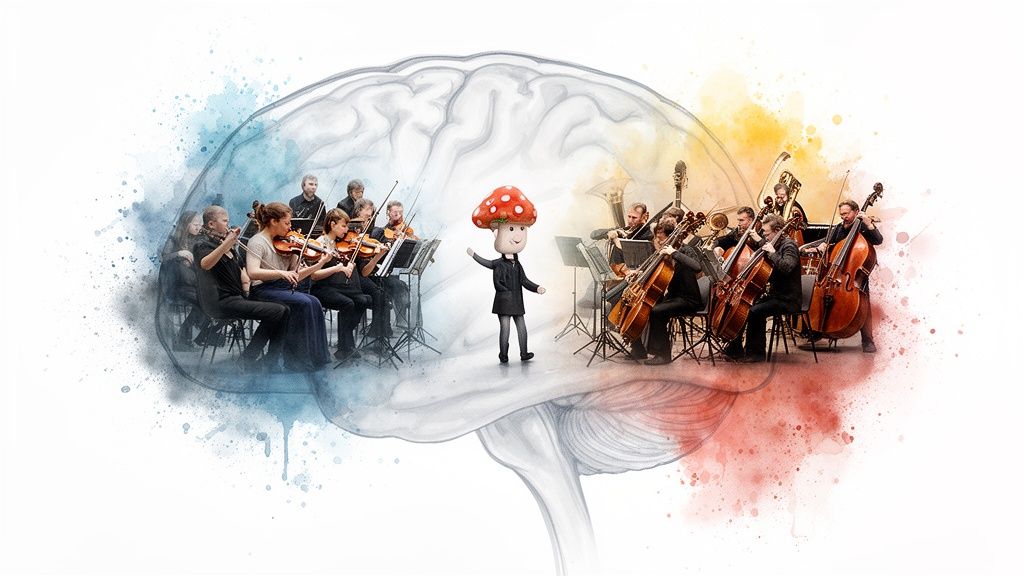
Imagine your brain as a symphony orchestra that's gotten used to playing the same old tunes day in and day out. Certain sections, like the lead violins, always take center stage, representing your routine thought patterns and the stories you tell yourself. Psilocybin is like a guest conductor stepping onto the podium with a completely new score.
A New Conductor in the Brain
This new conductor doesn’t just change the tempo; it rewrites the entire performance. It gently quiets those overbearing lead violins—your dominant, often rigid, ways of thinking. At the same time, it encourages sections that rarely interact, like the quiet woodwinds and the distant percussion, to start playing together in beautiful and unexpected harmonies.
This neurological remix is the core of psilocybin's effects on the brain. The whole point of this guide is to demystify the science behind it all. We want to translate the intricate neuroscience into clear, understandable concepts, whether you're just curious or have been exploring for years.
Think of it this way: Psilocybin doesn't add new musicians to your orchestra. Instead, it rearranges the seating chart and rewrites the music, allowing for a performance that is more interconnected, fluid, and novel than the one your brain is used to playing.
What You Will Discover
We're going to take a clear, responsible, and fascinating look at how this remarkable compound interacts with our neural hardware. Our journey will cover a few key areas to build a complete picture of what's happening inside the mind.
This guide will cover:
- The Biochemical Spark: How psilocin, psilocybin's active form, actually "talks" to your brain cells.
- Altering Brain Networks: Its impact on the "autopilot" systems that shape our sense of self.
- Promoting Neural Growth: How it can literally encourage the brain to forge new connections.
By the end, you'll have a much deeper appreciation for the intricate dance between chemistry and consciousness. Our goal here is to arm you with knowledge, fostering a respectful and informed perspective on the profound changes psilocybin can kickstart in the brain.
How Psilocybin Unlocks Your Brain Cells
To really get what's happening during a psilocybin journey, we have to look at the very first moment the compound meets your brain cells. It all kicks off with a simple, yet incredibly powerful, biochemical handshake. The second you ingest psilocybin, your body gets to work, quickly converting it into its active form: psilocin.
This newly created molecule, psilocin, holds a fascinating secret. Its structure is a near-perfect mimic of serotonin, one of the brain’s most crucial neurotransmitters. Serotonin is a master regulator, pulling the strings on everything from your mood and happiness to sleep and appetite. Because psilocin looks so much like serotonin, it can slip into the brain's machinery in a very special way.
The Lock and Key Mechanism
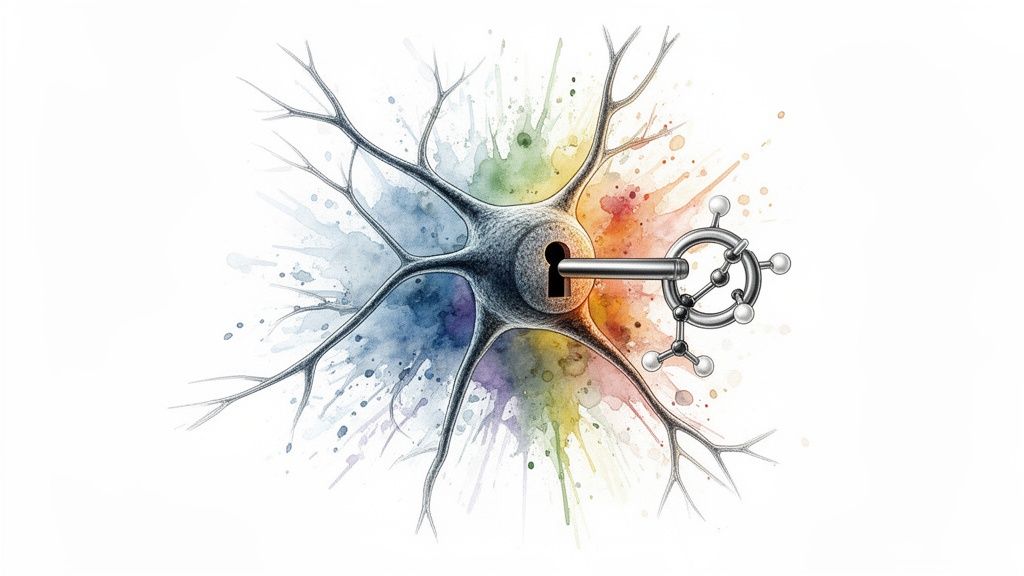
Imagine your brain’s neurons are covered in millions of tiny, specialized locks called receptors. Neurotransmitters like serotonin are the keys, floating around until they find the one specific lock they’re designed to fit. When a key slides into a lock, it turns, sending a message to the cell and kicking off an action.
Psilocin acts like a master key for one very special type of serotonin lock: the 5-HT2A receptor. While it can jiggle a few other locks, its main, and most profound, action happens right here. These receptors are packed into the brain regions that handle our most complex thinking—things like introspection, imagination, and our sense of self.
The activation of the 5-HT2A receptor is the single biochemical event that launches the entire psychedelic experience. It's the molecular switch that flips your brain from its everyday, normal programming into a completely different mode of operation.
When psilocin binds to these 5-HT2A receptors, it's like turning that key and setting off a chain reaction of neurological events. This one interaction is the foundation for everything that follows.
The Glutamate Cascade
Once that 5-HT2A receptor is switched on, it doesn’t just send a simple text message—it triggers a full-blown cascade. One of the most important downstream effects is the release of another powerful neurotransmitter called glutamate. Think of glutamate as the brain’s main accelerator pedal; it’s the primary chemical messenger that ramps up neural activity.
This sudden release of glutamate creates a surge of energy and communication throughout key brain circuits, especially in the cortex. This surge is what underlies the state of heightened brain activity and connectivity that we recognize as the classic psilocybin experience.
The whole biochemical journey can be broken down into a few key steps:
- Conversion: Your body metabolizes psilocybin into the active compound, psilocin.
- Mimicry: Psilocin’s structure impersonates serotonin, allowing it to cozy up to serotonin receptors.
- Binding: Psilocin fits perfectly into the 5-HT2A receptor, just like a key in a lock.
- Activation: This triggers a domino effect, boosting the release of the excitatory neurotransmitter glutamate.
- Effect: The brain fires up, entering a state of heightened, more flexible activity.
This single, elegant interaction at the cellular level is the launchpad for the profound shifts in perception, thought, and emotion that define the journey. It's the scientific starting line for the remarkable experience that unfolds within the mind.
Quieting the Brain's Autopilot System
Beyond that initial spark at the receptor level, one of the most incredible things psilocybin does is temporarily quiet our inner narrator—that constant voice in our head. To really get this, we need to talk about something called the Default Mode Network (DMN). Think of it as your brain's internal autopilot system.
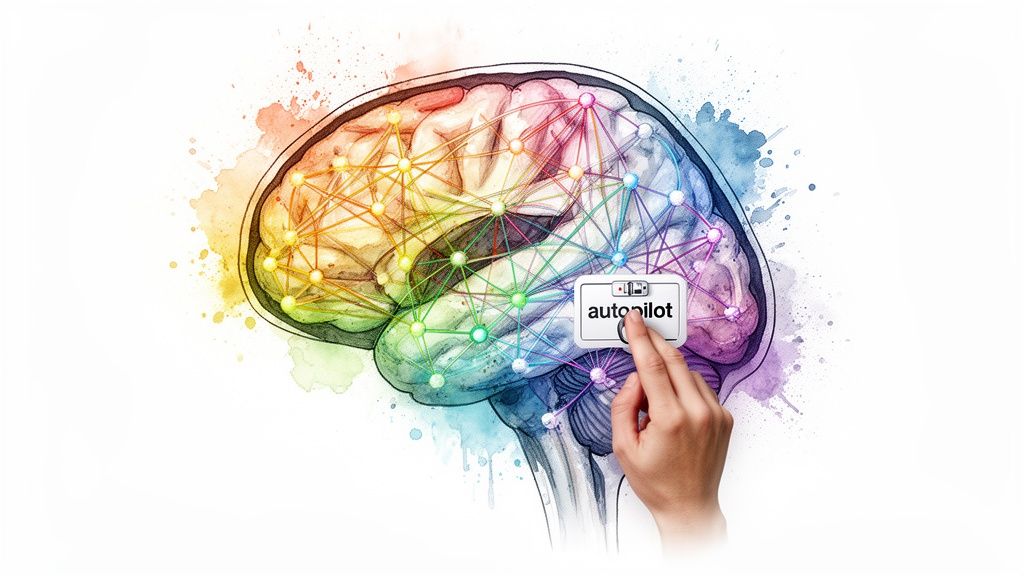
The DMN is the part of your brain that hums along when you aren't focused on any particular task in the outside world. It’s the hub for daydreaming, thinking about the past, worrying about the future, and basically constructing your sense of "me."
Now, this network is vital for having a sense of self, but it can get stuck in a rut. When the DMN becomes overactive and rigid, it can trap us in cycles of rumination and repetitive negative thoughts—the very hallmarks of conditions like depression and anxiety.
Hitting the Reset Button on the DMN
This is where psilocybin makes a dramatic entrance. Thanks to functional magnetic resonance imaging (fMRI) studies, we can actually peek inside the brain during a psychedelic experience, and what we see is pretty striking. Psilocybin significantly dials down the activity within the DMN.
Imagine your DMN is a busy highway system your thoughts travel on every single day. The routes are well-worn, efficient, and totally predictable. Psilocybin acts like a traffic controller that temporarily closes these main highways, forcing your thoughts and perceptions to find new, creative detours.
This drop in DMN activity is the neurological bedrock for what many people call "ego dissolution" or a feeling of "oneness" with everything. With that internal narrator turned down, the strict boundaries between you and the world start to blur, opening the door to a more expansive state of consciousness.
This isn't just a feeling; it's a measurable shift in how the brain functions. One landmark study showed just how dramatically psilocybin rewires brain communication. The research found that psilocybin caused widespread changes in connectivity across the cortex, thalamus, and hippocampus—impacting regions over 3 times greater than a stimulant like methylphenidate. The most significant shifts were in the DMN, which became desynchronized, freeing up normally separate brain areas to mingle and escape their rigid patterns. You can explore more about how psilocybin alters brain connectivity to see the full scope of these findings.
A More Connected and Flexible Brain
With the DMN’s usual grip loosened, something remarkable happens. Brain regions that almost never talk to each other suddenly start firing up conversations. This surge in cross-talk creates a state of hyper-connectivity across the entire brain, breaking down the old, siloed structure.
The visual cortex might start chatting with the auditory cortex. Your emotional centers might link up with the parts of your brain responsible for abstract thought. This new, free-flowing communication is what’s behind many of the classic psychedelic effects.
You can think of it as a shift between two different brain states:
- Normal Consciousness: Organized, separate brain networks with a strong DMN in charge. Communication is efficient but sticks to the old, familiar roads.
- Psilocybin State: Disorganized, integrated brain networks with a quiet DMN. Communication becomes global, fluid, and much less constrained.
The Benefits of a Quieter Autopilot
Temporarily dismantling these rigid brain patterns can be like hitting a massive mental reset button. By disrupting the well-worn grooves of thought, psilocybin creates a window of opportunity for new insights and perspectives to bubble up to the surface. It’s like shaking a snow globe—the familiar scene gets jumbled, but when the flakes settle, they form a completely new and beautiful landscape.
This is exactly why the experience can be so powerful for breaking out of mental ruts. It lets the brain escape its own echo chamber, paving the way for more creativity, better problem-solving, and a renewed sense of connection to yourself and the world around you. Quieting the DMN isn't just a side effect; it's a core reason why psilocybin holds so much promise for deep, psychological change.
How Psilocybin Helps Rewire the Brain
While temporarily quieting the brain’s autopilot system creates an immediate and profound shift in consciousness, the long-term benefits are rooted in psilocybin's remarkable ability to physically rewire neural circuits. This process is known as neuroplasticity—your brain’s fundamental capacity to change, adapt, and form new connections throughout life.
Think of your brain as a snow-covered hill. Over the years, your thoughts and habits are like sleds carving deep, well-worn grooves into the snow. It becomes almost impossible to slide down any other way. Psilocybin is like a fresh blanket of snow, covering the old grooves and allowing you to carve entirely new paths.
This isn’t just a metaphor; it’s a biological reality. Activating the 5-HT2A receptor doesn't just create a temporary psychedelic experience; it physically stimulates the growth of new dendrites (the branches that receive signals) and synapses (the connections between neurons). This structural remodeling is the physical foundation for lasting change.
Fostering New Neural Connections
When psilocybin encourages the brain to sprout new connections, it essentially makes the entire system more flexible and adaptable. This enhanced plasticity is what helps people break free from the rigid, looping thought patterns that are so common in conditions like depression. By physically altering the brain's architecture, it literally opens the door for new ways of thinking and feeling to take root.
We can see this rewiring effect clearly in clinical settings. A landmark study from UC San Francisco and Imperial College London examined fMRI scans from nearly 60 participants with depression. The researchers discovered that psilocybin helped forge new connections that directly combated rigid, ruminative thinking. It effectively dialed down overactive links in key depression-related networks while boosting connections to underused areas—an effect that stuck around long after the trip was over. You can discover more about how psilocybin rewires the brain to combat depression in the original study.
This physical rewiring provides a powerful mechanism for overcoming deeply ingrained mental habits and fostering genuine psychological healing.
To put this into perspective, let's compare the effects of psilocybin on brain connectivity with those of a common antidepressant. The table below highlights findings from a clinical trial that directly compared psilocybin-assisted therapy to escitalopram, a standard SSRI.
Psilocybin vs SSRI Effects on Brain Connectivity
| Mechanism of Action | Psilocybin | Escitalopram (SSRI) |
|---|---|---|
| Global Brain Connectivity | Significantly increased global integration between different brain networks. Promotes a more flexible, interconnected state. | No significant changes observed in global brain connectivity. Effects were more localized. |
| Default Mode Network (DMN) | Reduced modularity within the DMN. Connections between the DMN and other networks were strengthened. | Increased modularity within the DMN, reinforcing existing network segregation. |
| Emotional Processing | Correlated with improvements in mood and reductions in depressive symptoms. | Did not show a direct correlation between connectivity changes and symptom improvement. |
| Duration of Effect | Neuroplastic changes were observed immediately after treatment and persisted at the follow-up period. | Connectivity patterns remained largely unchanged throughout the treatment course. |
The results suggest that while both treatments can be effective, they work in fundamentally different ways. Psilocybin appears to "open up" the brain's communication pathways, whereas SSRIs may work by reinforcing existing patterns. This distinction helps explain why psilocybin can lead to such rapid and profound shifts in perspective.
A Critical Window of Opportunity
The period of heightened neuroplasticity following a psilocybin experience is often called a "critical window of opportunity." For days, and sometimes weeks, the brain remains in a more malleable state. This makes it far easier to learn new behaviors, adopt healthier perspectives, and integrate the insights from the experience.
This window is when the real work of change happens. The experience itself can provide the blueprint for a new way of being, but it's during this integration period that you can actively build that new reality, one habit and one thought at a time.
This heightened state of learning and adaptability allows the insights gained during the journey to solidify into lasting change. It’s exactly why the process of integration—making sense of the experience and applying its lessons to daily life—is considered absolutely vital.
Here’s how you can make the most of this enhanced plasticity:
- Building New Habits: Your brain is primed to form new routines, whether it's starting a meditation practice or breaking a negative behavioral cycle.
- Adopting New Perspectives: Insights about yourself or the world are more likely to stick, shifting core beliefs and emotional responses for good.
- Emotional Processing: It becomes easier to work through challenging emotions or past traumas with a more flexible and open mindset.
By promoting the growth of new neural pathways, psilocybin doesn’t just offer a fleeting change in perspective; it provides the biological tools to rebuild the very structures of thought and emotion. This ability to physically reshape the brain's landscape is one of the most exciting aspects of its therapeutic potential.
The Experience Timeline from a Brain Perspective
Understanding the neuroscience is one thing, but how does all that complex brain activity actually feel? This is where the science meets the experience. By mapping out the timeline of a psilocybin journey, we can connect the dots between the subjective shifts you feel and the profound changes happening under the hood.
The whole experience isn't just one long, uniform state. It unfolds in distinct phases, each driven by psilocybin’s evolving dance with your brain's communication networks. From the first subtle tingles to the peak's cosmic perspective, every moment is a direct reflection of your neural landscape being redrawn in real-time.
The Onset and Ascent
Somewhere between 30 to 60 minutes after ingestion, the first whispers of the experience begin. This is when psilocin, the active compound, really starts binding to your brain's 5-HT2A receptors. As this connection strengthens, you might notice your senses sharpening—colors may seem to glow, sounds take on new depth, and textures feel more intricate.
This isn't just in your head; it's a direct result of increased "cross-talk" between brain regions that normally stick to their own lanes. Suddenly, your visual cortex might be chatting with your auditory centers, creating a beautifully blended sensory world. Think of it as the brain’s orchestra warming up, playing new and unfamiliar chords.
This initial phase is really the brain shifting gears. Your internal autopilot, the Default Mode Network (DMN), is just beginning to quiet down, loosening its tight grip on your everyday patterns of thought and perception.
The Peak Experience
Arriving 2 to 3 hours in, the peak represents the most dramatic shift in brain activity. At this point, the DMN has gone nearly silent, and in its place, global brain connectivity skyrockets. This neurological state is the engine behind the most profound subjective effects of the journey.
Ever wonder where that deep sense of interconnectedness or the dissolution of self—often called "ego dissolution"—comes from? It’s a direct reflection of the DMN going offline. Without this network constantly reinforcing the boundaries of "you," your perception can expand to feel a sense of unity with everything around you.
At the same time, the hyper-connectivity between different brain regions can lead to intricate visual patterns, deep emotional releases, and stunning personal insights. This is the moment when the brain’s communication becomes incredibly fluid and unconstrained, opening the door for brand-new perspectives. If you're curious about the full duration of these effects, you can dive deeper in our guide on how long a shroom experience lasts.
The image below gives a great visual of how the brain transforms from a rigid state to one of incredible flexibility and growth.
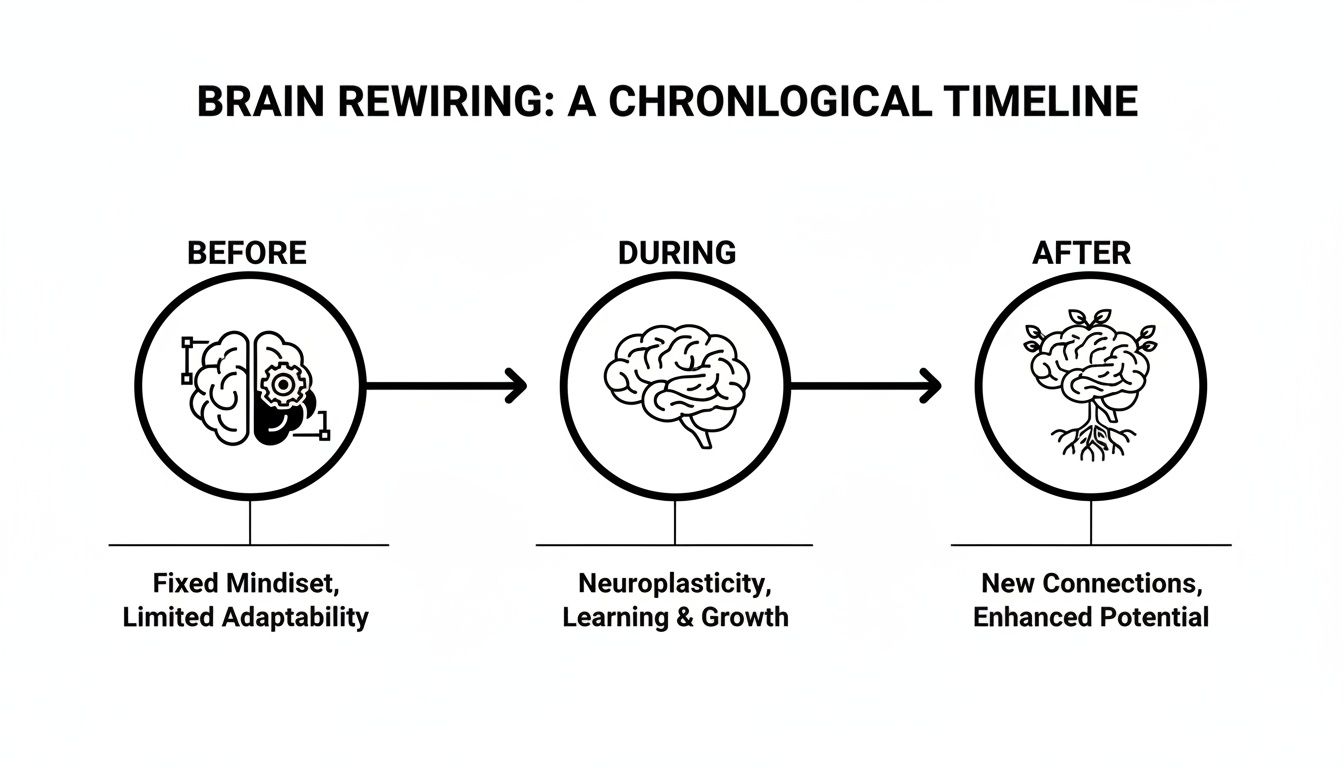
This journey shows the brain moving from its usual, well-worn pathways ("Before"), to a state of high connectivity ("During"), and finally sprouting new connections through neuroplasticity ("After").
To give you a clearer picture, here's a simple breakdown of what's happening both subjectively and neurologically throughout the experience.
Timeline of a Psilocybin Experience
| Phase | Approximate Timing | Common Subjective Effects | Corresponding Brain Activity |
|---|---|---|---|
| Ingestion & Onset | 0-60 mins | Subtle shifts in perception, mood lift, slight body sensations. | Psilocin begins binding to 5-HT2A receptors; DMN activity starts to decrease. |
| The Ascent | 1-2 hours | Intensifying sensory input (visuals, sounds), emotional amplification. | Increased 5-HT2A binding; cross-talk between brain networks increases. |
| The Peak | 2-3 hours | Ego dissolution, deep insights, sense of unity, mystical experiences. | DMN activity is at its lowest; global brain connectivity is at its highest. |
| The Comedown | 3-5 hours | Gradual return of self-awareness, deep introspection, emotional processing. | DMN slowly comes back online; hyper-connectivity begins to subside. |
| Return & Afterglow | 5-6+ hours | Feeling of clarity, calm, and renewed perspective that can last for days/weeks. | Brain returns to baseline but remains in a state of heightened neuroplasticity. |
This timeline provides a general map, but remember that every journey is unique and can be influenced by dosage, set, and setting.
The Comedown and Afterglow
As the most intense effects start to fade, around the 4 to 6-hour mark, the brain begins its gentle return to baseline. The DMN slowly boots back up, and the symphony of cross-network communication quiets down. This phase is often marked by a sense of profound calm, clarity, and deep, quiet introspection.
But the story doesn't end there. Even after the acute effects are gone, the brain remains in a state of heightened neuroplasticity for days, sometimes even weeks. This "afterglow" is a crucial window of opportunity. It's when the brain is most receptive to forming new habits, thought patterns, and perspectives, bridging a temporary change in consciousness with the real potential for lasting personal growth.
Preparing for a Responsible Journey
Knowing how psilocybin works in the brain is one thing, but the real magic happens when you use that knowledge to shape your experience. This is where we move from theory to practice. How you prepare for and navigate the journey is everything, because your mindset and environment directly steer your brain's response.
This brings us to the all-important concepts of set and setting. "Set" is simply your mindset—your thoughts, mood, and intentions heading into the experience. "Setting" is your physical space—where you are, and who you're with. When you pair a calm, open mindset with a safe, comfortable environment, you’re creating the perfect launchpad for the journey ahead.
Think about it: when your brain’s Default Mode Network (DMN) goes quiet, your usual mental defenses drop. A supportive setting ensures that the new connections firing across your brain are positive and insightful, not bogged down by anxiety or fear.
Harnessing Neuroplasticity Through Integration
The journey doesn't just stop when the main effects fade away. In fact, one of the most critical parts is what comes next: integration. This is the process of making sense of your experience and weaving its lessons into the fabric of your everyday life. This is where that heightened state of neuroplasticity becomes your greatest tool.
Remember how psilocybin helps your brain grow new synapses? This creates a powerful window of opportunity for real change. Integration is how you consciously use this period of enhanced mental flexibility to build new, healthier habits and ways of thinking. Without it, even the most profound insights can fade away like a dream.
Integration is the bridge between a temporary shift in consciousness and lasting personal growth. It’s the work you do to take the lessons learned while your brain was hyper-connected and apply them when it returns to its normal state.
Practical Steps for Preparation and Integration
To get the most out of the process, it helps to have a game plan that respects both the experience itself and what your brain is going through. This means careful planning beforehand and dedicated reflection afterward.
Here are a few actionable steps to get you started:
- Set a Clear Intention: Before you begin, take some time to think about what you hope to gain. Are you looking for a fresh perspective on a personal challenge? Exploring your creativity? A clear intention acts as a gentle anchor for your mind.
- Create a Safe Space: Your environment needs to be physically and emotionally safe. This means a comfortable, private spot with people you trust completely. By removing potential stressors, you give your brain the freedom to explore its new pathways without triggering a fight-or-flight response.
- Plan for a Gentle Return: Don't jam-pack your schedule for the day after. Your brain has just run a marathon and needs time to recover and process everything. Allow for plenty of rest, quiet, and reflection.
- Embrace Integration Practices: In the days and weeks that follow, engage in activities that help those insights stick. Journaling, talking with a trusted friend, spending time in nature, or meditation are all great ways to translate the experience into real-world change. For more ideas, looking into different magic mushroom experiences can offer some valuable perspectives on this crucial process.
By consciously preparing and integrating, you become an active partner in your brain's neuroplastic potential. This thoughtful approach turns a psychedelic experience from a passive event into an active tool for well-being, helping you build new neural pathways that support lasting, positive change.
Frequently Asked Questions
As you dive into the fascinating world of psilocybin and how it works with the brain, a few key questions usually pop up. Let's walk through some of the most common ones to give you a clearer picture.
How Long Do the Brain Changes from Psilocybin Last?
The most obvious psilocybin effects on the brain, like the famous quieting of the Default Mode Network, are temporary. They align pretty closely with the 4-6 hour duration of the experience itself.
But the really interesting part is what happens afterward. The deeper changes related to brain rewiring and connectivity stick around for much longer. Research has shown that the increased communication between different brain networks can last for weeks, sometimes even months, after just one significant dose.
This creates a kind of "window of opportunity" where your brain is more flexible and receptive to new patterns of thinking. The whole idea is to use that enhanced plasticity to build lasting positive changes in your life.
Are the Brain Effects of Microdosing Different?
Absolutely. The way a microdose and a full dose affect the brain are thought to be fundamentally different. A full, or "macro," dose is like hitting a reset button—it completely reorganizes brain communication for a few hours, creating that classic altered state of consciousness.
A microdose, on the other hand, is sub-perceptual. It's not designed to trigger those dramatic, brain-wide shifts. Instead, it’s believed to work much more subtly over time, gently encouraging neuroplasticity and fine-tuning serotonin signaling without the full system reboot. Think of it as a gentle tune-up for your brain's operating system, not a complete overhaul.
While a macrodose provides a profound, temporary shift in brain-wide communication, a microdose is theorized to support gradual, long-term adjustments to neural pathways, potentially enhancing cognitive function and mood over time.
Can Psilocybin Change Your Personality?
It’s a big question, and the science points to yes—in a very specific way. Studies have shown that psilocybin can lead to lasting increases in the personality trait of "Openness." This is the part of your personality tied to curiosity, creativity, appreciating art, and being open to new ideas.
This shift is often linked to having a "mystical-type experience" during the session, which can profoundly reframe how you see yourself and the world. These aren't random personality tweaks; they're seen as positive changes that reflect greater psychological flexibility and a more adaptable outlook. It’s a durable shift made possible by the brain's boosted capacity to learn and grow after the experience. Of course, to get the full picture, it also helps to understand how long psilocybin stays in your system from a physiological standpoint.
At The Magic Mushroom Delivery, we are dedicated to providing high-quality, organic products alongside reliable information to support your wellness journey. Explore our curated selection of psilocybin mushrooms, edibles, and microdosing options, all available with discreet, tracked shipping nationwide. Find the right product for your needs by visiting us at https://themagicmushroomdelivery.com.